Politics & Government
GALLERY: Kuncl Talks About Future of University of Redlands at Inauguration
The future of education was also a topic for Marlene Ross, former director of the American Council on Education Fellows Program, who spoke before Kuncl's formal inauguration.


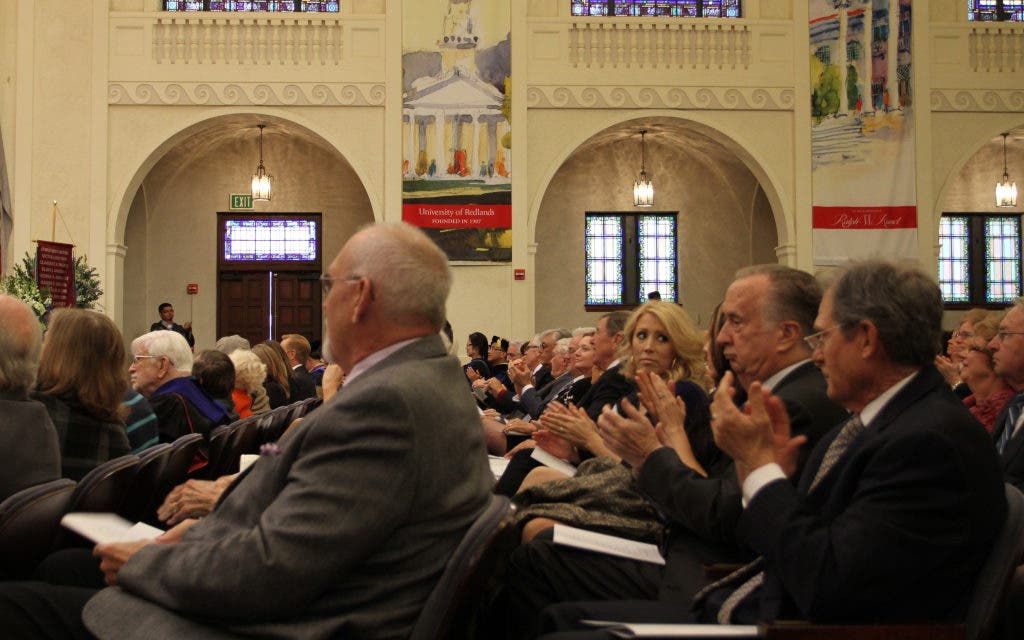


Ralph W. Kuncl spoke about his vision for the future Wednesday during his inauguration as the 11th president of University of Redlands.
"Imagine," Kuncl told hundreds of faculty, students and others gathered in the Memorial Chapel. "Our university is real estate rich, by about 28 contiguous acres, and can make a huge contribution to the Redlands community by making it available for private development.
"This can be a win-win for all, creating central new revenue streams for the university, and quality private development for the community," Kuncl said.
Find out what's happening in Redlands-Loma Lindafor free with the latest updates from Patch.
"It can be accomplished, I guarantee you, through a diversified funding portfolio of private investors' equity, federal and state transportation support, HUD grants, state loans and tax offsets, regional transportation authority grants, new market tax credits, philanthropy from donors who otherwise might not be likely to give, land grants, savings from increased efficiency in the use of energy and materials, and the university's valuable real estate, as well as the offering plate that is about to be passed."
Many in the audience laughed aloud at Kuncl's "offering plate" remark, but the new president of the 105-year-old private liberal arts and sciences institution made it clear he was serious about the rest.
Find out what's happening in Redlands-Loma Lindafor free with the latest updates from Patch.
"Our university is an integrated force in this community," Kuncl said with a straight face.
The future of education was also a topic for Marlene Ross, former director of the American Council on Education Fellows Program, who spoke before Kuncl's formal inauguration.
"Technological advances have made our institutions more efficient in their operations, and they have enabled instant communications around the world," Ross said.
"Scholars here often know their counterparts halfway around the world better than their colleagues on another floor or in another building on the same campus," Ross said. "They can work together with distant colleagues in ways they don't with colleagues on their own campus.
"The global environment facilitated by technological advances forces our universities to consider the question: How does a university really prepare a global citizen, one that can function effectively in the world we envision in the future?
"The advent of massive open online courses, called moocs, is challenging our education to think about and strengthen quality student experiences," Ross said. "These courses have been free and did not award credit, however this is changing as we speak.
"Some universities have decided to give credit, others are thinking about how to manage this new development. The American Council on Education has recently recommended degree credit for five courses offered by Corsera, one of the companies providing these courses.
"Students are trying to figure out what it means for them, what kind of education they want, and how to get it in this rapidly altering environment," Ross said.
"Here are two pieces of data to give you an idea of the impact of the moocs. In May 2012, about 300,000 people were taking 38 courses taught by professors from Stanford and other elite universities through Corsera.
"Today, nine months later, there are 2.4 million students, compared to 300,000, taking 214 courses, compared to 38 nine months ago.
"edX, a mooc that MIT and Harvard are building, featured a course by Anant Agarwal, the president of edX. Since May 2012, 155,000 students from around the world have taken this first course offering.
"That is more than the total number of alumni in MIT's 150-year history."
Ross then quoted Thomas Friedman of the New York Times, "This budding revolution in global online higher education leaves me hopeful about the future. . . . Nothing has more potential to lift more people out of poverty, nothing has more potential to unlock a billion more brains to solve the world's biggest problems. Nothing has more potential to enable us to re-imagine higher education."
"What does this mean for the University of Redlands?" Ross asked. "That's an agenda item for the university to consider."
Music for the inauguration included Bach, Vivaldi and Strauss, performed by more than 80 singers and musicians from the School of Music at the University of Redlands.
Kuncl was selected as U of R president June 2 and officially joined the institution in August 2012, a university representative said. He came to Redlands from the University of Rochester, N.Y., where he served as provost and executive vice president, and as a professor of neurology and of brain and cognitive sciences.
Kuncl earned his A.B. from Occidental College, magna cum laude with election to Phi Beta Kappa; his Ph.D. in experimental pathology at the University of Chicago, Division of Biological Sciences; and his M.D. at the University of Chicago's Pritzker School of Medicine, according to the University of Redlands.
For more information about U of R, visit www.redlands.edu.
Follow Redlands-Loma Linda Patch on Twitter and Facebook, and sign up for the free daily newsletter here.
Get more local news delivered straight to your inbox. Sign up for free Patch newsletters and alerts.