Politics & Government
DID YOU KNOW that David Kelley Founder of IDEO and d.school at Stanford Thinks That Government is Ripe for Design Thinking Change
Have we stopped investing in the infrastructure necessary for a successful democratic form of governance?


Thursday evening last week, along with a couple of hundred other locals I heard Mr. David Kelley the founder of IDEO and the d.school at Stanford speak at the Fox Theatre downtown Redwood City. In an informal chat format Mr. David Kelley answered questions like what design thinking meant and the changes it could make. One interesting project example he gave was the San Francisco Unified School District where they had examined the lunch program and determined that the reason a lot of students weren’t eating their lunches or eating the healthy items was that the students were more interested in socializing then in eating. By changing the format of how the food was delivered and the sequence of delivery design thinkers were hoping to change the amount of food eaten and the actual food eaten. Their suggestion was that instead of having a cafeteria style line, the food should be served family style at the tables with the healthy food being served first when the students would out of hunger eat it.
Mayor, Jeff Gee, was the master of ceremonies at the event and so at one point it was mentioned that if one wanted change in Redwood City one should talk to the mayor. However that has not been my experience. Mr. Kelley did note that one of the areas ripe for design thinking innovation and improvement was government. Researching some of IDEO’s work in the area or government, I came upon an article: “IDEO takes on the Government: The nimble consultancy brings design thinking to political structures in desperate need of reinvention.” (http://www.ideo.com/images/uploads/news/pdfs/Metropolis_IDEO_govt_June2011_1.pdf) This article lists seven keys to design and innovation for government: 1) start with citizens, 2) forget the “average,” 3) visualize change, 4) simplify in the face of complexity, 5) prototype before piloting, 6) envision a future together and 7) share the mission.
In another article “Capitalism Needs Design Thinking” (http://www.ideo.com/by-ideo/capitalism-needs-design-thinking), Mr. Roger Martin, the Premier’s Chair in Productivity and Competitiveness and Academic Director of the Martin Prosperity Institute at the Rotman School of Management at the University of Toronto in Canada noted:
Find out what's happening in Redwood City-Woodsidefor free with the latest updates from Patch.
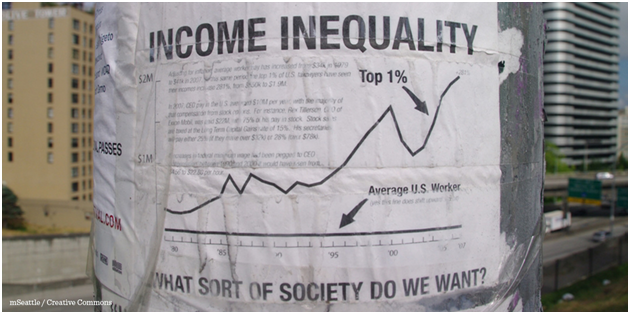
“ I’m studying the future of democratic capitalism. I love democratic capitalism but I’m very worried that we’ve now gone 24 years without the median household income in America rising, so it’s the same in 2013 as it was in 1989. That’s unprecedented in American history. The longest that’s ever happened before is when it took just under 20 years to recoup the loss in the Great Depression of the median income. Why I focus on the median is you need that voter to vote for you because the 51st percentile voter will determine who will be in power. I worry that while we have had this unprecedentedly long period of stagnation of the 51st percentile voter and their family, we’ve had it coinciding with the top 1 percent of the economy doing spectacularly. In the Great Depression, when median incomes were falling, actually the top 1 percent absolutely took it in the teeth; in fact income inequality shrank during that period.
I’m worried that democratic capitalism depends on the vast majority of the citizenry believing in the system and that the belief in that system is going to fade away and we may try something else or do radical things that over history haven’t worked out so well. That’s what I’m studying and asking from the following perspective: what is the infrastructure that lies under democratic capitalism? I would argue there is physical infrastructure—we need road, subways, the internet, etc. There’s transactional infrastructure – voting systems, capital markets, laws and regulations that allow us to transact in a democratic capitalist system. And finally there is knowledge infrastructure, the accumulated knowledge that we use. All those things, to my way of thinking, just lie underneath the machine of democratic capitalism. I’m asking the question, is the current stagnation and rising inequality a function of the infrastructure not being invested in properly? Have we got the wrong infrastructure? Is it no longer fit for purpose? I want to study that and come up with ways to make this democratic capitalist system work better.” (http://www.ideo.com/by-ideo/capitalism-needs-design-thinking)
Find out what's happening in Redwood City-Woodsidefor free with the latest updates from Patch.
Consider that at the national level our next presidential election is currently expected to be a contest between a Clinton and a Bush. Consider that at the local level a council member’s spouse is chosen to lead the local transit district. When being the spouse or child of either a current or former elected official gives one a better chance; voters become disenfranchised, stop voting and the democratic process breaks down. For how can one believe and participate in a system of government that claims to be a democratically elected one, when what one sees all around is a banana republic with all of its concomitant issues including nepotism and oligopoly?
(http://www.mercurynews.com/News/ci_27694480/Former-Redwood-City-councilman-chosen-as-new-chief-of-San-Mateo-County-Transit-District)
What do you think? What kinds of design thinking change do we need at the local, state and national government levels?