Politics & Government
New Food Labels to Decrease Food Waste, Money Waste & Climate Change!
Coming soon better labeling. Keep good food from going to waste and adding to climate change via carbon dioxide and methane production!


How many dollar bills did you throw out last week?
None you say.
Wrong. The average family in the United States wastes twenty five percent of the food it buys. According to the National Resources Defense Council, the food Americans throw away every year is worth $218 billion. Imagine yourself walking with four bags of groceries and forgetting one in the parking lot. I know, I know, you have done that. But every week! Week after week when you go shopping the statistics show us that most people will “forget” one bag out of four in the parking lot.
Find out what's happening in Redwood City-Woodsidefor free with the latest updates from Patch.
No, not in the parking lot. They will actually take the bag home, put the food away, look at it periodically until one day they decide it is not fit to be eaten or it actually really isn’t fit to be eaten. Fairly predictably it will turn out that twenty five percent of the food bought will be discarded.
First we simply buy too much! Most people need to plan better and buy only what is on a pre-planned list. We buy on impulse, we buy when we are hungry (and so buy more than we need), we buy because we think that one day we will eat something. We buy because we own huge refrigerators and kitchen cabinets that don’t look inviting unless they are filled to the hilt like the stores we shop in.
Find out what's happening in Redwood City-Woodsidefor free with the latest updates from Patch.
Sadly, our eyes have been trained by the superstores we buy in to see rows and rows of food and we begin to think that we need the same rows of choices and options in our own homes regardless of whether or not we will ever eat any of it. We have to see a selection of morning cereals, when in fact we only ever eat one of them. The others they all end up in the garbage every three or four months to be replenished by the next set of boxes that again we will not eat.
We fill our refrigerators and cabinets but can only see the front row and so the food stuffed behind is forgotten until one day we see it and of course it is way past its expiration date. So again we throw it out. We buy items we already have in stock because they are hidden behind the front row and so they get put even further back in the cabinets to end up in a year or two expired and needing to be thrown out.
And then there is the issue of labeling. Washington is finally doing something. "Advocates and environmentalists have been warning for years that many people interpret date labels as a sign that food is no longer good to eat. As a result, one industry survey found, 91 percent of consumers have mistakenly thrown away past-date food, when the label only signals the manufacturer's guess at its peak quality." This past Wednesday, the Food Marketing Institute and the Grocery Manufacturers Association, the two largest trade groups for the grocery industry, announced that they’ve adopted standardized, voluntary regulations to clear up what product date labels mean. It won't happen tomorrow and it is only voluntary but hopefully it will improve consumers ability to reduce waste. (Read more about the coming changes to labels by clicking here.)
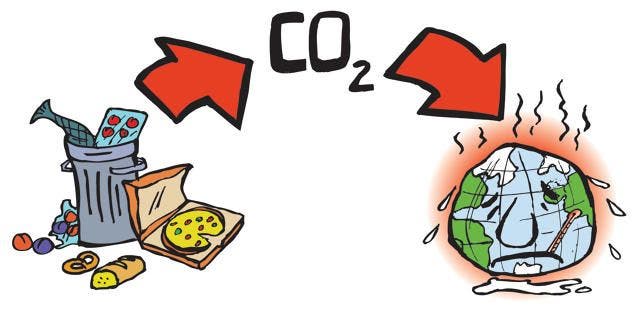
Food waste is not only a financial problem for individuals and families but a problem for the environment. Food waste accounts for thirty percent of residential waste collected by weight. Food waste should be composted but in fact usually ends up in landfills becoming in due time a source of carbon dioxide and methane which both lead to climate change.
Want to save money and help the environment?
Here are some good tips:
To avoid buying food you already have: shop your fridge and cupboards first.
To avoid overbuying: include quantities on your shopping list.
Buy less and certainly smaller quantities.
For cooking soups, sauces, pies or smoothies: use produce past its prime.
Move food that is likely to spoil soon to the front or a designated “eat now” area.
Share or donate food you won’t get around to eating.
Learn the difference between “sell by,” “use-by,” “best-by,” and expiration dates.
Remember your home is not a restaurant, buy only things YOU like and WILL eat within a certain time frame.
Photo credits: Harvard Food Law and NRDC