Politics & Government
What Is In My Petri Dish? Coronavirus?
On Pandemics, COVID-19, Social Distancing, Masks & Petri Dishes from CA Governor Newsom, NY Governor Cuomo & Dr. Fauci


When Governor Newsom first announced California’s Shelter in Place directive, one of the questions he was asked led to him explaining that it was still OK to have a barbecue with your family in your backyard. Today, listening to New York’s Governor Cuomo talk about going to a family birthday party and social distancing six feet away from each other, I had to wonder if we are misunderstanding social distancing.
As the recent paper by Sima Asadi, Nicole Bouvier, Anthony S. Wexler & William D. Ristenpart (2020) on Covid-19 transmission: The coronavirus pandemic and aerosols: Does COVID-19 transmit via expiratory particles? In Aerosol Science and Technology, DOI: 10.1080/02786826.2020.1749229 notes:
“modeling [from China] indicated that 79% of the actual documented cases were infected by undocumented individuals. Furthermore, inspection of the average delay time between infection and initial manifestation of symptoms led them to conclude that “…pre-symptomatic shedding [of virus] may be typical among documented cases”
Find out what's happening in Redwood City-Woodsidefor free with the latest updates from Patch.
In addition,
“given the large numbers of expiratory particles known to be emitted during breathing and speech, and given the clearly high transmissibility of COVID-19, a plausible and important hypothesis is that a face-to-face conversation with an asymptomatic infected individual, even if both individuals take care not to touch, might be adequate to transmit COVID-19.”
Find out what's happening in Redwood City-Woodsidefor free with the latest updates from Patch.
Essentially, they conclude “that speech plausibly serves as an important and under-recognized transmission mechanism for COVID-19.”
https://www.tandfonline.com/doi/full/10.1080/02786826.2020.1749229
The reality is that social distancing may not be enough. While:
“Direct or indirect ‘contact’ modes require a susceptible individual to physically touch themselves with, for example, a virus-contaminated hand; ‘direct’ indicates that person-to-person contact transfers the virus between infected and susceptible hosts (such as by a handshake), while ‘indirect’ implies transmission via a ‘fomite,’ which is an object like a hand-rail or paper tissue that has been contaminated with infectious virus. “
Aerosol transmission takes that further and says when you speak and emit this virus, this virus is alive and able to infect a new host for as far as it moves in the air and says alive which may be in the case of COVID-19 as long as an hour.
In addition, Dr. Lydia Bourouiba, PhD from MIT has found:
“Owing to the forward momentum of the cloud, pathogen-bearing droplets are propelled much farther than if they were emitted in isolation without a turbulent puff cloud trapping and carrying them forward. Given various combinations of an individual patient’s physiology and environmental conditions, such as humidity and temperature, the gas cloud and its payload of pathogen-bearing droplets of all sizes can travel 23 to 27 feet (7-8 m)” https://jamanetwork.com/journals/jama/fullarticle/2763852?appId=scweb
Are we really going to be able to social distance 23 to 27 feet?
Which brings us to masks. Having traveled to China a fair amount, I know that a lot of people use a mask there when they are personally sick as a polite way of protecting others from their own infection. In addition, my work at AirSpeQ, an air pollution sensor company, has taken me to several aerosol and air pollution conferences including the first ever world air pollution conference organized by the World Health Organization (WHO) in Geneva about eighteen months ago in Geneva. At both conferences the experts were clear, masks don’t do very much.
A recent small study from Korea notes:
“During respiratory viral infection, face masks are thought to prevent transmission……Neither surgical nor cotton masks effectively filtered SARS–CoV-2 during coughs by infected patients. Prior evidence that surgical masks effectively filtered influenza virus (1) informed recommendations that patients with confirmed or suspected COVID-19 should wear face masks to prevent transmission (2). However, the size and concentrations of SARS–CoV-2 in aerosols generated during coughing are unknown. Oberg and Brousseau (3) demonstrated that surgical masks did not exhibit adequate filter performance against aerosols measuring 0.9, 2.0, and 3.1 μm in diameter. Lee and colleagues (4) showed that particles 0.04 to 0.2 μm can penetrate surgical masks. The size of the SARS–CoV particle from the 2002–2004 outbreak was estimated as 0.08 to 0.14 μm (5); assuming that SARS-CoV-2 has a similar size, surgical masks are unlikely to effectively filter this virus.”
I realize that the WHO is now in process of changing its guidance but unfortunately, the reality is that the science isn’t there yet and people rarely wear masks properly. Additionally, if you are already sick with a respiratory disease and having trouble breathing normally, wearing a mask only makes the problem worse for you from the point of view of your own health. Moreover, if by wearing a mask you get overconfident and become more willing to go out and less careful about social distancing any benefits may be lost. So yes, like social distancing, masks help but they are no panacea.
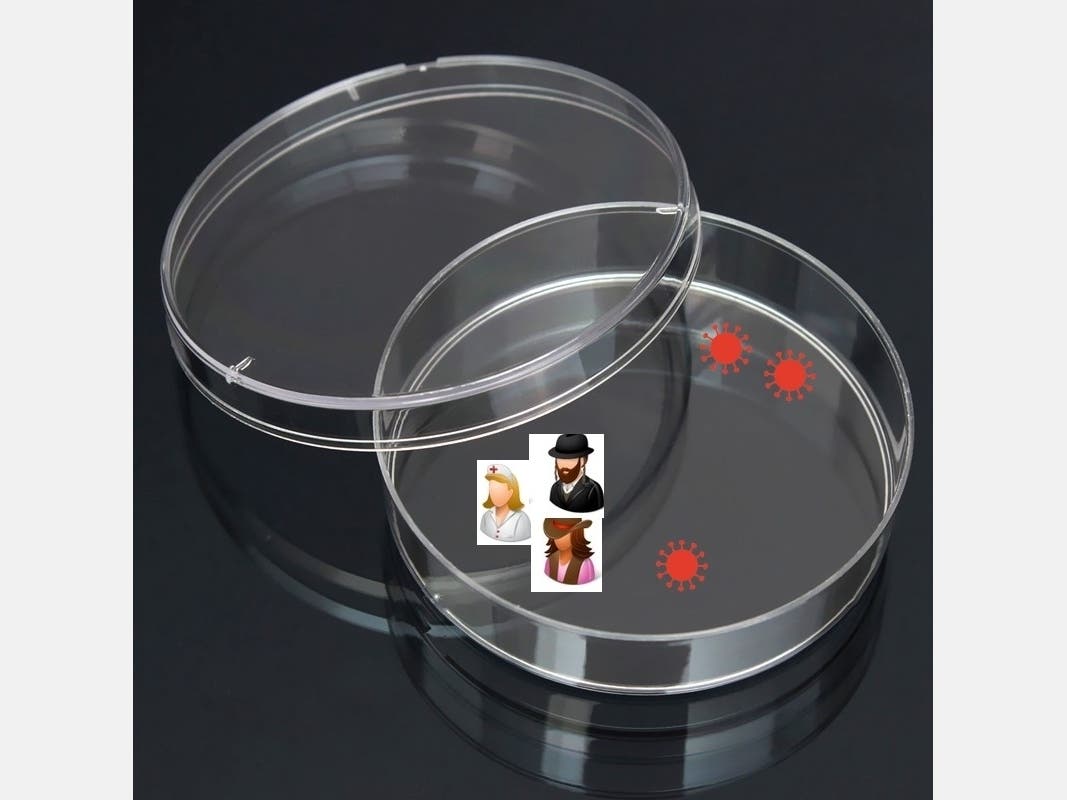
At this point, the debate about how far to distance from each other and whether or not to use masks, may not be the best way to think about exposure. They each help but not that much. The better way may be to think in terms of petri dishes. Who do you want and trust in your own petri dish? There have been numerous articles as well as explanations from government officials including California Governor Newsom, New York Governor Cuomo and Dr. Anthony Fauci at the Federal level as to how the virus moves person to person.
As we have now seen cruise ships are the real-world human equivalents of petri dishes in the lab: contained environments that one can use to grow cultures be it COVID-19, H1N1 or any other germ or virus. Staying six feet away from someone who speaks and ejects viruses into the air, unless you are downwind from them, doesn’t really help. Using a mask may reduce the virus’ ability to travel through air but is not likely to be a guarantee. The only thing that really works in this scenario is simply not to be in the same petri dish, not at home, not when you are out shopping for food, and certainly not in a hospital or already contaminated environment. Create your own effective petri dish of people and places you are willing to be in and don’t go outside it. If you don’t believe it can be done on a nationwide basis just look at New Zealand. They were able to close their borders, quarantine and stop the virus. (https://www.washingtonpost.com/world/asia_pacific/new-zealand-isnt-just-flattening-the-curve-its-squashing-it/2020/04/07/6cab3a4a-7822-11ea-a311-adb1344719a9_story.html
I doubt however that the US can become its own petri dish a la New Zealand. In which case, we will have to wait for mass immunity which involves a fair number of deaths or a vaccine which is about twelve to eighteen months out. Our personal outcomes will be determined by how many other people and how much air by design or not, we let into our personal petri dish. So create your own petri dish.