Business & Tech
La Jolla's Top Tourist Attraction Really Stinks, Locals Abide
La Jolla's growing populations of sea lions and brown pelicans produce a rancid fragrance that locals charmingly call "Cove Stench."


LA JOLLA — On a perfect August morning, swimmers packed the narrow beach at La Jolla Cove. Birds hovered over rocks where sea lions laze and bark. Workers at fancy restaurants where you can enjoy salmon benedict or fish tacos alfresco with an ocean view prepared patios for the lunch rush during tourist season.
Just then, a family of five spilled out of a minivan with out-of-state plates in front of a renowned eatery.
“EWW! Oh my God!” a boy theatrically screamed, while clamping his nose like a vise. “The smell is so bad!”
Find out what's happening in San Diegofor free with the latest updates from Patch.
He had inhaled the rancid fragrance that locals charmingly refer to as “the Cove Stench.”
“Don’t breathe through your nose,” the boy’s mom said.
Find out what's happening in San Diegofor free with the latest updates from Patch.
The boy wasn’t done complaining. “I wanna sit inside where I can’t smell anything!” he shouted, as they disappeared out of earshot into one of the town’s open-air establishments.
For a decade, La Jolla — this ritzy suburb of San Diego, home to Dr. Seuss, Raymond Chandler, a Lamborghini dealership, several billionaires and untold millionaires — has been cursed by the stink, the result of the state’s environmental good intentions, and the unofficial law of unintended consequences.
Although the Cove Stench unpredictably comes and goes depending on the day, when it’s there, it is unmissable. It’s the smell of sea-animal feces produced by hundreds of nearby animals resting on the rocks: pelicans, cormorants, and, most prominently, sea lions. Think of what a slurry of anchovies and saltwater passed through a mammalian digestive tract full of billions of ocean-borne bacteria might smell like, then imagine that stuff sautéing on the rocks under the summer sun.

Every year, as summer turns to fall, the stench especially resonates: It hasn’t rained in months, and the annual Santa Ana winds that blow westward from the Mojave Desert give Southern California its hottest and driest weather. On the right day — or rather, the wrong day — the stench doesn’t just hang over town. It ascends from the waterfront to four-star hotels and renowned restaurants high atop the bluff overlooking the ocean, far beyond where you’d expect the stink to dissipate.
The stench knocked one of the world’s greatest boxers out of town: Floyd “Money” Mayweather Jr. and his entourage, a few years back, checked in to two villas and six rooms at the legendary La Valencia Hotel. Fifteen minutes later, they checked out, reportedly due to the Cove Stench.
For business owners, there’s a lot at stake: San Diego hosts 35.8 million visitors every year, according to the local tourism authority. Its most upscale zip code — La Jolla — is said to draw an estimated 10 million of those out-of-towners. On the weekends the town’s sidewalks, parks and beaches are bustling with visitors speaking an array of foreign languages as well as Californians taking day trips to experience the city’s Mediterranean-esque, La Dolce Vita vibe.
Among polite society in La Jolla, Cove Stench is often a topic of conversation. You won’t find the Cove Stench in any tourism brochure though.
“The sea lions don’t just leave a little spot on the rocks — they release gallons at a time,” said one seaside restaurant proprietor who wished to remain nameless for obvious reasons.
For many in the local hospitality industry like this restaurateur, acknowledging the aroma is a double-edged sword: They desperately want a solution to the smell, but they also don’t want to talk about it — because whenever the stench makes the national news and names specific restaurants, they stand to lose hundreds of thousands of dollars. Wedding receptions get relocated. Dinner reservations and anniversary parties get canceled. Restaurant and business owners quietly talk about the effects of the Cove Stench, but when a reporter starts asking questions they go stone-silent — or even go full-on absurdist.
“I don’t know what you’re talking about,” said the general manager of a $300-a-night hotel in town who knew exactly what was being talked about.
It raises the question: If a sea lion defecates in La Jolla and no tourists are around, does the town still stink?
Of course it does, but there’s not much that anyone in this town full of wealth and power can do about the unintended consequence of preserving California’s unique coastal habitats — like La Jolla Cove.
The Cove and its flora and fauna are protected to the teeth by an arsenal of separate but overlapping local, state and federal designations. According to the City of San Diego, it’s an Underwater Park. To the state Water Resources Control Board, it’s an Area of Special Biological Significance. To the state Department of Fish and Wildlife, it’s a Marine Protected Area. To the National Oceanic and Atmospheric Administration, it’s a Marine Sanctuary and a National Marine Protected Area.
But back when these designations were enacted one by one in the ’70s and ’80s, the Flintstone-looking rocks rising out of the water — cascading terraces of what were once sea floors during the last ice age — had few, if any animals on them, certainly not sea lions. Brown pelicans were even on the Endangered Species list, their population ravaged by the effects of the notorious pesticide DDT.
In the mid-2000s, years after city leaders installed white-lattice wooden fencing that aimed to prevent people from walking along the rocks, the sea lions came. It started with a single one — “Marley Brando,” locals named it — which barked at night like a neighborhood dog. The next year there were two. By the third year, a dozen sea lions colonized the rocks. In 2009, La Jollans — and so many tourists — experienced the first summer of the Cove Stench.

A group of business owners banded together under the moniker Citizens for Odor Nuisance Abatement and sued the City of San Diego in 2013 for erecting the fences, which, they claimed, were responsible for the proliferation of these recently arrived animals. The lawsuit went all the way to the state court of appeals, which in 2017 determined both that the city isn’t responsible for preventing harm caused by wild animals, and that the fences didn’t make the rocks more habitable for animals (instead, the court determined the environmental conditions were simply favorable).
The San Diego Parks and Recreation department’s solution (such as it is) to the Cove Stench for the past few years has been to spray a bacterial solution on the rocks several times a month. The bacteria feasts on the caked-on fecal matter; locals widely agree that it makes a real difference, at least in the short term. The effort to stem the stench that started in 2013 continues to this day, at a cost of $73,400 annually.
But even that work has to be done with caution due to the state water board’s designation of the Cove as an Area of Special Biological Significance; only the rocks can be sprayed, and none can run off into the ocean. Likewise, according to David Gibson, executive director of the San Diego Regional Water Quality Control Board, simply hosing off the rocks with water would be an “unauthorized discharge” into the ocean. And, crucially, only certain rocks are allowed to be sprayed. According to Graham, while the spraying has proven effective, “the sea lions and birds are starting to congregate in areas that are not sprayed, and that can be the reason why the smell may be more prominent.”
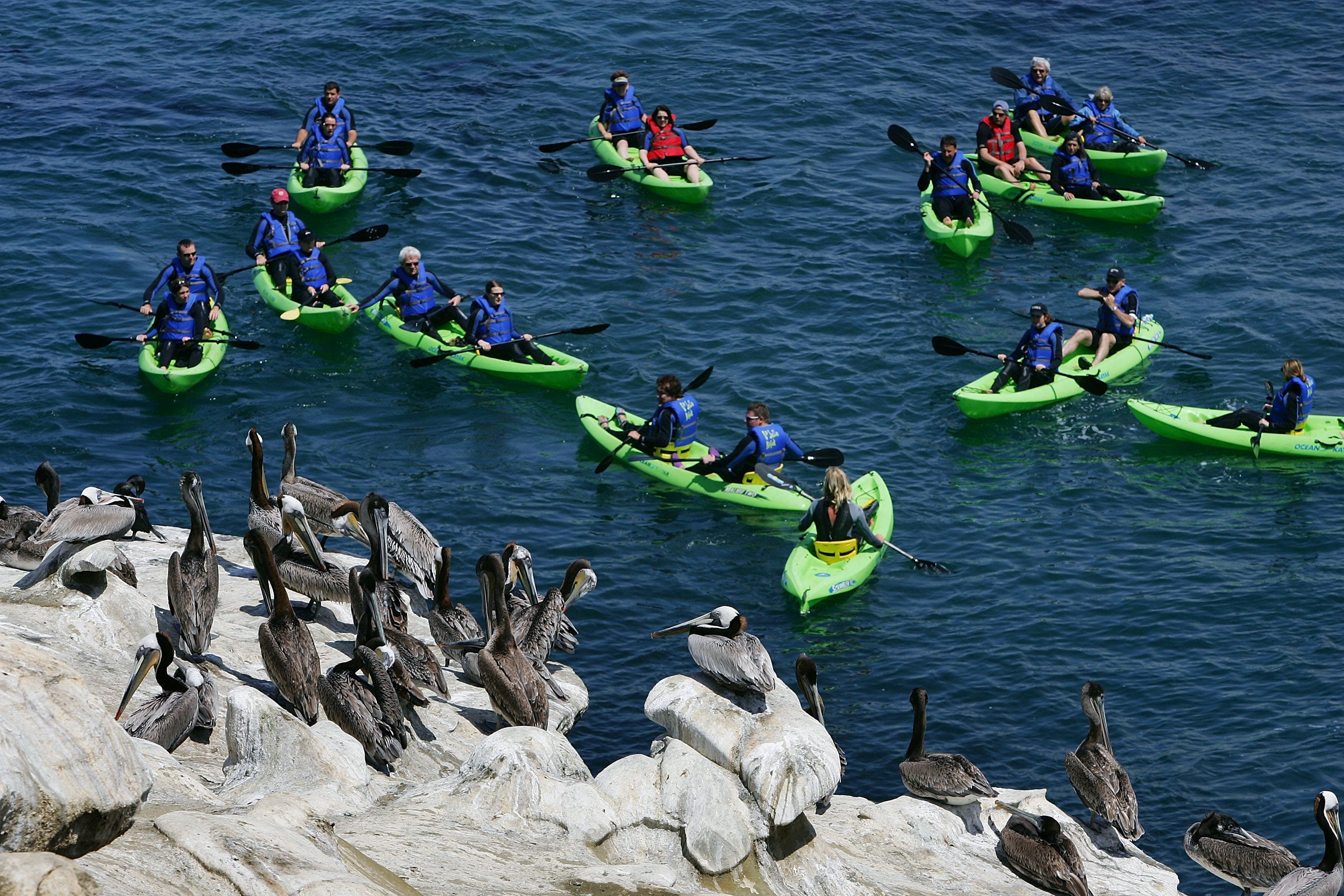
Living and working among this smell isn’t a pleasure. But from an economic perspective, the Cove Stench has tourism benefits — in a roundabout way, of course.
The subtext to the stench is another long-running humans vs. nature conflict a half-mile south. Seals have effectively taken over a sea-wall-protected beach, which pitted animal-rights advocates against preservationists both at the beach and in the courtroom. It’s a long-running battle that goes back and forth like a tennis match, and has effectively whittled locals down into a binary choice: Are you for the seals, or against them? (It was also featured on an episode of This American Life.)
More than a little small-town mischief has taken place at the small beach over the years: People have occasionally crossed a rope line on the sand that, depending on the most recent judicial decision, was either legally mandated or simply voluntary, to harass the seals and force them to retreat into the water.
Whether or not some people want these stinky interloping pinnipeds around, they are on every list of must-see attractions in La Jolla. A study done by San Diego State University’s college of business students this year revealed that “natural beauty/marine life” was the single biggest draw for visitors to La Jolla at 57 percent, more than twice as much as restaurants, the town’s second biggest attraction.

And of those thousands of people — La Jollans and visitors from around the world — who walk the oceanfront paths and sidewalks every day, few seem daunted by any noxious bouquets of marine-animal excrement, and most are clearly enjoying the experience. A bit of acclimation does help — perhaps the boy stepping out of the climate-controlled minivan into the coastal air just needed to give it some time.
Try telling all that to a La Jolla restaurateur, though. For now and the foreseeable future, like the thick marine layer of clouds that stubbornly hang around some days, the Cove Stench is something you just have to put up with.
So if you’re dining at a La Jolla alfresco restaurant with an ocean view when the Cove Stench is strong, remember a mother's sage advice: Don’t breathe through your nose.
Adam Elder is a writer in San Diego who's written for Esquire, The New York Times, The Wall Street Journal, NewYorker.com, VICE, The Guardian, WIRED.com and elsewhere.
More from Adam Elder on Patch.com:
Get more local news delivered straight to your inbox. Sign up for free Patch newsletters and alerts.