Neighbor News
Laser Vision Correction Pre-Screening Tests Demystified
Ophthalmologist Chooses Laser Vision Correction Candidates Based on 5 Corneal Diagnostic Tests

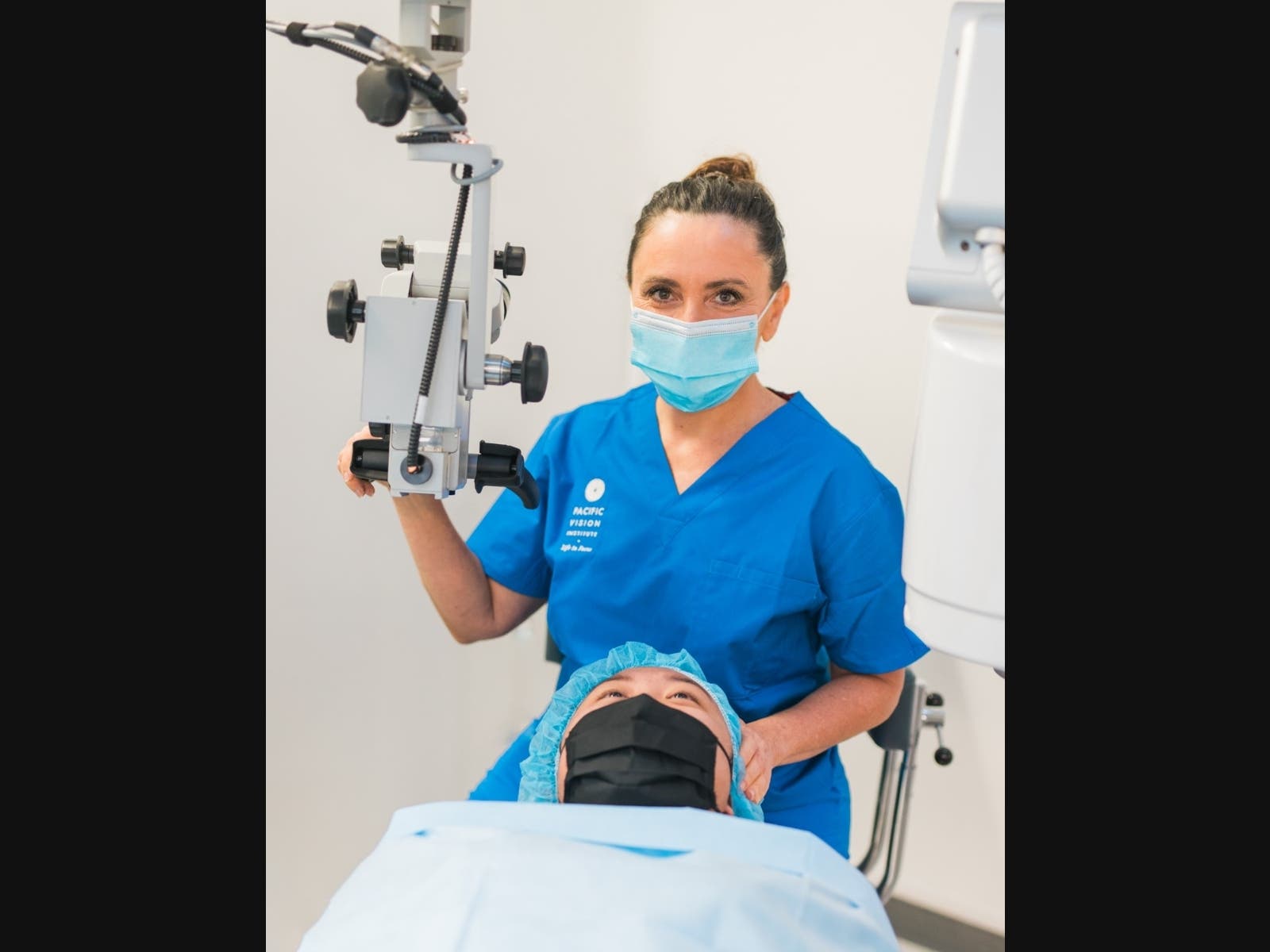
In July this year, I spoke with Dr. Ella Faktorovich, one of the country’s leading ophthalmologists and founder of San Francisco’s Pacific Vision Institute, about a surge among laser vision correction patients she was seeing who were looking to ditch their glasses and contacts in the midst of the COVID-19 pandemic. The increase in traffic not only affected her practice, but others like it in the Bay Area. As a result, there has been some confusion among patients around the myriad tests that are performed to determine if they are even a qualified candidate to undergo laser vision correction surgery.
“As you reported in your previous article, COVID-19 has more people working from home, who now have more available time to determine if laser vision correction is right for them. The people we are seeing are tired of wearing a mask and having their glasses fogging up all the time. More people are getting into outdoor exercise that leads to sweat, which then causes their glasses to slide down their nose,” said Faktorovich. “But what I’m seeing today is that most potential patients coming in aren’t aware of the most up-to-date requirements used to determine their candidacy for laser vision correction.”
The doctor explained that getting laser vision correction is not as simple as walking in the door and just “having it done.” Patients are required to undergo a thorough evaluation of their eyes, especially their cornea, before it can be determined their vision can be corrected safely and with a great result.
Find out what's happening in San Franciscofor free with the latest updates from Patch.
“There are actually five corneal diagnostic tests that are specifically performed to evaluate corneal health, that need to be done to determine whether LASIK, photorefractive keratectomy (PRK), other procedures, or no procedure at all is best for the patient,” Faktorovich continued. “If patients have only two or three of these tests performed, they may not receive the most comprehensive corneal evaluation required to make the safest recommendation.”
Adding to the confusion is when prospective patients get multiple opinions from multiple doctors, as not all clinics run the same tests. And while one clinic may say a patient is not a good candidate for laser vision correction, another clinic performing another set of tests may say, they are a good candidate. Dr. Faktorovich stresses the importance of standardizing the five tests available today to provide the most accurate assessment and a clear treatment plan.
Find out what's happening in San Franciscofor free with the latest updates from Patch.
Faktorovich states that she has seen patients come to her after they have visited several other clinics and have been told they are a good LASIK candidate in one clinic but a PRK candidate in another clinic.
“Only after running all five corneal diagnostic tests can you be sure whether or not someone is a good candidate for laser vision correction.”
For those interested, below, the doctor has explained what those five tests are:
Topography is usually the first corneal test performed. In this test, we look for inferior steepening, skewed axis and other possible irregularities.
Tomography is performed to evaluate anterior corneal surface further, to determine corneal thickness, including the exact location of the thinnest spot of the cornea, to evaluate posterior cornea, and to perform ectasia risk assessment with advanced software that compares multiple parameters of the patient’s cornea to those found in a general population of people with normal corneas.
Epithelial Thickness Mapping (ETM) is performed to evaluate a patient’s corneal epithelium to rule out subtle pre-ectatic conditions, contact lens warpage, and epithelial basement dystrophy. It is not uncommon for subtle focal abnormalities on topography and tomography to be misdiagnosed as pre-ectatic conditions, whereas they are truly epithelial basement membrane or contact lens warpage (Schallhorn, JM, et al. Distinguishing between contact lens warpage and ectasia: Usefulness of optical coherence tomography epithelial thickness mapping. J Cataract Refract Surg. 2017;43(1):60-66.) Topography and tomography simply do not show the “whole picture” and often lead the examiner to recommend PRK for patients who are great LASIK candidates based on ETM or recommend no procedure to patients who are excellent PRK candidates. I have seen patients for second and third opinion whose diagnosis and treatment plan becomes unequivocally clear after performing and analyzing their ETM.
Ocular Response Analyzer (ORA) is a sophisticated technology designed to test the elasticity of the cornea and its ability to remain strong and stable after laser vision correction. ORA is also helpful in sorting out different opinions about a patient’s diagnosis and treatment options and resolving split opinions. Moreover, a recent review of literature by Moshirfar M, et al has concluded that technologies such as ORA are essential for screening of corneal ectasia because “changes in biomechanical properties may occur before disease becomes apparent via tomography or topography.” (Moshirfar M, et al. Advances in biomechanical parameters for screening of refractive surgery candidates: A review of the literature, Part III. Med Hypothesis Discov Innov Ophthalmol. 2019;8:219-240).
CONTOURA® Vision Analysis is performed to generate a highly detailed map of corneal higher order aberrations by measuring elevation profile of 22,000 unique data points on the cornea. This creates a highly detailed contour scan of microscopic peaks and valleys to screen out pre-ectatic conditions and to determine if the patient has been out of contacts for a sufficient length of time to establish a precise treatment plan.