Kids & Family
Remember D-Day: Repeating WCers' Stories
Repeating Memorial Day article: A World War II prisoner of war tells his story along with an Army mate who was with the liberation forces in Germany.


Update If you missed this piece on Memorial Day, you get another crack today — D-Day — as we remember the sacrifices made on the Normandy beaches 68 years ago today. These two Walnut Creekers were with the 104th Army Division in the invasion of France and Germany.
The walkin' mayor was impressed by the story of a walk to freedom by a World War II POW Monday in the city's Memorial Day ceremony.
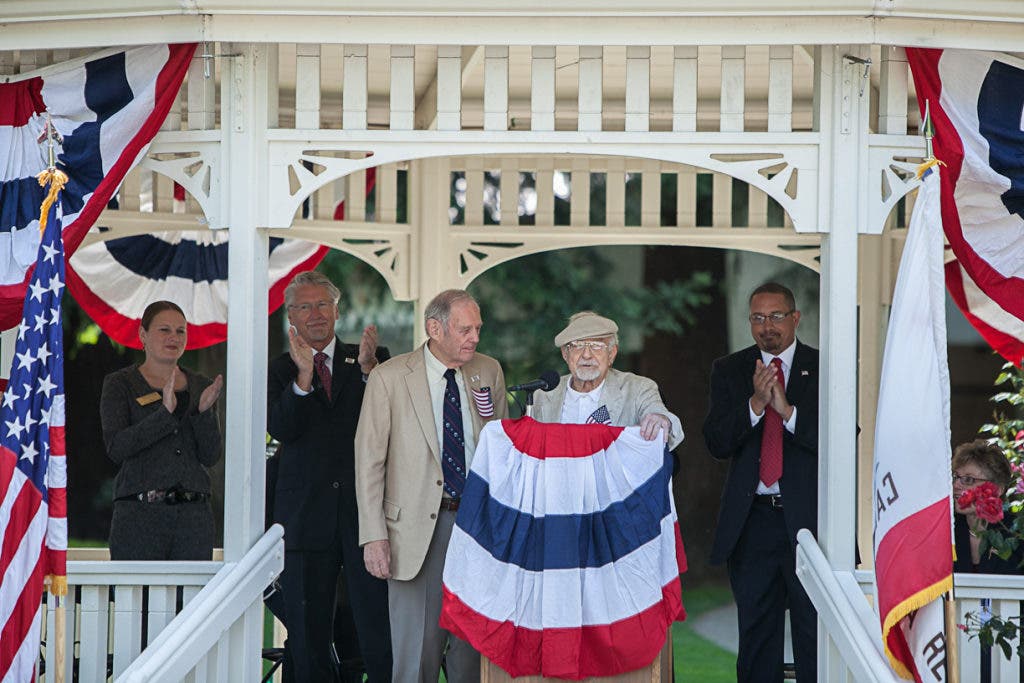
More than 300 people gathered at the gazebo in Civic Park to hear Mayor Bob Simmons — known for initiating the "Walnut Creek Walks" program — and World War II veteran Bob Tharratt, who told his story of German soldiers packing up American POWs in 1945 and marching them hundreds of miles south into the heart of Germany. They slept in fields and barns, fleeing the approach of the Russian army. Eventually the prisoners heard they were within 15 miles of the American line on the Elbe River and a group of POWs lit out that way.
Find out what's happening in Walnut Creekfor free with the latest updates from Patch.
"That last 15 miles you had to walk to freedom had to feel pretty good," Simmons told Tharratt.
Tharratt spoke to the Memorial Day crowd along with his pal Dick Ingraham, a member of the same 104th Army Division. The division with Ingraham was on the other side of Elbe River waiting as Tharratt and his fellow POWs walked across a bridge.
Find out what's happening in Walnut Creekfor free with the latest updates from Patch.
Decades later, Tharratt and Ingraham got to talking at St. Paul's Episcopal Church in Walnut Creek and realized they were mates from the 104th Infantry (along with Lou Boswell of Walnut Creek, who did not attend Monday's event).
You can listen to Ingraham and Tharratt in a piece that aired on ABC7 News television.
"We think that their sacrifices inform our roles as citizens," said Chaplain Dwane Michael of John Muir/Mt. Diablo Health System in his invocation. He talked of remembering fallen veterans with "a sense of gratitude and humility."
Simmons said, "We will never take for granted the sacrifices made by these special Americans."
The National Guard presented the colors. Simmons paid tribute to two fallen vets who died in 2007 and have markers in Veterans Memorial Plaza behind City Hall, Specialist James. J. Coon, who died in Iraq, and Cpt. Sean K. A. Langevin, who died in Afghanistan.
After the speeches at the gazebo, Boy Scout troops 818 and 277 of Pleasant Hill, and Cub Scout Pack 215 of Walnut Creek led the procession across Broadway to the Veterans Memorial Plaza, where wreaths were laid at the Veterans Memorial Plaza. The Walnut Creek Concert Band played 'Taps.'
War stories
Ingraham, a wine lover, remembered an occasion when soldiers got a chance to sample some local Gewurtztraminer in Cologne, Germany. They were enjoying it in Army-issue tin cups when a German plane came in low on a strafing run and everyone hit the deck. The plane passed, Ingraham said, "and we all reformed and got our rations."
After the liberation in Germany, the division was reassigned to the States, and training in Monterey and San Luis Obispo for the planned invasion of the Japanese mainland. The soldiers were told there might be a million American casualties in the invasion, Ingraham said. That's when the atomic bombs were dropped on Hiroshima and Nagasaki, and the Japanese soon sued for peace.
A quarter-century later, his son asked Ingraham to help him prepare for a debate in class about whether the atomic bombs should have been dropped. Recalling the 1 million casualty estimate, Ingraham said, "I don't think you might be here if those bombs hadn't been dropped."
Tharratt was a ball turret gunner on the underside of a B17, watching the world below. He remembered shortly after D-day having that view of the English channel between Britain and Normandy and it looked like a road with lines of ships going back and forth assembling the invasion. "It was magnificent," said Tharratt.
On his 18th mission over Nuremberg, the plane was taking hits and had lost three of four engines, Tharratt said. He was helping a wounded gunner get out of his turret when the alarm sounds for all to parachute out of the plane.
Tharratt helped the wounded man don a parachute and helped him out the door, and then donned a parachute himself. He received several awards for the effort, including the Distinguished Flying Cross.
Tharratt landed a quarter mile from a Hitler Youth Camp. He and his mates were taken by train to Frankfurt, where they were interrogated for five days. From there it was on to a POW camp near the Baltic Sea. In February 1945, with the approach of the Russian army, the POWs took off on their odyssey of 600 miles, Tharratt said, noting that he had originally signed up for the Army Air Force "because I didn't want to walk."