Politics & Government
Bethany First Selectman Backs Backhoe Vote
Safety is the priority, Gorski says of her decision.

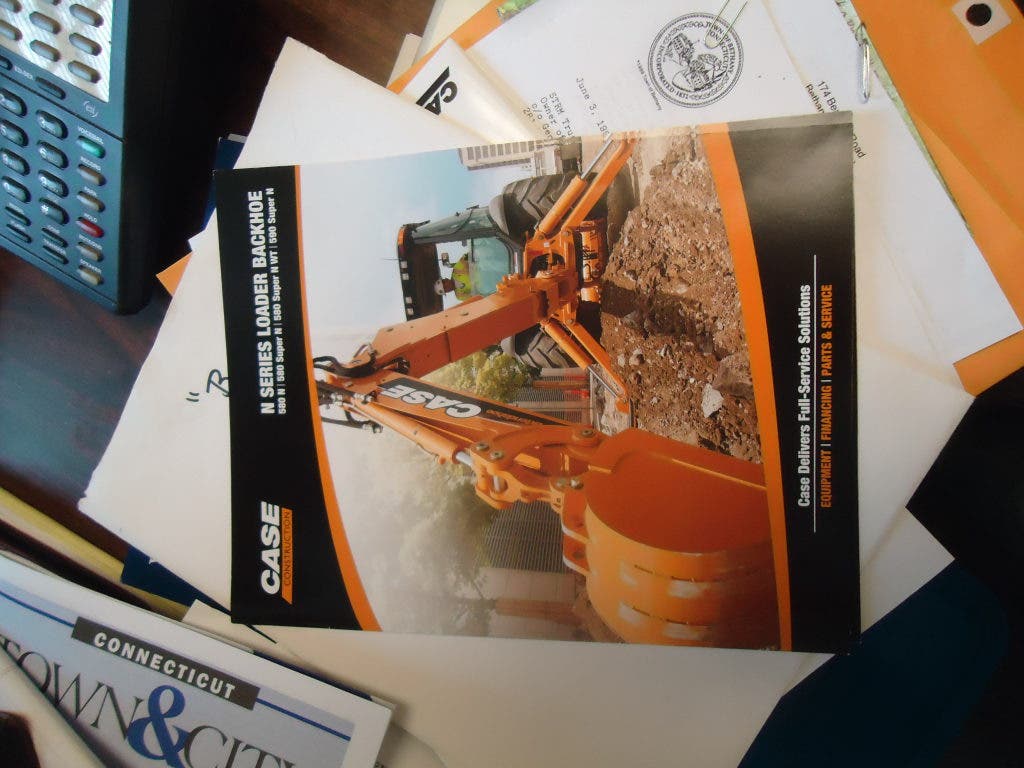

The price of a new backhoe for Bethany has ignited a firestorm of controversy over the choice of a John Deere model over several lesser-priced models. The backhoe under public debate is a Case model with a price tag of $112,200, the lowest bid received by the town. It was offered by F & W Equipment, whose president, Bethany resident Roger Funk, had submitted a letter requesting that the board reconsider his machine.
Funk addressed his letter to the board of selectmen protesting their decision to go with the John Deere over the Case; “As a 44 year resident of The Town of Bethany, along with our 72 year old company being one of the three bidders as well as the supplier of the Town's current 16 year old, 7000+ hours of use, Case Backhoe, I must state I am surprised at the path this process has taken,” Funk wrote.
Democrat Selectmen Derrylyn Gorski and Steve Thornquist voted for the John Deere while Republican Don Shea gave his nod to the Case backhoe.
Find out what's happening in Bethwoodfor free with the latest updates from Patch.
The John Deere bid came in priced at $132,690, the Caterpillar at $125,995 and the Case at $112,200. A budget of $140,000 for the new machine was approved at the town meeting.
First Selectman, Derrylyn Gorski, said the Case model was never even considered during the decision process.
Find out what's happening in Bethwoodfor free with the latest updates from Patch.
According to Gorski, Public Works Director Al Green, along with other public works road crew employees, had tested all three models, Caterpillar, John Deere, and Case. The evaluations came back unanimous; the John Deere was the clear winner. Of a total possible 192 points, the John Deere received 172, the Caterpillar 162 and the Case held the lowest rating with 148 points.
According to Gorski, the Case model has the potential for the boom lock to accidentally engage which causes the material in the bucket to come back at the cab and be deposited on the operator.
“This has been an ongoing problem with the current Case model,” Gorski said.
All testers gave this feature on the Case a rating of only a one or two on a scale of one to six, with six being the highest.
Another problem with the Case is the operator can only leave the machine from the left side, a safety concern in tight spots or should the backhoe tip on its side.
A feature that both the John Deere and Caterpillar have in common is something called a banana boom that can bring the bucket in closer to work in tighter spaces alongside a narrow road; the Case has a straight boom which will not accommodate these situations as well.
The John Deere also has three modes of operation, slow, regular and fast, instead of the single one the Case offers.
“If you have a man in a hole guiding a 4,000 pound sump pump into place, the operator can slow the machine down,” Gorski said, adding there is little arguing that safety advantage.
The issue that seems to have ignited the greatest controversy is the consensus that the John Deere is the most comfortable machine for its operators and that this was the greatest reason it was chosen. Not true, Gorski said. However, she added that in Bethany the question of “comfort” is different from other towns.
“Most people trailer to a jobsite,” Gorski said. “We don’t have a trailer so we drive the backhoe there. Some jobsites can be 10 miles away from the town garage. Both the John Deere and the Caterpillar have a ride control feature that evens out the ride; the Case does not.”
Even with all of these additional features, the one that clinched the deal for Gorski and helped her decide to cast her vote for the John Deere instead of the Caterpillar is that the controls on the John Deere are built right into the seat, a brand new feature for backhoes, so no matter what direction the operator is facing, the controls are with him.
Gorski said when all was said and done, the three criteria she used to make the decision were the operator evaluations, the recommendation of the public works department, and ultimately, operator safety.
“Let’s not forget we did everything we could as far as safety,” Gorski said, “and we still have a member of our road crew who is a quadriplegic [a reference to Kieth Johnstone, a public works employee who was paralyzed when a tree limb fell on his head several years ago.] They do a job that is very dangerous and that fact is very real.”
“I’m not going to put workers’ safety in jeopardy for the next 20 years,” she said, “to save a total of $20,490.”
Get more local news delivered straight to your inbox. Sign up for free Patch newsletters and alerts.