Community Corner
A Tale of Treachery
Joseph Barratt was brilliant, but his writings and actions expose a dark side to the good doctor's character
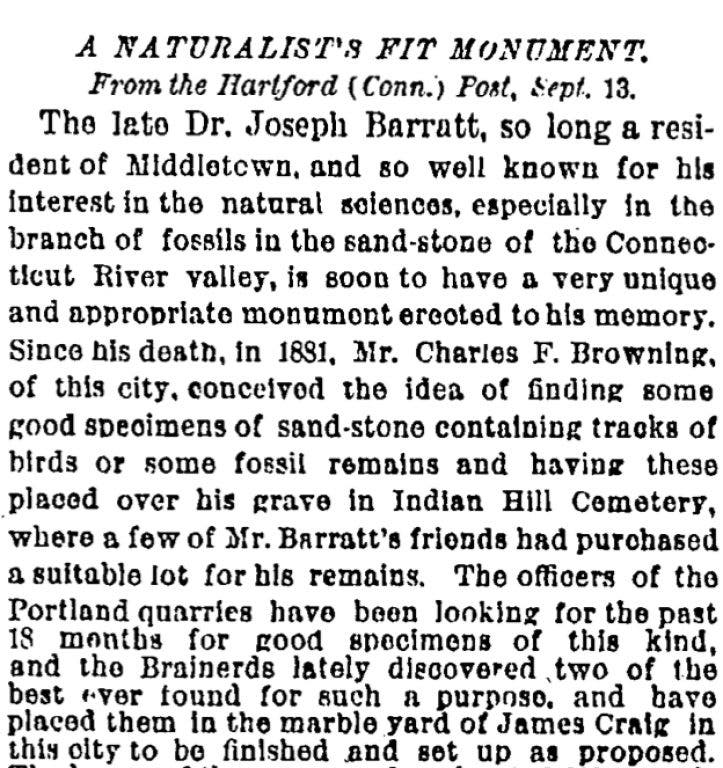

Dr. Joseph Barratt, as you learned this morning, was a talented geologist, botanist, historian, and local physician. He came to Middletown with Alden Partridge's college in 1826, and stayed when the school moved.
Materials left behind that relate to a person can tell a great deal about them. In 1836, Dr. Barratt published an article in the Boston Medical Journal entitled,"Poisoning by Opium - Case of Successful Treatment by Flaggellation, where a large dose of Laudanum Had Been Taken." Overdoses of opium, a treatment for pain, were common at the time; treating the patient by whipping him, however, was not. He claimed it cured the patient.
His fascination with the footprints in brownstone led him to donate a sidewalk section from Middletown to Amherst College in 1835. The sample was labeled Sauropus barrattii, indicating Barratt credited a giant lizard with making the footprint.
Find out what's happening in Middletownfor free with the latest updates from Patch.
The most revealing indications about Dr. Barratt's character are comments written by his peers. His colleague, Dr. Thomas Miner, one of the trio of physicians in the city, was an invalid, but exceptionally well respected. Dr. Miner sent a manuscript in 1836 containing the story of his life to Dr. Barratt and asked that he arrange to have it published.
Barratt finally did take it to a publisher -- more than three years after Miner's death. Frank Hallock, the author of a paper on Dr. Miner written in 1936, which appeared in the Journal of Biology and Medicine, claims the delay was due "undoubtedly, to Dr. Barratt's thoughtlessness and erratic habits."
Find out what's happening in Middletownfor free with the latest updates from Patch.
To support his poor opinion of Dr. Barratt, Hallock points out that in the very autobiography that was published about Dr. Miner, Barratt added an editorial note in the preface that demeaned Miner and questioned accomplishments Miner claimed in his life.
Barratt added: "He [Miner] was not profoundly learned in any branch of science or literature, but was distinguished rather for that general knowledge which marks the finished scholar. Of the modern languages of Europe he was a complete master of the French only -- his knowledge of German was superficial, and of the other tongues still less."
Barratt continued, "He speaks of himself as a disciple of Kant; but his knowledge did not extend beyond the distinction between the reason and understanding."
Yet Barratt had his supporters. After his death, a group of his disciples collected money to have a grave marker put on his plot in Indian Hill Cemetery. They found a piece of brownstone at the quarry with "bird" footprints (they still hadn't figured it out) and had it engraved with Barrett's name and birth and death dates.
It is quite unique ... just like the man.