Community Corner
Hundreds March In Peaceful Protest In Downtown Middletown
Several city officials spoke at the event, in which around 750 people marched peacefully downtown to condemn the death of George Floyd.



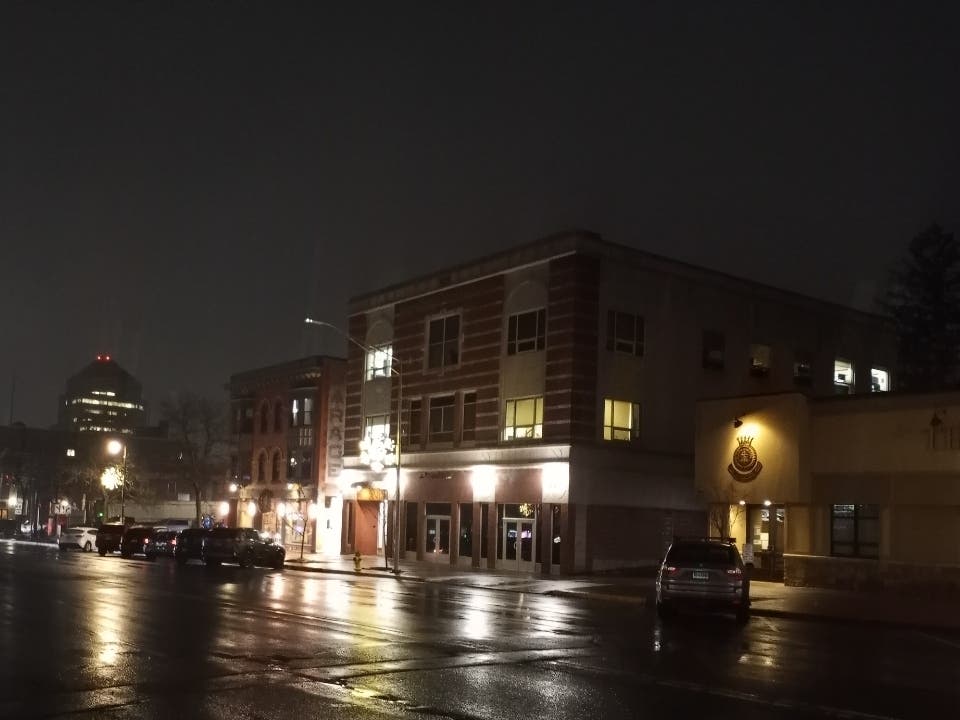
MIDDLETOWN, CT — Around 750 people marched peacefully in downtown Middletown Saturday night to condemn the death of George Floyd at the hands of a Minneapolis police officer. Several city officials spoke during the event, including Superintendent of Schools Michael Conner, Mayor Ben Florsheim and Police Chief William McKenna, while several Common Council members joined the march, according to the Middletown Press.
The Press reports Conner spoke of his personal experiences, saying “When I leave my house every day, I don’t feel safe. I worry about if I’m coming home to my family. It doesn’t matter if I have a suit on, doesn’t matter if I have an education, they don’t see that. All they see is my color.”
Florsheim wrote a lengthy post on Facebook addressing the rally and what happens next. Read Florsheim’s full post below:
Find out what's happening in Middletownfor free with the latest updates from Patch.
Last night, hundreds of people (750, according to press reports) gathered peacefully in downtown Middletown to mourn the death of George Floyd, to condemn his murder at the hands of the Minneapolis Police, and to demand justice for him and the inexcusably growing list of other black people who have been killed by police violence and white supremacy.
I am grateful to everyone who was a part of this important event. Thank you for your presence.
Find out what's happening in Middletownfor free with the latest updates from Patch.
I have thought and felt many things about what I’ve seen taking place in dozens of cities in the past few days, from sadness to outrage to a hopefulness that something better will emerge out of this devastating moment for our country. One thing in particular that has been on my mind is a question that occurred to me as a mayor: “Where are all the mayors?”
It was in that spirit that I reached out to the organizer in advance of the event to let her know I planned to attend, and I agreed to speak. In my remarks, I attempted the self-contradictory task of using a speech to talk about the insufficiency of speech-making, and called on our community to move beyond passive tolerance of injustice towards active anti-racism. It was then pointed out by people in the crowd that the actions themselves will speak louder than the same words they’ve been hearing from white politicians for a long time. It became abundantly clear that there were voices other than mine there that needed more urgently to be heard last night.
After the megaphone was put away, the rally turned into more of a dialogue. Several smaller groups emerged with people going back and forth, some more heatedly than others. I am deeply grateful for many of the comments and questions that were expressed by Middletown residents. During a conversation with several protestors, I was able to answer some questions about what local government is already doing with regard to racial justice and policing. I was also able to hear from them a desire, an insistence, that we need to be doing more.
So let me address these three central questions:
What are we doing now to prevent the killing of black people in our community?
What more will we do in the future to prevent such violence?
How can the public be more involved?
The answer to the first question is both “a lot” and “not enough.” Clearly, there needs to be more transparency and communication about the work that both the city and MPD are doing to advance racial justice and to improve police-community relations. And the list of things we are working on needs to grow, along with the number of people who are involved in doing that work. But it is a question I want to answer with some facts about what’s already going on:
In 2017, the city began funding a partnership the Human Relations Commission (a city board, whose members are appointed by the mayor), the Middletown Racial Justice Coalition, and an outside organization called the National Conference for Community and Justice to undertake a comprehensive anti-racism project. Part of that project has been requiring racial justice training for every city employee, including every member of the police department, a process that is ongoing to this day.
In my budget, I proposed renewing funding for the project to continue into 2021, and at the Common Council budget workshop that took place this past Wednesday, it was met with enthusiastic support not just from council members but from city directors who have been involved with the project through those racial justice trainings.
The Middletown Police Department has extremely high training and vetting standards; as Chief McKenna has explained to me, “we take the candidates who we think are basically qualified, and then we look for any reason at all not to hire them.” A record of complaints at a previous police agency is a disqualifier. For new recruits, so is a bad answer to the question of why you want to be a police officer (“I always wanted to be a cop because everyone in my family is a cop,” for example, is a bad answer). All members of the police force participate in regular training and professional development work on topics such as deescalation and community policing. The department has actively partaken in the racial justice trainings and significantly ramped up its outreach efforts to find and hire more officers of color. All this needs to be more widely known and transparently presented, and I will work with the MPD in the coming days to make the details of these efforts accessible to all.
I could go on, but the point is not to list everything here. It’s to realize that we need to do a better job of being transparent about what’s already happening to prevent police brutality against communities of color.
The more salient questions are #2 and #3: what happens next? And how can the public be involved?
The answers are related because our ability to do what needs to be done is contingent on more people being a part of it. From a policy standpoint, I think there are a few things we should clearly look at. One is making sure that-- as in Minneapolis-- the act of not intervening when an officer witnesses police brutality is also a fireable offense in addition to the act of brutality itself. Another is establishing some form of community oversight for MPD to ensure that complaints and concerns are addressed and reviewed externally as well as internally. Yet another is to increase the scope of the citywide anti-racism partnership, strengthen its community outreach efforts, and continue it in perpetuity as an ongoing practice of city government, rather than simply funding it through next year.
As to how to get involved, that’s both the easiest and hardest one to answer. While my staff and I strive to make government transparent and accessible, one problem is that not everyone has the time or ability to access the information necessary for becoming more involved in local politics. That means city government needs to come to the people, not just wait for the people to come to us. The need for that was, in fact, one of the main reasons I ran for mayor; with the help of the community, it is something I hope to help change about the political culture in Middletown. In the first couple of months of my term, I held regular in-person town hall meetings in different locations and began meeting with all of the city’s citizen boards and commissions in the hope of broadening their work to more people and more issues. The COVID-19 pandemic changed much of that, with everything moving online and the city’s day-to-day focus becoming consumed with crisis response. As soon as it is safe, those public meetings will resume. If there are topics you think we need to be having community meetings about, or particular groups of people who need to be involved, let me know in the comments and we can start to plan. You can also still attend regular city meetings virtually, like the monthly Common Council meeting (tomorrow, June 1-- more info can be found on the city website), a weekly 6pm Tuesday Zoom call hosted by Community Health Center, and the annual budget hearing coming up this Thursday (also on the city website). And finally, you can reach me anytime. The number on this Facebook page is my cell number-- it’s there because this job is really all about listening and receiving feedback, and if you have some, I’d rather hear it directly from you.
It has to be said that, in many of the cities where violence has broken out in recent days, that violence was unambiguously started by the police: there are countless videos documenting examples of tear gas and rubber bullets being used on peaceful protestors, journalists, and medics. It is obvious that there is something fundamentally broken about policing in this country. While I truly believe, for many of the reasons shared above, that no one will die at the hands of a Middletown Police Officer the way that George Floyd, Mike Brown, Philando Castile, Tamir Rice, Sandra Bland, Freddie Gray, Breonna Taylor, Laquan MacDonald, or any other black person killed by police did, it is imperative that we ensure, in every way possible, that this belief proves true. And while I cannot imagine that anything like what we’ve seen in Minneapolis, Los Angeles, Chicago, Seattle, and countless other places could happen in Middletown, it is clear after last night that there are others in Middletown who do not feel protected by the police, and their trust can only be won when action is taken to win that trust.
I’ve used a lot of words to say that words are not enough, but I do need to say one final thing. There is a difference between being personally “not racist” and being actively engaged in anti-racism. White people like myself have an obligation in this moment to forget about the first thing and focus on the second thing. We need to take our own feelings out of the equation and begin to intentionally and explicitly fight against racism in all its forms. The only absolution to be found will not be given to us; we must create it ourselves through our actions. We must use our voices now not to demonstrate to people of color that we are on their side, but to demonstrate to other white people why racial justice matters to us and why it should matter to them too.
The work is beginning. Let us ensure it is completed. #BlackLivesMatter
Get more local news delivered straight to your inbox. Sign up for free Patch newsletters and alerts.