Community Corner
The Bridge That Wasn't
Based on the Virginia example, it was probably a good thing ...


Imagine a major railroad line running near Connecticut Valley Hospital and through Bow Lane and Maromas, and then crossing the river to Portland. This would be the case if the state had followed through on a proposal recommended in 1848!
The proposal called for a railroad suspension bridge to cross the river at The Narrows, where the Connecticut River is at its narrowest point in this region.
During this period, the suspension bridge was an idea, yet unproven. As one engineer stated, "Suspension bridges have generally been looked upon as loose fabric hanging up in the air, as if for the very purpose of swinging."
Find out what's happening in Middletownfor free with the latest updates from Patch.
Charles Ellet was the mastermind behind the bridge plan at Middletown. His first "successful" bridge was over the Ohio River at Wheeling, Va. After it was completed he submitted the proposal for Middletown. The bridge was to be 1,050 feet long between towers at each end of the bridge. The deck was approximately 140 feet above low water. He submitted plans for a similar bridge over Niagara Falls.
The illustration sent to the State of Connecticut exaggerated the river's width, but was a convincing rendering of the bridge's ability to span the river. One end of the proposed bridge is shown to the right. (A rendering of the entire bridge is visible in the Pictorial History of Middletown, page 55; I am not authorized to reproduce it here.)
Find out what's happening in Middletownfor free with the latest updates from Patch.
The state took no action on the bridge. This was probably a good idea; Ellet's Wheeling bridge blew down during a storm in 1854.
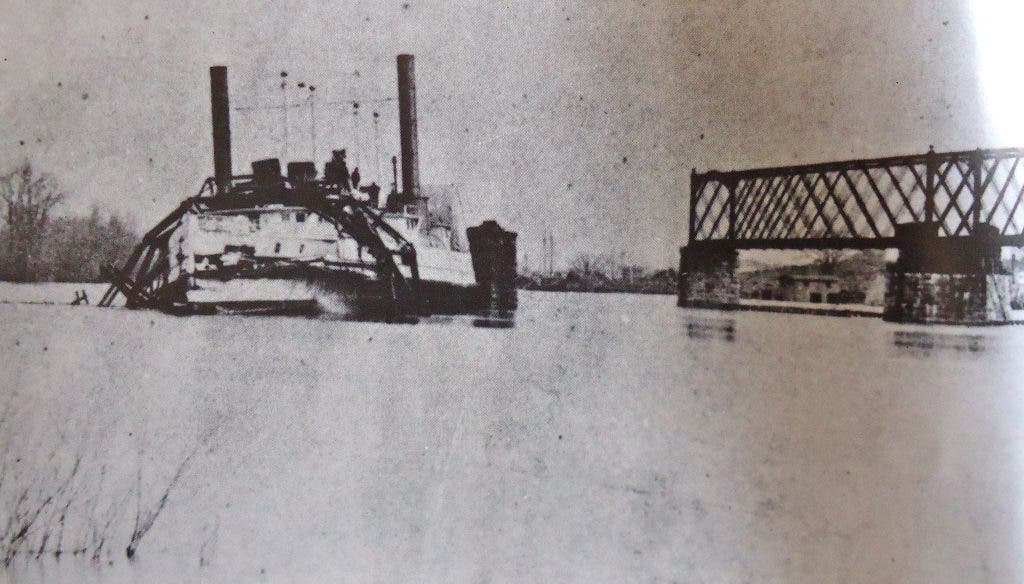
The Connecticut River was bridged at Middletown in 1872 when the Airline Railroad constructed a bridge from Middletown to Portland. This bridge was hit by a steamer (photo to right) in 1876, requiring the bridge to be rebuilt. The swing bridge remains today and is still in use.