Health & Fitness
2 New Tick Threats In CT: What You Need To Know
A new report released this week by Connecticut officials reveals some bad news as we approach spring next month.



CONNECTICUT — As we get closer to the warmer months here is some concerning news via the Connecticut Agricultural Experiment Station (CAES). This week, scientists at CAES released results obtained from the first year of a new federally funded surveillance program for ticks and tick-borne diseases.
More than 2,500 ticks were collected in the spring, summer and fall of 2019 from 40 locations in all eight counties and were screened for five pathogens that cause disease in human.
The two most commonly collected species were the deer tick (2,068 cases), followed by the dog tick (437). Two newly identified emerging species, Amblyomma americanum (lone star tick) and Haemaphysalis longicornis (Asian longhorned tick) were identified in Fairfield and New London Counties.
Find out what's happening in Milfordfor free with the latest updates from Patch.
This is the first record of the Asian longhorned tick in New London County. Statewide, Fairfield County had the highest average adult blacklegged tick density (61 samples per acre) and Tolland County the highest average nymphal tick density (51 sampled per acre).
All adult female and nymphal blacklegged ticks were tested at CAES for the presence of the five different disease-causing pathogens. Fairfield County reported the highest infection rates for all pathogens in adult female and Litchfield County the highest in nymphal blacklegged ticks. 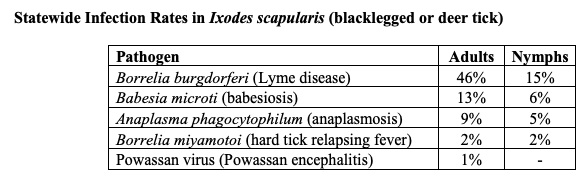
Find out what's happening in Milfordfor free with the latest updates from Patch.
Two emerging tick threats
Survey results demonstrate that the lone star and Asian longhorned ticks are "emerging in Connecticut," state officials said this week. According to the Connecticut Department of Public Health, there were three confirmed human cases of hard tick relapsing fever and five human cases of Powassan encephalitis in 2019.
Lyme disease, 1,221, babesiosis, 330, and anaplasmosis, 297, continue to the major tick-borne diseases of concern for Connecticut residents.
The survey was funded by a one year grant from the Centers for Disease Control and Prevention and may continue as a way of documenting tick and pathogen abundances statewide to inform the public so that appropriate precautions are taken when spending time outdoors.
"Scientists at CAES remind Connecticut citizens to perform regular checks for all stages of blacklegged ticks when they are active in spring through fall and on warm days in the winter, as tick bite prevention is the best strategy to combat tick-borne diseases."
What is the lone star tick?
It is an aggressive human biter and transmitter of several human diseases, and is rapidly expanding its range in Connecticut and the entire Northeast, according scientists at the Connecticut Agricultural Experiment Station.
The number of lone star ticks submitted to the Connecticut Agricultural Experiment Station increased by 58 percent between the periods of 1996-2006 and 2007-2017, mainly from Fairfield County. In 2019, established populations of this tick were discovered in New Haven County for the first time, according to Dr. Goudarz Molaei, who directs the station's Tick Testing Program.
"The lone star tick is an aggressive human biter that has been associated with several human diseases and medical conditions, including tularemia, ehrlichiosis, rickettsiosis, Heartland virus disease, southern tick-associated rash illness, red meat allergy and probably the newly identified Bourbon virus diseases," according to a prior news release by Connecticut health officials. "In addition, the bites are highly irritating."
Lone star ticks — which get their name from the white dot or "lone star" on the adult female's back — are most active from mid-March to late June, nymphs most active from mid-May to late July, and larvae most active from July to September, officials have said.
Asian longhorned tick
The Asian longhorned tick, as it is commonly known, was first discovered in the U.S. on a sheep in New Jersey in August 2017. Since then, the CDC says the tick has been identified in eight other states including Connecticut.
In other parts of the world, the tick has caused serious problems for both humans and livestock. Its bites can make people and animals seriously ill. In Asia, it has caused human hemorrhagic fever and a reduction of production in dairy cattle by 25 percent.
The first case of human biting by the exotic east Asian longhorned tick, Haemaphysalis longicornis occurred in a resident from Fairfield County in 2018.
This newly discovered tick is a major livestock pest that feeds on a wide variety of mammals including humans, but it is not clear how often. Longhorned ticks have been found to carry several human pathogens in Asia, but it is unknown if this tick will be capable of transmitting native pathogens such as those that cause Lyme disease, babesiosis, anaplasmosis, or Powassan virus.
Get more local news delivered straight to your inbox. Sign up for free Patch newsletters and alerts.