So you're an Entrepreneur now, and just like you set up an umbrella at the beach and immediately get shade, all you have to do now is hang your shingle out, and you immediately get business, right?? Boy, if it were only that easy. If you think it's going to be that easy, get your head out of the clouds and come back to earth. I hate to bust your bubble here but it's simply not that easy. You can choose not to believe me, but I think time will reveal the truth for you.
I haven't met too many small business owners that weren't out there pounding the pavement every day promoting their business. Sure you can put some money into direct mail, TV, radio or magazine advertising, or the host of other ways to get your business known, but if you avoid relationship marketing and networking face to face with others, you're missing a big chance to have others promote your business for you. In this blog, I'll be talking mostly about networking face to face and what kind of events are out there for you, as well as what tools should always be with you when you go.
Networking comes in all sorts of shapes, sizes and colors. There are open category events, closed category events, industry specific, chambers, visitors and convention bureaus, networking for just men, networking for just women and many, many more. Basically, where there are people, there are opportunities to network. It's just people meeting people, learning what they do and seeing if there is an opportunity for mutually beneficial relationships. Don't ever take this for granted. Most people know close to 250 people in their sphere of influence, maybe more. When they tell others about you and your business, do the math, that's a lot of people who are getting a warm introduction to your business. The warmer the relationship, the better the chance you have of sharing what you do with them. Warm introductions are based on trust.
Find out what's happening in Cummingfor free with the latest updates from Patch.
For sake of discussion, I'm going to choose open and closed category networking to talk about here, and what tools you need to have with you to make this more than a coffee or cocktail hour.
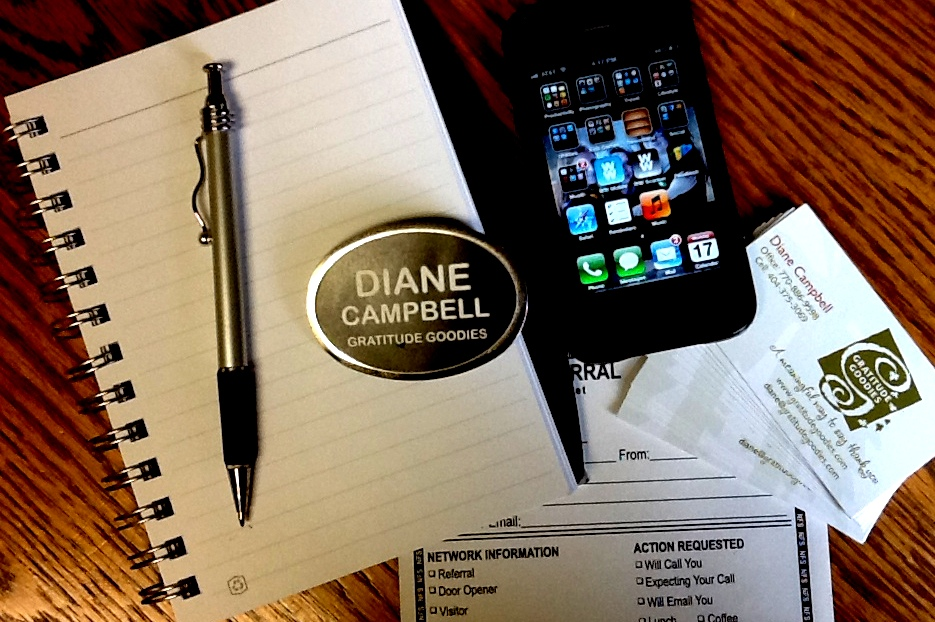
1. Name tag. So you're in a room with a lot of people. You're shaking hands with so many that it starts to get muddled, and you're forgetting names. Wouldn't it be nice to meet someone, go to shake their hand and right in front of you is a person wearing a name tag. Relief for your tired brain. One less name you have to remember, right? Where's your name tag? If you think you don't need a name tag, you might be missing out on a great sale. Your name tag should do a couple of things. It should be clear and easy to read. It should give your first name (I like my first name larger than my last name) and your company. Where you place your name tag on your person is extremely important also. When you shake someone's hand, which hand, do you offer out? It's the right hand, correct? Your name tag should also be on the right, so when you reach to shake their hand, the name tag is also drawn in and is easier to read than on the left.
Find out what's happening in Cummingfor free with the latest updates from Patch.
2. Business cards. If you don't have them with you, go home. You're really not that serious about doing business if you leave your name tag off and your business cards at the office or at home. I always have my name tag on and loads of business cards on me. When someone sees your name tag, they might ask what you do. It's easy to pass a card along. When I'm in a networking event, I have a system for my cards. I place my own business cards in my left pocket and put the ones I collect in my right pocket. You don't have to do it like this but I find that they don't get mixed up that way. It's a little awkward if someone asks for your card and you pull out the card you just collected from the last hand shake. Suddenly you're fumbling around through all the cards to find yours again. Make sure your card is up to date with all the relevant contact information on it. It's also wise, if you can control this, to have your cards printed on material on which you can write. You may be standing in front of your biggest prospect ever and they need to jot something on the back of your card. If the card stock is so glossy they can't do that, you may miss that opportunity.
3. Pen and Paper. Having a pen with you is a no brainer, right? I've been at events where some people do not have a pen, a name tag, or anything that makes me want to work with them. I view them as unprepared, disorganized and not serious about their business. Why bother going if you're not prepared? With pen and paper in hand, you can take that 5 minute or less conversation and turn it into a future meeting. Plus, you can reintroduce yourself based on the conversation you had with them at the networking event.
4. iPhone® or smart phone. No, I'm not going to get into which phone device is best. I use an iPhone®. My goal at networking events is to get leads and set appointments. When I have a calendar handy on my phone, it allows both me and the person with whom I'm talking to sync up our calendars right then and there. I enter the date, the time, and always add their contact phone number to follow up and confirm the appointment, if needed. I usually don't set appointments on Monday unless I know that it's set in stone. It's hard for people to remember appointments over a weekend, and I won't follow up on Sundays to a personal cell. Not a good idea. My appointment days are Tuesday through Friday.
5. Referral slips. Referral slips are used in some closed category networking groups to pass leads. In my networking group, called "Networking For Success", we have a three part referral slip. The top copy goes to the business to which you're passing a lead. The second copy goes to the group's count of how many leads were passed, and the third copy I keep. Why? I want to know that some action has been taken by the business to which I gave this lead. If you say you know someone that needs XYZ product or service, and you don't have their number on you, take the third copy back to the office, find the information needed, then send it on so the lead will be complete. There is so much to know about a lead slip. I'm not going to get in to it here, but on another blog, I'll address some good and bad habits people use on lead slips.
In summary, there are so many easy things to do to make you a more prepared networker. You are entering your field office when you go to a networking event. All of these people you meet have the potential of becoming your sales force. Be professional, be prepared, and be out there! I'll see you in a future blog.