Health & Fitness
Can't Wait for Spring: I Miss the Snakes!
Boundary Waters Park is one of the best kept secrets in Douglas County. I love the wildlife, especially the rare encounters with snakes.


I'm writing today's blog because I love Boundary Waters Park, and I just feel like writing. So indulge me, or not. I've been jogging or bicycling around Boundary Waters Park on a regular basis for a few years now. There are miles and miles of trails. There are deciduous areas, coniferous areas, pastures, swamps, sandy areas, ponds, hills and riverbanks. They all have their unique and blended ecosystems, and they change dramatically with the seasons. The entrance to the park is on the west side. To the east is the Chattahoochee River. To the south is a gas line right of way, a big open grassy fairway. South of that is a stretch of woods and then a bordering trail next to a horse pasture. The north part of the park is very dramatic, hilly country with great views of the river that you can reach on the red trail. There are three trails as you go roughly from the south to north, blue, yellow and red The park never ceases to entertain me, or at least distract me from my aching muscles and labored breathing.
This time of year it's wet. Not as wet as it was last year, certainly not as wet as 2009, the year of the flood. If you're familiar with the park, the main lake behind the Aquatic Center still needs three more feet of water to be full. There's another pond east of the sandy parts of the red trail that's still far from full, and a small looping dam south of the gas line borders a swampy area most years, but not this year, yet. As I approach a pond or swampy area, I love hearing the chorus of insects in the distance fade to silence as I approach. It's almost like they're talking about you and hushing up as you enter their room. I'd love to have a naturalist explain the different insect calls, but there's such a cacophony that I'd be amazed if anyone could separate the sounds.
I have made some effort to study animal tracks and signs. This a perfect time of the year for muddy footprints. There's a pond that fills with raccoon tracks before it dries up each year. A few days ago a possum set his forefoot on a muddy trail so perfectly, I wondered if he thought he was at Grauman's Chinese Theater. It was on the gas line area where I've seen possums before. That always helps when you're trying to pretend you're a woodsman. Deer tracks are the easiest to recognize, and because of the sharpness of their hooves, it doesn't have to be during the wet season. You can actually watch fawns grow. In the spring there will be tracks so small you can cover them with a quarter. Of course, you get plenty of chances to see the real thing.
Find out what's happening in Douglasvillefor free with the latest updates from Patch.
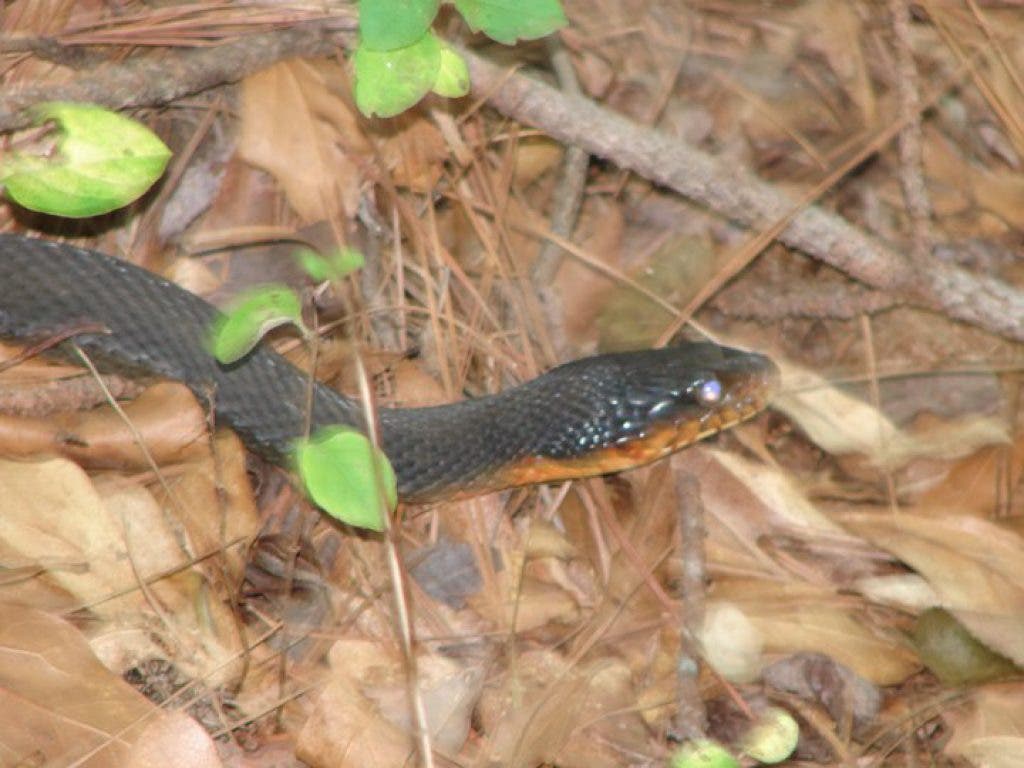
As I noted in the title I enjoy finding snakes in the park. Don't get the impression that snakes are a particularly common sight. They are extremely rare. I believe that in the spring and summer I might see one snake for every twenty hours spent jogging in the park. For me spring is the best time to see them. In the summer they may be more active, but not necessarily easier to spot. Spring mating season gets them out and about. That especially gets water snakes on dry land. I think the main reason they are more visible is that snakes often want to sunbathe in the springtime, and the search for sunny spots brings them out onto the trails. Last year the two species I saw most were yellow-bellied water snakes and rough green snakes, both nonpoisonous. The yellow-bellied water snakes tended to be on the edges of the trails, and they didn't seem to like me. They'd either pretend they didn't see me, or they'd act aggressive and then make their escape. I've read that bites from these water snakes are very common. I've also heard that that's often from falling off of branches and into boats, so they feel endangered.. Rough green snakes are fascinating. They rarely bite humans. The ones I've seen are a beautiful bright green, pencil thin and about three feet long. Each time there were two laying all the way across the trail, parallel. In both cases last year, neither moved until I was well away, but when I returned they were gone. It reminded me of an antiquated law in North Carolina that said if two trains meet on the track going in opposite directions, they should stop. The law went on to state that after stopping, neither could move until the other one was gone. I think they finally took that law off the books.
I have seen only one poisonous snake, very briefly, a copperhead. This was the shyest one of all, and one of the most beautiful. It was lying along the edge of the trail, light tan with a row of brown Hershey's Kisses along its side. It left in a hurry. I have a history with copperheads. One bit me in the index finger when I was four. We lived far out in the country, and my mother had a traumatic home remedy. She sliced my finger over the fang marks and put my hand is a dishpan of warm water, Then I was forced to eat butter and drink milk until the ambulance arrived. This was the snakebite cure her father had used for dogs. It apparently worked. I still have the scars. The experience didn't leave me in fear of snakes, but I was a little more cautious around my mom.
Find out what's happening in Douglasvillefor free with the latest updates from Patch.
My mother loved old wives tales and had quite a few about snakes, especially coach whips, but that's another story. She said you could tell if copperheads are around, because they smell like cucumbers. I'm not so sure, but I pay close attention when I smell cucumbers in the woods. She taught the difference between king snakes and coral snakes with “Red touch yellow kills a fellow, red touch black, friend of Jack.” All my life I've thought of king snakes as black with yellow or red horizontal rings, depending on whether they were eastern king snakes or scarlet king snakes. I was totally stumped when I ran across several black snakes with tiny randomly grouped yellow dots. The dots were very distinctive. Several groups on one snake almost looked like star formations. I picked out Orion, Pegasus and Cassiopoeia. I called it the constellation snake. I finally discovered that they were black king snakes. Among other things, they eat rattlesnakes. All of them were on the sandy soil where the red trail approaches the yellow trail in the middle of the park.
If you jog or hike with dogs, don't count on them to warn you of snakes. Mine are useless. I can stand between my dogs and point at a snake, and they don't have a clue. Maybe snakes do smell like vegetables. Once the snake moves, though, they get it. Actually they get too much of it. For the rest of the day they decide that every twig they see is a snake.
So discover the park. It's one of the best kept secrets in Douglas County. If you're lucky enough to see a snake, please don't hurt it. For one thing, it's against the park rules, and of course they're important to the ecosystem, beautiful and fascinating. If you keep your distance, you should be perfectly safe. If there is a problem, the best snake bite kit is your cell phone. Call 911. Enjoy.