Health & Fitness
Rare Transit of Venus Visible in June
If the sky is clear the public will be able to watch the transit of Venus at the University of West Georgia Observatory on June 5, from 6 p.m. until 7:30 p.m.
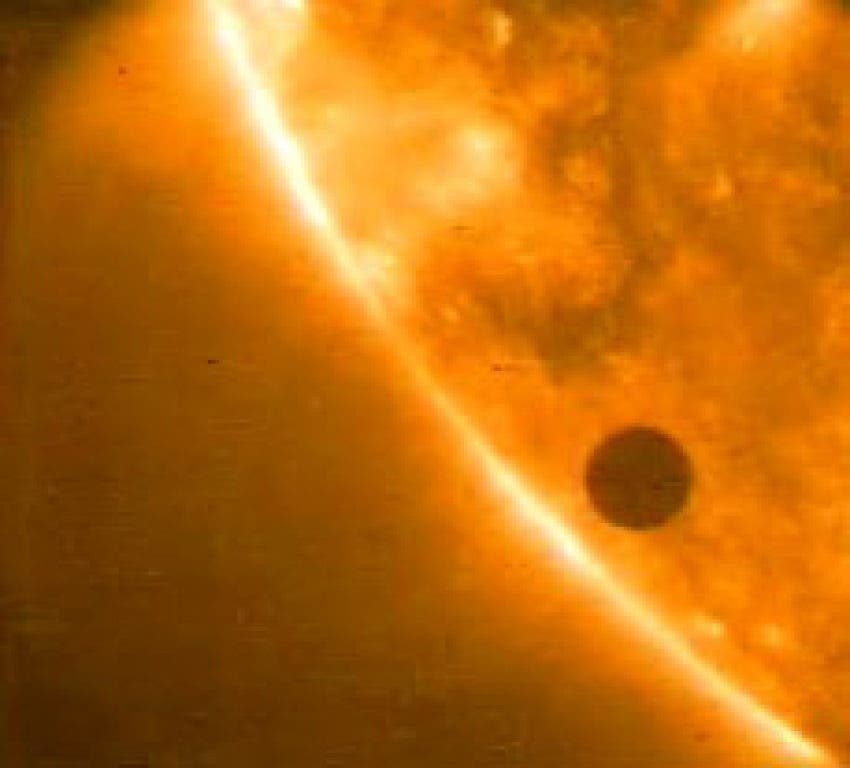
In June, observers of the sky will be able to witness one of the rarest celestial events in the solar system, the transit of Venus.
If the sky is clear, the University of West Georgia Observatory will be open to the public to observe the transit on June 5, from 6 p.m. until 7:30 p.m.
Sky-watchers will see Venus pass directly between the Earth and the sun, similar to what happens during a solar eclipse when the moon passes between the Earth and the sun. Because of its distance from the Earth, instead of blotting out the sun, Venus will look like a small dot as it makes its journey.
Find out what's happening in Douglasvillefor free with the latest updates from Patch.
Bob Powell, the chairman of UWG’s Department of Physics, saw the last transit of Venus on June 8, 2004.
“It was awesome,” Powell said. "The transit was ending as the sun rose that day. Seeing the small black dot that was Venus against the much larger solar disk gives one a sense of the scale of the solar system, since Venus and the Earth are about the same size.”
Find out what's happening in Douglasvillefor free with the latest updates from Patch.
Because of the orbital periods of the two planets, transits of Venus repeat every 243 years, with pairs of transits eight years apart separated by long gaps of 121.5 years and 105.5 years.
Johannes Kepler was the first person to predict a transit of Venus four years before the 1631 event. It was not visible in Europe and Kepler did not see it. Then in 1639 England, Jeremiah Horrocks watched the path of Venus on a small piece of paper, becoming the first person in recorded history to note the passage.
Subsequently, transits have been observed in 1761, 1769, 1874 and 1882. This will be the last chance to see the transit of Venus in our lifetime. The next time Venus will glide into the path between the Earth and the sun will be in December 2117 and December 2125.
Staring at bright solar disk with the unprotected eye can quickly cause serious and often permanent eye damage. A transit of Venus can be safely observed by taking the same precautions used when observing the partial phases of a solar eclipse. These include projection methods and using specially designed solar filters.
For more information contact: Powell at 678-839-4095 or bpowell@westga.edu.
---
This photo is of the Transit of Venus seen by NASA's Sun-observing TRACE spacecraft in June 2004. Photo courtesy of NASA/LMSAL.