Community Corner
Our History: Take a Bridge to the Past
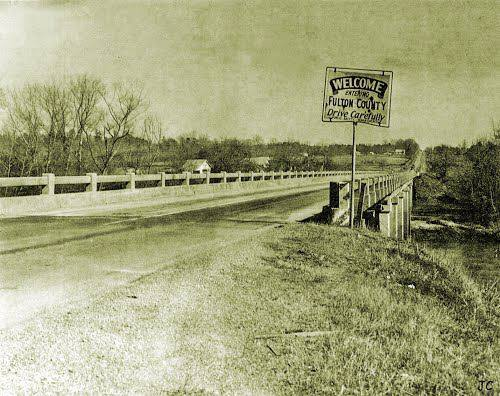
If you have ever ventured outside of Douglas County at some point you have crossed one of the bridges over the Chattahoochee River connecting Douglas County to Fulton County.


By Lisa Coooper
“If I had a nickel”–is the phrase that come to mind, right?
We use our roads and bridges so often that we begin to take them for granted, and only when they are taken away from us do we begin to realize their importance in our daily lives. During the floods of 2009 we all got a taste of what it would be like to be cut off from the rest of the world when all of the bridges across the river were closed and Interstate 20 and numerous state routes were closed as well. Douglasville was an island, and it was a bit unsettling, wasn’t it?
Find out what's happening in Douglasvillefor free with the latest updates from Patch.
Even experiencing the aftermath of the floods it is still hard to imagine having no bridges at all across the Chattahoochee River, but there was time prior to 1937 when there WERE no bridges.
If you wanted to cross the river you had to depend on the ferry and luckily there were a few men who ran ferries in the area. Claiborne Gorman has the distinction of running one of the first ferries as early as 1837. He had a large plantation along the river where the Dick Lane Bridge crosses the Chattahoochee River today along Campbellton Road. In fact, by the time the Civil War occurred he had amassed 1,250 acres of farmland. Claiborn’s son, James M. Gorman, took possession of the plantation and ferry in 1869.
Find out what's happening in Douglasvillefor free with the latest updates from Patch.
This is the point where the Atlanta National Bank and Alfred Austell, Sr. come into the picture. You might be wondering if Austell has anything to do with the city of Austell in Cobb County, and you would be right. Alfred Austell, Sr. was very involved with business affairs in Atlanta including Southern Railway. When the rail officials needed a name for the place where two of their lines converged near Salt Springs–the line to Birmingham and the line to Chattanooga–they decided to honor Alfred Austell, Sr. by naming the city of Austell for him.
The year was 1873–a year having some distinction with historians since they named a time of economic difficulty after it–the Panic of 1873. Effects from the Civil War were still being felt and the railroad boom resulted in too much capital involved in projects offering no immediate or early returns per Oberholtzer’s A History of the United States Since the Civil War. A total of 18,000 businesses failed between 1873 and 1875. Unemployment in the United States reached 14 percent, and real estate values fell. Men who depended on farming to make their living were hit very hard. James Gorman borrowed money from the Atlanta National Bank to pay off some debt, but his financial woes continued through 1873 when Alfred Austell, Sr. took the land and plantation home off Gorman’s hands for a sum of $12,000.
Austell continued to live in Atlanta but used the plantation house as a country home and made many improvements to the property. At this point the place took on the title of “Austell Farms.” He kept the farm and ferry operational. Over the years as the land was sub-divided and sold.
The story becomes even more interesting once Alfred Austell, Sr. passed away and left the plantation and ferry to his son, Alfred Austell, Jr. who graduated from Yale University in 1902. Alfred, Jr. decided he would return to Atlanta and live in the plantation home his father had left him. He created quite a stir as many believe he has the distinction of being the first resident of Douglas County to cross the ferry with a motor car. He left New Haven Connecticut after graduation in July, 1902 and continued South in a 1902 Winton Touring Car. Fannie Mae Davis identifies the car as a “Locomobile," but since the Winton car was red in color her mention of the nickname “The Red Devil” is probably correct.
Today we could make the trip in just a few hours, but it took Austell and his Swedish chauffeur, Charles Swenson, three months arriving at the ferry on Sept. 8. Roads back then were not like they are today. Most were unpaved and in poor condition. Jeff Champion who is well versed concerning the history of the Gorman-Austell plantation advises, “Only two breakdowns were reported, a burned out induction coil at Staunton, Virginia, and a broken brake just before Atlanta was reached.”
Alfred Austell, Jr. was the quintessential rich boy of the early 1900s. He was a member of the Capital City, the Piedmont Driving, and Atlanta Athletic Clubs. He had money, and he spent it on his hobbies–cars and horse racing. Jeff Champion’s research indicates Alfred, Jr. wrote to the Yale alumni magazine, “My time has been spent mostly in Atlanta and a country house located about twenty miles from town. My time seems mostly spent automobiling.” In fact, Alfred, Jr. participated in the Good Roads Tour of 1909 from New York City to Atlanta. Champion advises, “He drove an Apperson Automobile valued between $3,000 and $4,000. After the event he was named the Apperson Agent in Atlanta, and planned to open an Apperson dealership on Auburn Avenue later that year.”
Alfred, Jr. wasn’t into running the farm, and fortunately he had Miss Mamie Wier for that. Miss Mamie Wier lived on the plantation with Alfred Austell, Jr. She has been described as his house keeper, property manager, consort, and lifelong partner. She took over the daily operations of the farm and ferry leaving Alfred, Jr. to dabble with his automobiles. Fannie Mae Davis advises Miss Mamie oversaw the home’s entertainments as well. Rumor has it there were some fine times on the plantation when parties were held. Fannie Mae Davis states, “Gossip in the area told of their all night dances.”
Sadly, Alfred, Jr. passed away in 1922 and left Miss Mamie the proceeds of a $20,000 savings bond he had from the railroad, a car, and appointed her as dower of the estate until a time where she married or passed away. She continued to oversee the work on the plantation and also the parties continued at the home.
Besides running the farm and entertaining friends Miss Mamie ran the ferry. Jeff Champion advises, “She ran the ferry until the winter of 1935 when an ice slide took out the flat. Knowing the state would soon be building a bridge she didn’t rebuild.”
Get more local news delivered straight to your inbox. Sign up for free Patch newsletters and alerts.