Arts & Entertainment
Art Inspires Lifelong Cancer Fighter
David Eldridge Smith has experienced the tribulations of cancer multiple times and uses his art to work through his struggles.


For local artist and cancer patient David Eldridge Smith, life has been anything but easy. He was born into a military family; his Air Force enlisted father met his Italian mother in North Africa.
Eldridge was dealt a bad hand early in life in 1952 when he was diagnosed with his first cancer, a tumor in his left femur at 6 months old. During this time, radiation was one of the only options for treating cancer and was still a relatively new procedure. Eldridge's doctor convinced the boy's mother to give the treatment a try rather than amputation. The therapy was effective for treating the cancer, but caused Eldridge's leg to grow incorrectly.
From six months until age 16, Eldridge underwent corrective leg surgery every 18 months. Missing so much school during these critical years did not put a dent in his education; he never failed a class. He worked hard on homework in the hospital to be sure he was passing his classes during his stays. Eldridge said appreciates his mother's wise decision regardless of his subsequently reduced height.
Find out what's happening in Woodstock-Towne Lakefor free with the latest updates from Patch.
“I was supposed to be 6'2", and at my tallest I am 5'8". Still, I don't regret her decision because I got to do all the sports as a kid,” he explained.
Eldridge has lived in Libya, Alabama, Italy, North Africa, Germany and Japan, but his family finally settled in Biloxi, MS, during his junior high and high school years. One of six children, Eldridge did not have anything handed to him. He worked at a convenience store in high school in order to support his expensive affinity for fast muscle cars. It was at this convenience that he met his wife of 36 years, whom he married in 1975.
Find out what's happening in Woodstock-Towne Lakefor free with the latest updates from Patch.
Eldridge came to work in Atlanta in 1985, when he ran convenience stores around the Southwest. He and his brothers joined forces in 1989 to form Fratelli, whose services included film, fashion and model work. During this time, Fratelli's clients included Coke and Rich's. Eldridge recognized the growing nature of the field of digital art in the '80s and '90s and convinced otherwise opposed clients to make the switch to digital.
“When digital came out, no one would use it. Department stores and Coke were scared of it. They thought it would be too pixelated or that it wouldn't reproduce well. It was hard to convince them to move toward digital,” he said.
Eldridge was anything but scared of the digital movement. He embraced it, and learned to use Photoshop as a professional. This love for digital art helped him immensely when he was diagnosed with cancer in 1996. After a biopsy, Eldridge was told he had incurable multiple myeloma, which is a blood disease that affects the bones. He traveled to Alabama to undergo an autologous stem cell transplant, a lengthy process involving the the infusion of his own healthy stem cells into his body. He then began a slow recovery process.
“When I got into the recovery area, my wife and daughter would come stay with me. I wasn't really back up to 100 percent until spring of 1999. My daughter Angela keeps telling me, 'Daddy, it's short term for the long term.' That's the motto for all people doing treatment for cancer, you have to ignore the short term treatment and focus on the long term.”
This was a difficult period for Eldridge, and he found himself constantly turning to his digital art and photography to occupy his mind. Though he went back to work at Fratelli, he still needed something to distract himself from dwelling on mortality.
“I had to stay busy mentally, and digital art is a great way to keep busy because you can lose yourself at the computer for hours and hours."
His older sister had connections to traditional art galleries and was able to convince some owners to display Eldridge's digital art, though this art form was not quite respected just yet. He sold quite a few pieces, some of which were printed on watercolor or silk paper.
His cancer then returned after six months short of five years, and he was put on trial drugs which forestalled the problem for almost three more years. Eldridge was beginning to become depressed in 2005 when he had to stop working because of the constant treatments. His sister came to the rescue, buying him paints and establishing a studio for him in his own basement. She encouraged him to work through his problems by painting.
“My sister said I needed something to do and got me to start painting in acrylics,” he said. “I used it as therapy. Getting your mind off feeling sorry for yourself, that's what I always tell people is the only way to beat this thing is with your mind.”
Along with his digital art, many of his paintings are for sale in galleries, including some in Roswell and Atlanta. In one instance, he sold seven unique paintings simultaneously to a single customer. Anyone can visit some of his displayed pieces at Downtown Woodstock's. He said he is grateful to the deli for displaying his work and encourages people go visit.
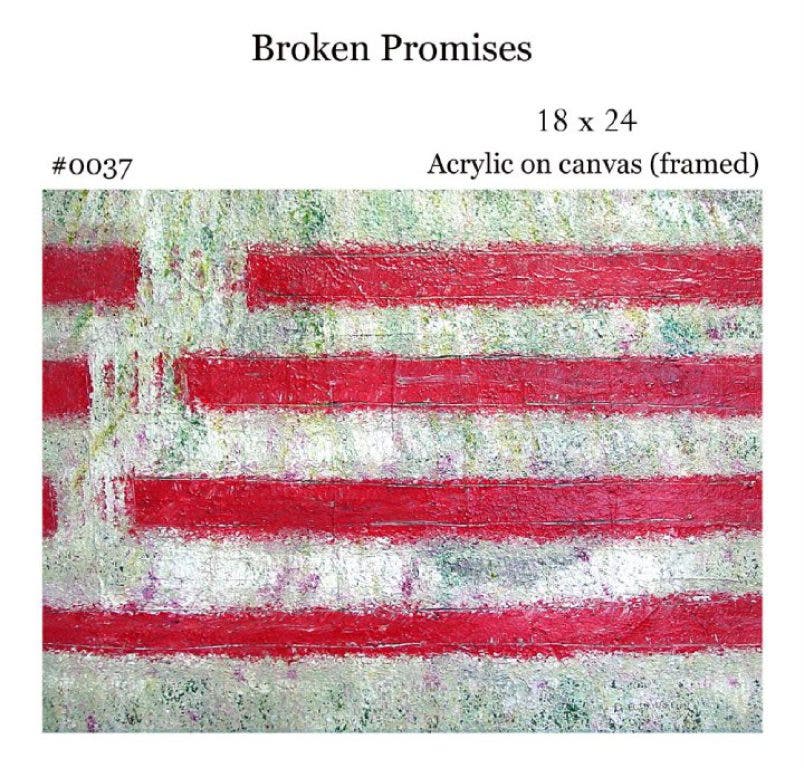
Many of his works evolved after multiple layers of paint into fascinating and striking abstracts. These pieces are like snapshots of Eldridge's mind; most are emotionally based and he lets his paintings flow naturally.
“The art comes out of the canvas to me. I start seeing shapes and patterns. A lot of my abstract work is that way.”
The biggest highlight of Eldridge's artistic life, according to him, is the piece he auctioned during a Magic of Life event by the Georgia Cancer Foundation. Each year, this event features an artist who is either a cancer survivor or someone related to a cancer survivor. In 2002, Eldridge was chosen to be featured and produced an abstract boat scene printed on canvas for the silent auction. He autographed T-shirts for thousands of people and was able to inspire other cancer patients with his story.
“That was the highlight for me: me having cancer at that point and trying to help people is as good as it gets. To see some of those people who are still alive today, if I influenced even a few of them then I've done my part,” Eldridge said.
He appeared to have made that impact because in 2010 he met a woman at therapy who carried one of these T-shirts in her purse hoping to run into him for an autograph.
He typically donates approximately 50 percent of his profits to charity and is always looking to donate a piece for a charity auction. Currently, he is working on a series he has named “Serenity”. This series involves him trying to find peace with what lies ahead of him.
“It's always a picture of my back because I'm trying to find serenity out there. I put myself in the painting.”
Though painting is becoming more and more difficult for Eldridge, he still completes about a painting a month. He is hopeful, however, because his most recent test results show that his cancer is at the lowest level it has reached in three years.
“Dr. Mansoor Saleh of Georgia Cancer Specialists, he's kept me alive all these years," Eldridge said. "He's been my doctor since 2005, and he's a research professor from UAB in Birmingham. I'm his poster child. He says:,'You've got more lives than a cat.' I'm very fortunate."
He will continue to paint as a form of therapy and is immensely thankful to his family for their support and encouragement. He knows what he needs to do to stay in control of his mind and urges others dealing with trauma to do the same.
“That's why my paintings came about, to fight depression. You have to find an outlet. You have to have somewhere to put your mind, because your mind can either make you live longer or kill you."
Though he admires artists like , he doesn't feel that commercial success is the end all be all of his artistic existence. He realizes that the true worth in art lies in the emotions it can relieve or inspire. Eldridge sees everyone as having talent in some area, and advises people to pursue their gifts.
“If you can't find commercial worth that makes you money, find something that makes you rich inside. All the money in the world can't get you happiness.”