Seasonal & Holidays
Fall Foliage Peaking Across Northern Illinois
A tool meant to gauge the best time to see fall colors across IL shows foliage will peak over the Oct. 26 weekend.


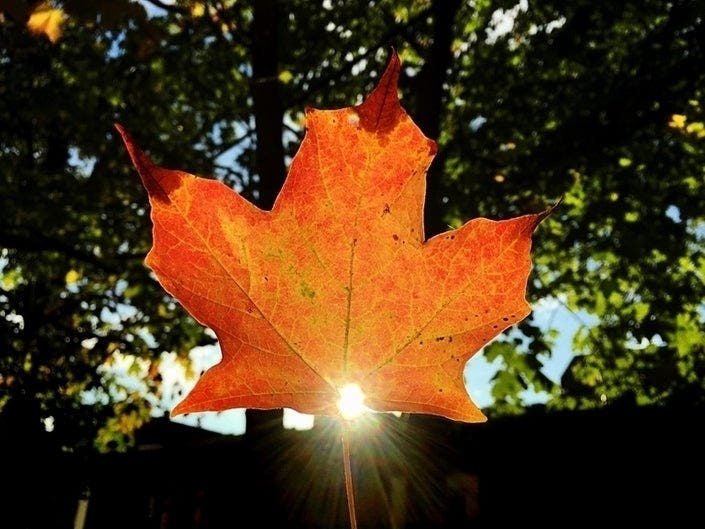
ILLINOIS, IL — One of nature’s greatest shows is on display across northern Illinois: the fall foliage peak with its blazing red leaves as well as shades of vibrant oranges and sunny yellows. And this is the weekend to get out and enjoy it in the Chicago area, according to the Fall Foliage Prediction map, which is a handy tool to help you plan excursions when fall foliage should be at its most spectacular.
The Oct 26 weekend is the weekend for peak fall foliage across Illinois and the Chicago area and by next week, the most brilliant of colors should be centered in central Illinois area, according to the foliage prediction, which is found on the Smoky Mountain National Park website and includes predictions for all 50 states. Fall colors are expected to peak in far southern Illinois by mid-November.
Our state offers some stunning vistas, including several in state parks:
Find out what's happening in Crystal Lake-Caryfor free with the latest updates from Patch.
- Starved Rock State Park in LaSalle County is renowned for its beauty, especially in the fall. It's even been named Conde Nast Traveler's Most Beautiful Place In Illinois and Thrillist's Best Illinois State Park.
- Matthiesen State Park, LaSalle County: When you're done exploring Starved Rock, head a few miles south to Matthiesen State Park, also located along State Route 178.
- Mississippi Palisades State Park, Savanna: This scenic destination, just a three-hour drive from Chicago, was one of Patch readers' best family vacation destination picks in 2018 and offers boating, camping, fishing, hiking, geocaching and more, and has easy access for Mississippi River steamboat rides.
- Giant City State Park, Makanda: A shooting location for 2014's "Gone Girl" and another Best Family Vacation destination pick, this park close to Carbondale has hiking, fishing, boating and more.
- Pere Marquette State Park, Grafton: Located along the Mississippi River, this 8,000-acre state park is a "nature lover's paradise," and is "famous for the exceptional beauty of its fall colors and for its wintering bald eagles," according to the Illinois Department of Natural Resources.
View this post on Instagramশীতের আগে রঙীন কিছু ঝরা পাতার গল্প! #fall #foliage #chicago #illinois #starvedrockstatepark
A post shared by Hassan Zamir (@zamee_) on Nov 13, 2018 at 6:38pm PST
In addition, Enjoy Illinois, a website ran by the Illinois Office of Tourism, offers up these picks for great places to check out in the Chicago area and beyond as the fall colors change:
- The lush woods that make up over 10,000 acres of protected land at the Forest Preserves of Winnebago County
- In Chicago, the fall trees are a great excuse to visit sites such as Millennium Park with its iconic Cloud Gate
- Located in Lisle, the Morton Arboretum celebrates with fall-themed events among 1,700 acres of seasonal splendor
- Galena, an idyllic river town surrounded by tree-lined hilltops
- Drives from Alton to Grafton along the Great River Road
- The town of Monticello, home to the 1,517-acre Allerton Park
- The area around beautiful Lake Decatur, including the Rock Springs Nature Center
View this post on InstagramLast pic from my fall set • • • #artofvisuals #agameoftones #illgrammers #fatalframes #moodygrams #citygrammers #streets_vision #justgoshoot #thecreatorclass #trappingtones #ThisIsChicago #Chitecture #ExploreChicago #Instagram312 #thechieye #igerschicago #artofchi #eyeinthechi #thisismychi #chi_shooters #chitecture #choosechicago #chicity_shots #redeyefollow #chicagopulse
A post shared by Mathew Patria (@mathewpatria) on Nov 19, 2018 at 5:32pm PST
Have a favorite fall foliage destination in Illinois? Let us know in the comments
Find out what's happening in Crystal Lake-Caryfor free with the latest updates from Patch.
If you’re planning a trip south in the coming weeks, the Fall Foliage Prediction Map can help you pinpoint the best dates for a visit.
"The predictive fall leaf map helps potential travelers, photographers and leaf peepers determine the precise future date that the leaves will peak in each area of the continental United States. By utilizing the date selector at the bottom of the map, the user can visually understand how fall will progress over a region,” data scientist Wes Melton, the website’s chief technical officer, said in a statement.
“We believe this interactive tool will enable travelers to take more meaningful fall vacations, capture beautiful fall photos and enjoy the natural beauty of autumn,” he said. “Our nationwide fall foliage prediction map is unique — it is one of the only fall leaf tools that provides accurate predictions for the entire continental United States."
The major factors that determine the fall foliage peak are sunlight, precipitation, soil moisture and temperature.
“Nothing is 100 percent accurate,” David Angotti, the cofounder of the website told Patch, but the tool “gets pretty darned close.”
Of course, “we can have a brilliant fall, and Mother Nature can come in with a wind storm and rip those leaves off in minutes,” Angotti said.
The website refines its predictive algorithm every year, using hundreds of thousands of data points from private and government sources, including historical and forecasted temperatures and precipitation data from the National Oceanic and Atmospheric Administration, historical leaf peak trends and peak observation trends.
New maps are created from scratch every year using new data that reflects the drastic year-to-year changes, and the prediction becomes more accurate as the foliage peak nears, Melton said.
Where To Find The Best Fall Color
Angotti and his team monetize the Fall Foliage Prediction Map with Smoky Mountain cabin rentals.
“At the time we started, we had a lot of people asking about fall color in the Smoky Mountains,” Angotti said. “We didn’t want to give people bad advice, so we started talking with a meteorologist. The first year was pretty accurate and was very well received, and people were asking, ‘Are you going to do it again?’”
That was six years ago.
“It’s our M.O. now,” Angotti said. “We don’t have a choice.”
He admits some “bias that Tennessee has some of the best leaves in the country.”
“I honestly do believe that,” Angotti said, “but you’ll also find good color in the Blue Ridge Mountains; up in the Northeast corridor, especially Vermont and even into Virginia; the Poconos in Pennsylvania; the Colorado aspen trees; and in a lot of different areas of the country.”
What Causes The Different Colors
You probably remember from science class that the color change all starts with photosynthesis. Leaves constantly churn out chlorophyll — a key component in a plant’s ability to turn sunlight into the glucose it needs to stay healthy — from spring through early fall. Those cells saturate the leaves, making them appear green to the human eye.
But leaves aren’t green at all. Autumn is the time for leaves’ big reveal: their true color, unveiled as chlorophyll production grinds to a halt. The colors in fall’s breathtaking tapestry are influenced by other compounds, according to the national park’s website.
Beta carotene, the same pigment that makes carrots orange, reflects the yellow and red light from the sun and gives leaves an orange hue.
The production of anthocyanin, which gives leaves their vivid red color, ramps up in the fall, protecting and prolonging the leaf’s life on a tree throughout autumn.
And those yellows that make you feel as if you’re walking in a ray of sunshine?
Get more local news delivered straight to your inbox. Sign up for free Patch newsletters and alerts.