The Fuller Park neighborhood in Chicago has homicide rates comparable to actual war zones, an August 2026 report finds. A new study by Walner Law examined crime statistics across all of Chicago to reveal which districts residents are better off avoiding.
- Fuller Park's homicide rate is 10 times higher than the Chicago average, making it the city’s deadliest neighborhood.
- 1 in every 30 residents in West Garfield Park falls victim to robbery, assault, or battery each year.
- At least one person gets shot in Greater Grand Crossing every three days on average.
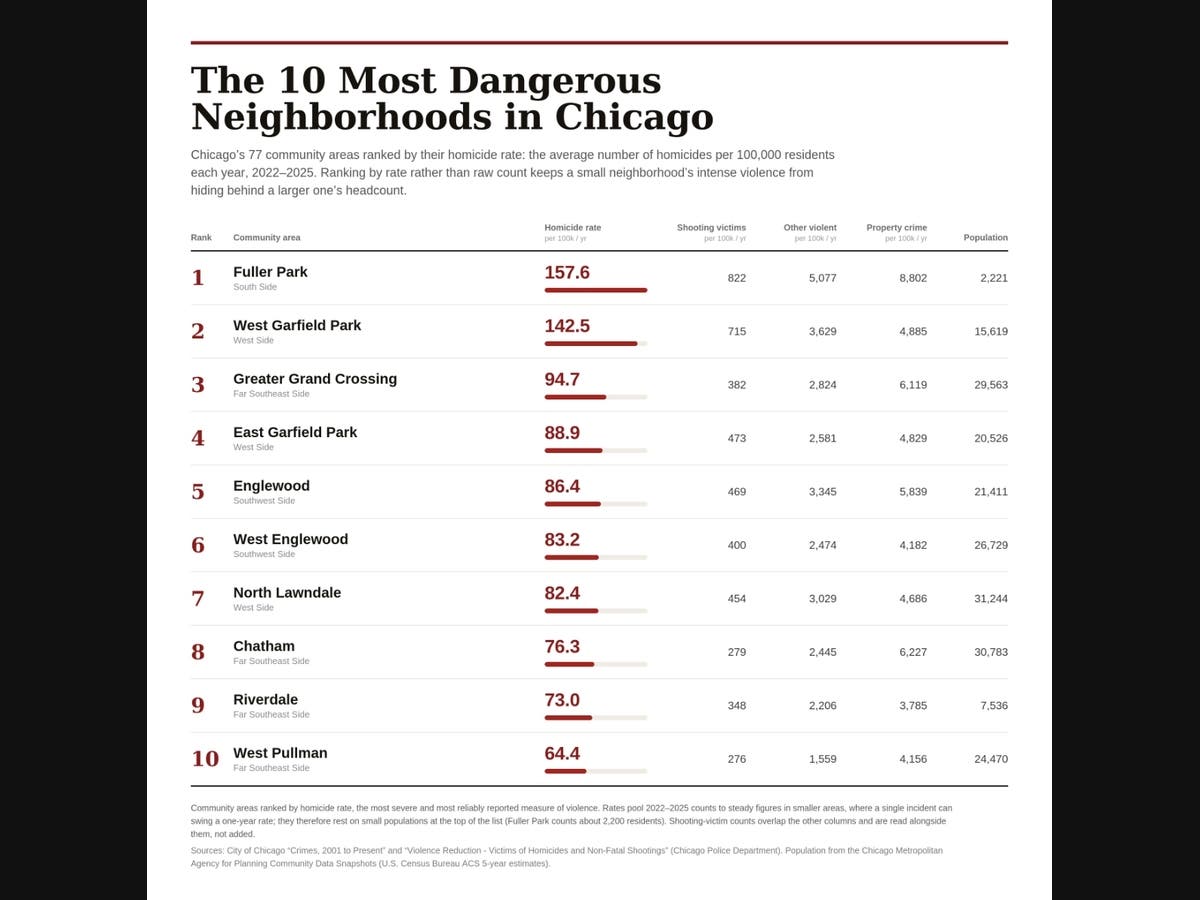
The research examined crime statistics across all 77 of Chicago's official community areas to find which neighborhoods are most dangerous. The report tracked homicide rates, violent crimes including robbery and aggravated assault, shooting victims, and property crimes like theft and burglary. Every figure was converted into a rate per 100K residents, so smaller neighborhoods could be compared more accurately against larger ones. Here's a look at the 10 most dangerous neighborhoods in Chicago:
You can access the complete research findings here.
Find out what's happening in Downers Grovefor free with the latest updates from Patch.
1. Fuller Park
- Homicide rate: 157.6 per 100K residents per year
- Population: 2,221
- Other violent crime rate: 5,076.5 per 100K per year
- Shooting rate: 821.7 per 100K per year
- Property crime rate: 8,802.3 per 100K per year
Fuller Park is Chicago's most dangerous neighborhood. Every year, roughly 3 to 4 people are killed here, and another 18 are shot, in a community of just over 2K residents. Assaults and robberies are also constant, with 110 violent offenses recorded annually. On top of that, around 1 in 11 residents falls victim to burglary each year, the worst property crime rate in the entire city
Find out what's happening in Downers Grovefor free with the latest updates from Patch.
.2. West Garfield Park: West Garfield Park records 22 homicides a year, more than one killing every two weeks. Gun violence is a problem of similar scale as well, with 112 people shot annually. Beyond the deaths and shootings, residents here also deal with over 2,000 robberies and batteries every year, making violent crime a near-daily reality in this neighborhood.
3. Greater Grand Crossing: Greater Grand Crossing averaged 28 killings a year, one of the highest death tolls in Chicago. Another 113 people are injured in shootings annually, also ranking among the city's worst figures. That actually means someone is shot in this neighborhood once every three days on average. Residents here also frequently fall victim to thefts, with nearly 3.5K property crimes reported over four years.
4. East Garfield Park: East Garfield Park reported more than 70 homicides over the study period, averaging around 18 killings a year. Nearly 100 people are shot here annually, and violent offenses including robbery and aggravated assault cross 2,000 incidents every year. For a neighborhood of just over 20K people, that works out to roughly 1 in every 40 residents facing serious violence each year.
5. Englewood: Englewood rounds out the top five most dangerous neighborhoods in Chicago. The district averaged 18 homicides a year across the study period, with another 100 people shot annually on average. The police here also report over 2,700 violent incidents per year, including aggravated assaults. Property crime is equally bad, with nearly 1 in 10 residents losing something to burglary.
Managing Attorney Jonathan Walner from the Walner Law commented on the study: "Crime data like this tends to shape real estate decisions. When homicide rates are this far above the city average, residents who can leave often do, which reduces the tax base and commercial activity that the neighborhood needs to recover. Chicago has seen this pattern in Englewood and Garfield Park for years. Reversing it requires sustained investment over a long period, not just in policing, but in jobs, schools, and housing."