Politics & Government
Evanston Asks Federal Judge To Dismiss Skokie Water Lawsuit
Skokie aims to "generate headlines" with a suit in order to get an "undeserved discount" on water rates, according to Evanston's attorneys.


CHICAGO — The stream of claims and counterclaims in the battle over water prices between neighboring suburbs continued flowing this week in a filing Tuesday in U.S. District Court in Chicago. Skokie's federal lawsuit claiming civil rights violations when Evanston raised the wholesale price of water is a "meritless" endeavor to get media attention and should be thrown out, according to lawyers for Evanston.
The village wants "to generate headlines and create political pressure in hopes of forcing a discount on the price of the Lake Michigan water it purchases from Evanston," according to a motion to dismiss the case from Derke Price of Ancel Glink, the outside law firm representing Evanston in the case.
Price argued the federal lawsuit is part of Skokie's "long standing effort to avoid paying the actual cost of the premium water service it requests and receives" and just aimed at getting a better deal on the wholesale water rate. The dispute, he argued, belongs in state court.
Find out what's happening in Evanstonfor free with the latest updates from Patch.
Filed June 20, Skokie's federal lawsuit named the village, a local nut company and three residents as plaintiffs. It argued their constitutional rights to due process and equal protection were violated when talks over a new water supply contract failed to lead to an agreement.
But the motion to dismiss the suit said those private citizens have no relationship with Evanston and will never have standing to sue it. Plus, the village does not qualify as a "person" under the Fourteenth Amendment and cannot claim its civil rights were violated, the lawyers argue.
Find out what's happening in Evanstonfor free with the latest updates from Patch.
Skokie's suit also claims Evanston officials hid a looming budget deficit from voters ahead of last year's election before trying to plug a "growing $10 million municipal deficit" with "discriminatory" new water rates. Attorneys for Evanston said the the whole claim was fatally flawed because the basic premise of the suit is false.
"The entire pretext of the complaint is that Skokie has a federally guaranteed fundamental right to receive water from Evanston," according to a brief accompanying the motion. "Not true. There is no fundamental right to water (much less water from Evanston.)"
Skokie's complaint alleges there is a requirement in state law requiring Evanston sell water "to any municipality at the same price as it sells to all other municipalities." The claim is footnoted with a reference to section 26 of the Metropolitan Water Reclamation District Act, a state law that says no such thing.
In fact, the Illinois law restricts municipalities from charging people outside its borders more than what it makes its own residents pay. Evanston makes local customers pay over a third more than the price it wants to charge Skokie.
Michael Lorge, Skokie's village attorney, did not respond to a request for clarification Wednesday about the seemingly false claim included in his complaint.
Last September, Evanston alderman voted to raise Skokie's water rate to $2.06 per 1,000 gallons. The day after the vote, Evanston's law department filed suit in Cook County court seeking a judge to enforce the new price. The Illinois law cited by Skokie in its federal claim said any dispute over rates should be handled by county court.
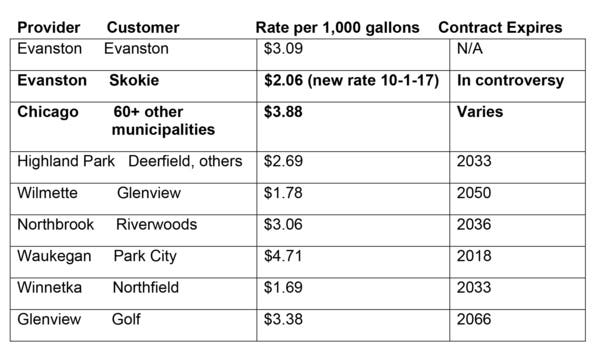
Skokie has not only refused to pay the new rates, it actually took a discount, officials in both towns confirmed. Evanston's motion points out, and Patch has previously reported, the village unilaterally gave itself a discount last October after Evanston filed suit. Skokie now pays Evanston just 10.4 cents per 1,000 cubic feet, whereas its residential customers are set to pay $45.92 for the same amount by the end of the year.
Skokie village officials said they tried in good faith to negotiate a fair deal with Evanston for more than a year, including offering to use a third-party mediator.
Village Manager John Lockerby said there was no "credible" reason for the new rates.
"Evanston leaders stated that they would prefer to leave it to the lawyers," he said.
Skokie has so far refused to release any records of its communications with Evanston regarding water that could substantiate public statements made by its officials.
In a denial of a request for public records, the village claimed letters sent from Evanston stuff were "used, prepared, and/or advised by attorneys" and therefore qualified as privileged communications. Skokie's denial remains under review by the Illinois attorney general's office, which has previously found the village improperly withheld billing records related to its use of an outside law firm in the case when it claimed the same exemption.
Price' motion suggests naming Evanston elected officials as defendants in the federal complaint was a publicity stunt.
"As Skokie knows," it argued, "the individual defendants it named in order to garner headlines are immune from suit and should be dismissed with prejudice."
Evanston Mayor Steve Hagerty, who was not in office during much of the negotiations, denied the assertion that the city had failed to negotiate in good faith. Skokie, he said, must "pay its fair share" after getting an unsustainable and unfair "huge subsidy" for years.
"Once the courts have weighed in," Hagerty said, "I hope that Skokie will remain a valued customer of Evanston."
Meanwhile Evanston is picking up new customers as more northern Cook County communities turn off the tap from Chicago's more expensive water system. Construction for the Morton Grove Niles Water Commission has included placing 4 miles of new water mains through Skokie, which are expected to come on line at the end of the year. And on Monday, the Evanston City Council approved the sale of water to Lincolnwood.
The Cook County lawsuit (2017-CH-12966) was put on hold as Circuit Judge Celia Gamrath decided to wait to see what happens in the federal case.
U.S. District Judge Charles Kocoras set a status hearing for Aug. 11 in the federal case (18-CV-04289), for lawyers for both sides to report on any possibility of a settlement and the anticipated length of the discovery process.
Brief filed Aug. 14, 2018 in support of Evanston's motion to dismiss Village of Skokie et. al. v City of Evanston el. al:
Related
- Skokie Raises Prices On Consumers While Unilaterally Cutting Wholesale Payments
- Skokie Sues Evanston Saying New Water Rate Violates Civil Rights
- Skokie Calls Evanston Water Lawsuit 'Reckless And Hostile'
- Evanston Sues Skokie To Enforce Water Rate Hike
- North Shore Water Rates Vary Widely
Get more local news delivered straight to your inbox. Sign up for free Patch newsletters and alerts.