Health & Fitness
U.S. Army collaborates on joint suction-cup project inspired by the octopus
An improved robotic grasping capability could increase the effectiveness of robotic operations and help emergency response teams observe areas of devastation at dangerous locations.


ABERDEEN PROVING GROUND, Md. – Natural disasters like earthquakes, hurricanes and tsunamis can unveil points of weakness in man-made infrastructure, and now robots are being called in to lend a helping hand. Scientists at the U.S. Army Research Laboratory (ARL) and the Edgewood Chemical Biological Center (ECBC) at the Edgewood Area of the Aberdeen Proving Ground are developing suction cups that could one day be featured on robots designed to perform tasks in unstructured and contaminated environments.
The self-sealing suction cup is a collaborative project between the two Army laboratories and the University of Maryland, where Chad Kessens, a robotic manipulation researcher for ARL, is pursuing his doctorate degree in Mechanical Engineering under the advisement of Professor Jaydev Desai. As part of the Ph.D. program, Kessens decided to test the limits of robotic grasping by developing a new suction technology to expand the range of graspable object shapes and sizes. An expanded grasping capability could improve the way emergency response teams observe areas of devastation by increasing the effectiveness of robotic operations while reducing human risk at dangerous on-site locations.
“Manipulation of unknown objects is a very difficult task for a robot. In traditional applications, the robot would have a model for the object it wants to pick up, and would then know how to pick it up. The self-sealing suction cup design could enhance grasping technology, making grasping of unknown objects easier,” Kessens said.
Find out what's happening in Aberdeenfor free with the latest updates from Patch.
On Dec. 7, a 7.3-magnitude earthquake was measured by the U.S. Geological Survey off the coast of Japan, shaking buildings in Tokyo and causing a small tsunami to revisit an area that was destroyed by the Fukushima-Daiichi disaster in 2011. Last year, a 9.0 earthquake killed nearly 20,000 people and led to widespread devastation when the nuclear power plant experienced fuel-rod meltdowns that caused unchecked radiation leakage and contaminated foodstuffs and water in what Reuters called “the world’s worst nuclear crisis in 25 years.”
“When something like Fukushima happens, it would be very useful if the robots that are sent in could perform some sort of manipulation activity like closing a valve, recovering an object or operating a tool in a contaminated area,” Kessens said. “Even opening a door or a hatch could allow the robot to better observe what’s going on inside the reactor while eliminating the risk of exposing people to radiation.”
Find out what's happening in Aberdeenfor free with the latest updates from Patch.
Inspired by the octopus, Kessens’ design features a self-sealing component that imitates the sea creature’s ability to individually actuate suction cups based on the object it wants to pick up—from large and small fish to rocks and even a jar of peanut butter. Though suction technology has been applied to the robotics field since the 1960s, it has been limited in its scope and practical only for objects with a specific size and shape. According to Kessens, a traditional suction grasper uses one vacuum pump as a central suction source, which limits the effectiveness of the technology for grasping if some cups on the grasper do not attach to a given object, creating leak points where air enters at the point of engagement.
Instead, Kessens is modifying the technology so a robot could grasp a large range of items by maximizing the strength of the suction. The self-sealing suction cup features a plug that sits nominally in the suction inlet. When the source pump is turned on, the plug of any cup not in contact with an object gets sucked in, sealing itself. This increases the pressure differential and strengthens the suction capability of the cups that are engaged on an object. The design also uses passive reaction forces that cause the cup to activate and open when the lip contacts an object, breaking the seal to initiate suction.
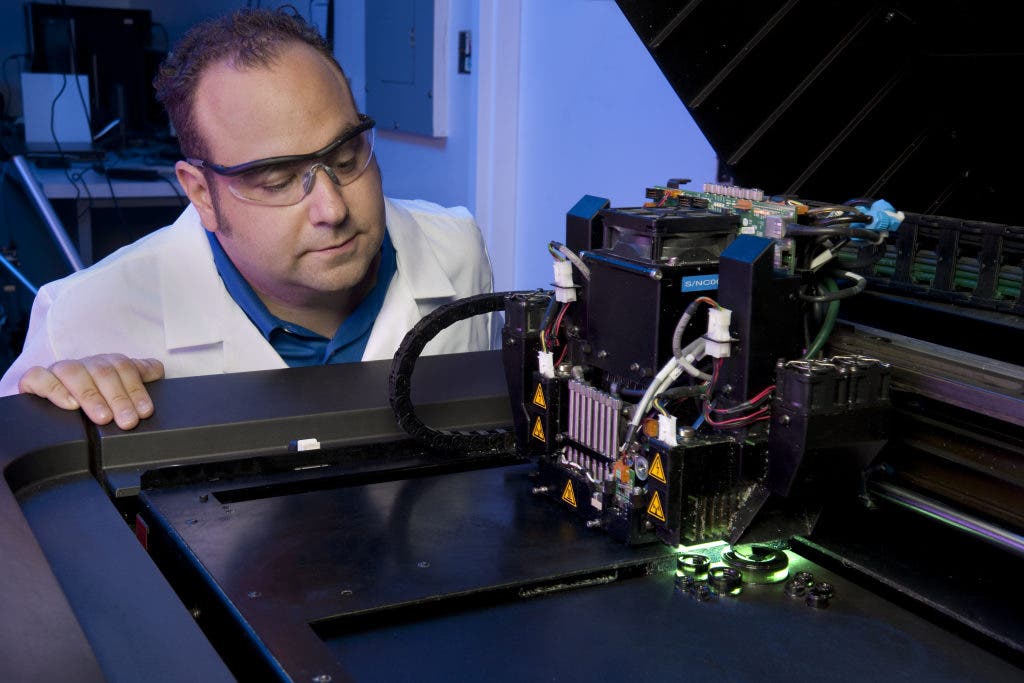
The joint project between ARL and ECBC is currently in the middle of its lifecycle, however, and comprehensive testing of the prototype still needs to be done, said Kessens. While the ARL scientist provided the concept and design, it was ECBC that generated the prototypes through its expertise in rapid prototype manufacturing. According to Brad Ruprecht, engineering technician and senior model maker in the Advanced Design and Manufacturing Division of ECBC’s Engineering Directorate, the biggest challenge was determining how small the cups could be while still making them functional. Part of the process was ECBC’s design capability, including experienced engineering personnel and advanced equipment, to craft a prototype using a multi-material 3D printer.
“What I loved about the project is Chad came to ECBC first and foremost because we had the multi-material machine, and he leveraged that to get a working model right off of the 3D printer,” Ruprecht said. “It has levers and springs and everything else needed to be a working prototype, and it’s worked very well for him. He’s received a lot of good data from it and is definitely moving forward with his designs.”
Ruprecht used the 3D printer to create prototypes composed of elastomeric materials such as a liquid photo polymer that solidifies into plastic once exposed to ultraviolet light, and more rigid materials like nylon. In about 20 minutes, the ECBC engineer could produce 20 prototypes of various shapes and sizes.
Now on its fourth iteration of the design, the self-sealing suction cup ranges anywhere in size from the palm of a hand to the point of a fingertip. Four fingertip cups can pick up a bottle of wine. The next step is developing a substrate such as a hand or tentacle, where the cups would be located on a robot. Until then, there are plenty of prototypes to finalize the design and conduct testing.
The collaborative effort between ARL and ECBC demonstrates a desire to improve technology, share resources and utilize the expertise of personnel working in laboratories across the U.S. Army Research, Development and Engineering Command.