Traffic & Transit
Bay Bridge Traffic Jams Could Be Curbed With 24-Hour Work: Hogan
Maryland Gov. Larry Hogan shared some ideas Wednesday to cut down on Bay Bridge traffic delays while repairs are under way.


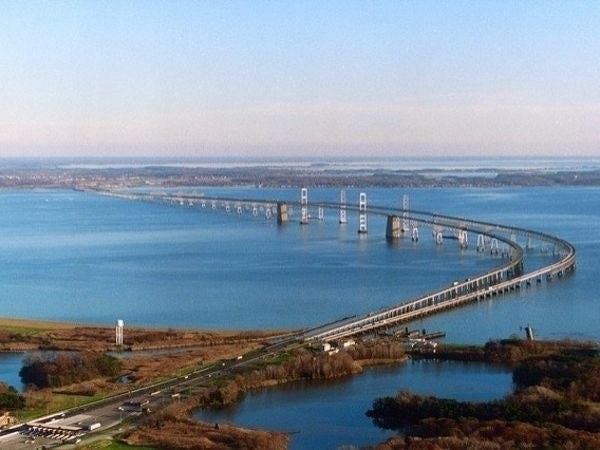
ANNAPOLIS, MD — Gov. Larry Hogan said he was "furious" about the extreme traffic gridlock that continues on the Chesapeake Bay Bridge because of the $27 million repair project under way. However, Hogan said during the Maryland Board of Public Works meeting Oct. 16 that delaying work, as some have proposed, could lead to “catastrophic” and potentially life-threatening safety risks.
Hogan said during the meeting that state officials cannot do anything to alleviate the sometimes miles-long traffic backups and make them “magically disappear.” But Hogan did promise to take action to ease some of the headaches and expedite the two-year project, including:
- Ordering contractors to work on the bridge re-decking project 24 hours a day.
- Eliminating all toll booths and moving to fully electronic tolling at the bridge “as soon as possible.”
- Considering the use of faster-drying concrete to speed up the project.
- Tasking state troopers with helping improve the flow of traffic.
Maryland State Comptroller Peter Franchot has suggested delaying the project until spring or summer, but Hogan said during the meeting that such an idea is not feasible.
Find out what's happening in Annapolisfor free with the latest updates from Patch.
“Delaying this critical safety work any longer would not only risk safety and potentially risk lives, but it would also turn the current project into an even bigger nightmare, which would take five years to complete and would cost the taxpayers more than eight times as much,” Hogan said. “That would obviously be even more unacceptable than the current situation.”
Maryland Secretary of Transportation Director Pete Rahn warned that delaying the project any further could have “catastrophic and life-threatening” repercussions, the Capital News Service reported.
Find out what's happening in Annapolisfor free with the latest updates from Patch.
“This is an issue, and it means the long-term safety of the people who cross this bridge,” Rahn said. “It would really be irresponsible of us to neglect this bridge any longer.”
The Bay Bridge first opened in 1952 and the second span was added in 1973. Important maintenance and repairs have been repeatedly postponed for upwards of a decade, leading to safety issues, officials have said. The deck surface on the westbound lane of the bridge is deteriorated beyond the end of its service life, Hogan said. In one section of the lane, 75 percent of the area is deteriorated, he said.
“The condition is worsening every single day,” Hogan said. “If neglected any longer, the crisis could go from terrible and unbearable, to catastrophic and life-threatening.”
Hogan noted that postponing the project would cost an estimated extra $200 million and take five years to complete instead of the anticipated two years.
During the meeting, Franchot insisted it was unacceptable that traffic delays on the bridge are causing school buses to arrive late, holding up emergency vehicles and impacting businesses negatively. On the first Friday after the project began, media reports indicated a 14-mile backup with about 10 hours of delays.
“I guess it comes down to whether we want to do this project the right way, or just press on with it because it’s already began,” said Franchot.
However, there are traffic hold-ups that just cannot be avoided. For example, the contractor must water-blast under the rebar that crisscrosses the roadbed, but in order to keep debris out of the Chesapeake Bay, the water must be vacuumed by a vacuum truck parked in a lane, thereby needing to reroute traffic safely around the truck.
“This is a very elaborate ballet that has to occur a couple-hundred feet up in the air,” Rahn said. “It means that we have to keep traffic moving, it means that we have to have contractor’s equipment moving around and doing work in a very confined space.”
Currently, the right-lane closure on the westbound span is expected to continue through April 2020, with the possibility to extend until May, except during the Thanksgiving holiday, according to an MDTA press release.
From 9 p.m. to 5 a.m., the entire westbound bridge will be closed, relegating traffic to a one-lane operation per direction on the eastbound span. In the fall of 2020, and spring of 2021, similar closures will occur before the project’s estimated completion in August 2021, according to the release.
Officials continue to ponder where to build a second Chesapeake Bay crossing to help alleviate traffic backlogs. They have narrowed the list down to three, but Hogan said he will only accept adding a third span to the existing Bay Bridge.
The corridor where the existing Bay Bridge sits — between Annapolis and Queenstown — would relieve the most traffic congestion year-round, the Maryland Transportation Authority has explained. That route would best reduce backups at the existing Bay Bridge, provide the greatest reduction in the duration of unacceptable congestion levels and is more compatible with existing land-use patterns, according to study data.
The three possible locations for building a bridge are:
- Corridor 6: MD 100 to US 301 between Pasadena (Anne Arundel County), Rock Hall (Kent County) and Centreville (Queen Anne's County);
- Corridor 7: existing Bay Bridge corridor, US 50/301 to US 50 between Crofton (Anne Arundel County) and Queenstown (Queen Anne's County); and
- Corridor 8: US 50/301 between Crofton (Anne Arundel County) and Easton (Talbot County).
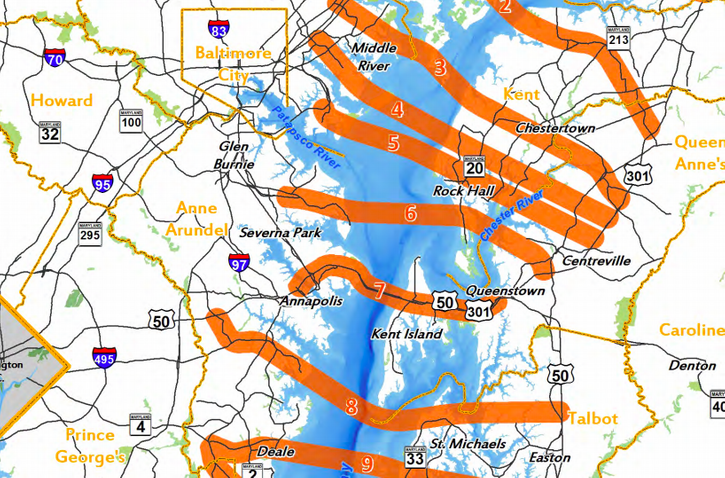
However, Anne Arundel County Executive Steuart Pittman opposes Hogan's "only option." All three of the Anne Arundel bridge options will be severely disruptive to existing communities and sensitive environmental areas, Pittman said. All three options could destroy parks along the Chesapeake Bay, at a time when the county is trying to expand public water access, he added. His description of the sites is:
- The northern crossing (Corridor 6) appears to go through Downs Park
- The middle crossing (Corridor 7) appears to go through Sandy Point State Park
- The southern crossing (Corridor 8) appears to go through Beverly Triton Nature Park
"The study's 2040 projections for Bay Bridge traffic are based on an assumption that the Eastern Shore will develop in ways that its communities oppose," Pittman said. "I suspect that residents will protect their Eastern Shore land from development interests, and that bridge traffic can be better addressed with the forward-looking public transit options that this study dismisses. If we haven't figured out how to get cars off the road by the time this bridge gets built, we'll have much bigger problems to confront than traffic. Let's not build yesterday's bridge tomorrow."
See More:
- Only 1 Option For New Bay Bridge Crossing Gov. Hogan Will OK
- U.S. 50 Traffic Backed Up A Dozen Miles Before Bay Bridge
- Bay Bridge Traffic Jams Prompt MDTA Toll Changes
- Zipper Merge Technique Recommended For Bay Bridge Construction
- Massive Traffic Delays For Miles On Westbound Bay Bridge July 7
- New Chesapeake Bay Bridge Options Provoke Debate
Get more local news delivered straight to your inbox. Sign up for free Patch newsletters and alerts.