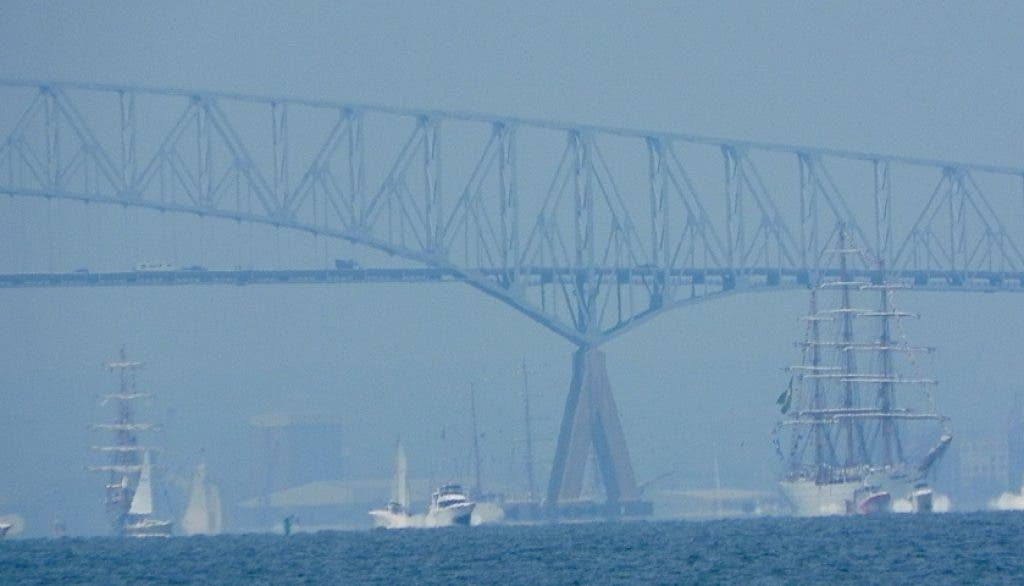


Sitting at Fort Smallwood with several hundred excited Denas, we watched the horizon eagerly for tall ships to appear under the Key Bridge. The morning air was cool so some were wrapped in blankets as navy ships from Canada whisked past on their journeys. Various size gray ships with flags draped from bow to stern could barely be seen in the mist and ashen waters. Chairs lined the bulkhead, people sipped coffee, read books, and dogs lay in the grass. I turned and thought about sitting between modern war ships passing in front of us and the remains of a gun defense from a hundred years ago behind us. Fort Smallwood was not like Ft. McHenry which was built over two hundred years ago. And who was Smallwood?
Thanks to Wikipedia and my smartphone I discovered that he was born in 1732 and his parents, who were tobacco planters like most Marylanders, sent him to Eton, England for his education. His father and grandfather both served in the Maryland Assembly, which he also was elected to after being an officer in the French and Indian War. When the American Revolution began, he served as a Colonel and after being wounded twice served as a Brigadier General with George Washington. He distinguished himself in battle and after the war he was elected to Congress. However, shortly after, he was chosen for governor which he accepted. He never served as a Congressman. His picture is included in the painting of George Washington resigning his commission which hangs in the Maryland State House. He never married and his estate was named Mattawoman. Traveling in St. Mary’s County, I have come across that road and its name always stuck in my mind.
The fifteen or more navy ships disappeared down the Bay as more and more people arrived. While children played and rode bikes, the smell of hot dogs drifted in the breeze. The sun beat down on us and blankets were discarded for suntan lotion and hats. Water bottles replaced coffee cups and we waited for the tall ships to appear. Children scampered between the concrete projections behind me. What was this? I got out my phone again.
I discovered that in 1885 President Grover Cleveland wanted to improve our coastal defenses which had not changed since the Civil War. Naval warfare had greatly advanced with iron ships and long range cannons. He appointed the Secretary of War, William Endicott, to head a committee known as the Board of Fortifications. They worked on improving 29 coastal defenses, Fort Smallwood being one of them, with a design that was different from Ft. McHenry. It would employ an open top reinforced concrete wall that protected a few large disappearing guns that could be raised to fire and hidden to reload. The very walls which hid the guns remain here where children now play.
Having gone to the Inner Harbor by boat, I was eager to see the tall ships actually under way with their sails full. Sharing my binoculars with those nearby, we could see sprays of water from fireboats in Baltimore and The Pride of Baltimore II skimming quickly over the river. Four tall ships looking like ghost ships with their sails furled appeared on the far side of the Key Bridge. Murmuring excitement swept through the crowd.
“Look. I can see sails.“
“How many can you see?”
“I can’t quite make them out.”
Arms stretched pointing to the ships and children crowded closer to the bulkhead to look. Slowly they came drifting by us.
“They look so small!”
“I thought they would be larger.”
Sure enough, these huge tall ships were dwarfed by the immensity of the water and the huge container ships they passed. People gathered up their chairs and departed the past along with me.