Sports
Civil War-Era Baseball Thrives in Glen Burnie
The Arundel Excelsiors, a local baseball team that plays by the game's 1864 rules, opens its second season.
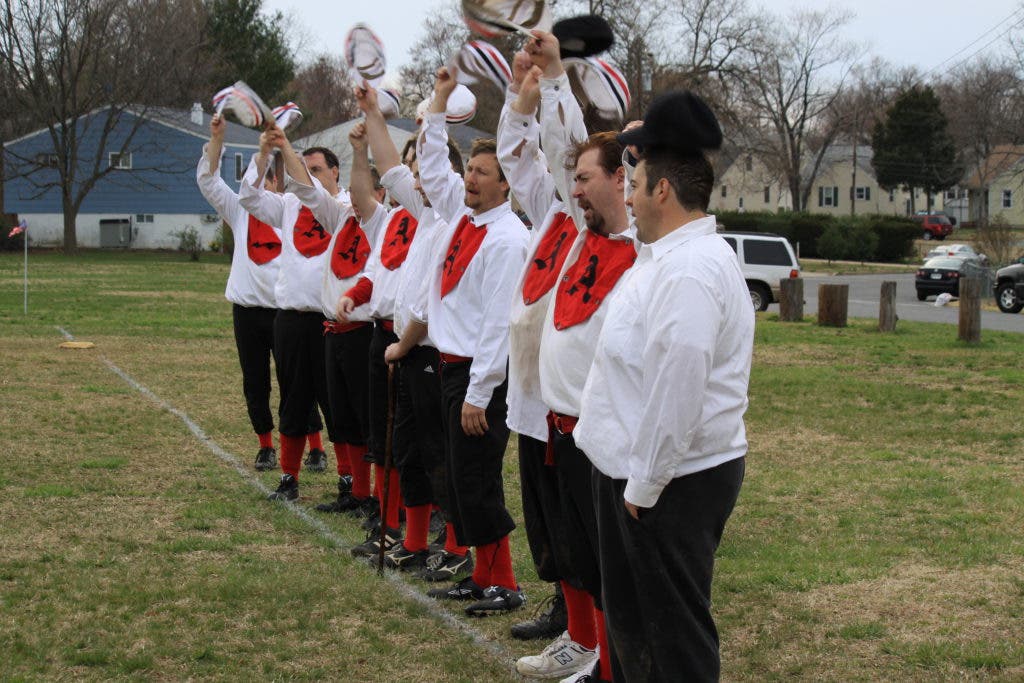


Every spring and summer weekend, recreational athletes take their turns at the home plates across the country, hoping to get big hits for their teams. The dreams of those who play for the Arundel Excelsiors, whose home ground is Recreation Acres Field on 4th Avenue in Glen Burnie, are no different—but much about their game is.
The Excelsiors play in the Mid Atlantic Base Ball League, whose games are governed by the rules as they existed in 1864, just as baseball was taking off in the United States. At that time, the sport was considered a recreational activity for gentlemen, with a particular emphasis on sportsmanship, and many of the game's early stars were, in fact, converted cricketers.
"I think its a good medium point between baseball and softball," said Chris "Five" Nicolo, the team's treasurer. "Not having gloves, it's more challenging than softball, and I also enjoy bringing back the history."
Find out what's happening in Glen Burniefor free with the latest updates from Patch.
Most Arundel team members agree that the game should focus on fun and sportsmanship, rather than intense competition. The Excelsiors are interested in welcoming anyone curious about their team and sport, and will happily include novices in the games.
The essentials of the sport are largely unchanged in these games, but some of the "throwback" rules have a considerable impact on the outcome. For example, if a fielder catches a batted ball on one bounce, the batter is still out, and if the catcher fields a foul tip cleanly, even after it hits the ground, the batter is also out. It should also be noted that, as in cricket, none of the fielders wear gloves.
Find out what's happening in Glen Burniefor free with the latest updates from Patch.
A central difference that spectators will recognize immediately is that the pitcher throws underhanded to the batters, or strikers. The umpire is referred to as an arbiter, and is less involved than a modern-day umpire. The arbiter may elect to make no call on a given pitch, and, rather than immediately call "strike one" or "ball one," he will usually issue a warning to the pitcher or the striker first.
The players wear uniforms that can cost nearly $200, and are modeled after the earliest professional baseball styles. These clothes must be custom-ordered, and the long-sleeved jerseys are intended to be worn even in the heat of summer, just as they would have been in the 19th century.
The bat and ball are familiar, but slightly different. The bat is less tapered than its modern counterpart, with there being less difference in the circumference of the barrel and handle. The ball is made of white stitched leather, but is softer than a baseball, and sounds like a softball when hit. The softer ball doesn't travel as far, either.
The Excelsiors were formed last year, and are comprised of members of varying athleticism, and varying devotion to 19th century history. Most were simply looking for an interesting alternative to the typical adult sport offerings.
"If the wins come, that's great, but the first thing is to have a good time," Excelsior Secretary Bart "Toe" Raeke said.
It seems that not every team agrees, however.
The Excelsiors' opponent on this day, the Cecil BBC of Chesapeake City, has a reputation as a club that is focused on winning, and this can sometimes rub other teams the wrong way.
Ahead by 20 runs late in the game, the Cecil players continued to play aggressively, including stealing bases, which the Arundel team found to be of dubious sportsmanship.
Some Excelsiors members unease at the competitive nature of the Cecil players is reflective of the changing game in the 1800s, as it was the introduction of this element that drove the game to professionalize later in the 19th century.
A leisurely pastime that once prized character and gentlemanly conduct above all else soon became the chosen sport for players like John McGraw and Ty Cobb, who were known for their "win at all costs" attitudes. The champion Baltimore Orioles of the 1890s were known for "dirty tricks" and were often accused of unsportsmanlike conduct on the field.
History may end up repeating itself with current 19th century baseball leagues, as there may be a need to separate recreational teams from competitive teams, for the sake of fairness.
Some things, it seems, never change.
Editor’s note: This story was updated at 10:11 p.m. Wednesday, March 6. This story also has been revised. An earlier version identified a number of people in photographs incorrectly. Photo identifications are now correct.