

What you're about to read is written by my colleague and fellow traveler Erin Lange.
Enjoy!
Andy
-----
First Day, First Impressions
Our first day of work at Jinsha Senior High School of Jintan began with jitters for all of us. I think we each had some shared apprehensions (had Larry Lee come through on the copies? How much English did these teachers really know?) and some that were specific to each of our assigned disciplines. For me, I was still adjusting to the idea of teaching drama for the next ten days. I mean, sure, in a former life, I was a burgeoning opera singer, dreaming of the majestic stages of La Scala and of Habanera-ing my way through an illustrious career full of divas and high notes. And, since being called to a far more challenging stage (the classroom), I have been the musical/drama director and/or conductor at every school at which I have taught (save Arundel). But in my life in its current manifestation at Arundel, I am the social studies teacher-varsity swimming coach-class advisor-Invisible Children (an advocacy group) advisor who gets a little too into reenacting scenes from World History and who wakes up sleepy students with a surprise rendition of Quando Men Vo. So, my drama-based pedagogical skills were a little rusty. Still, I was well-prepared with an armory of ideas and activities (and back-ups to those. And back-ups to the back-ups. A teacher can never be too prepared) and a healthy dose of optimism yet untouched by the menace of night school (Andy promised you more on that later).
Find out what's happening in Odenton-Severnfor free with the latest updates from Patch.
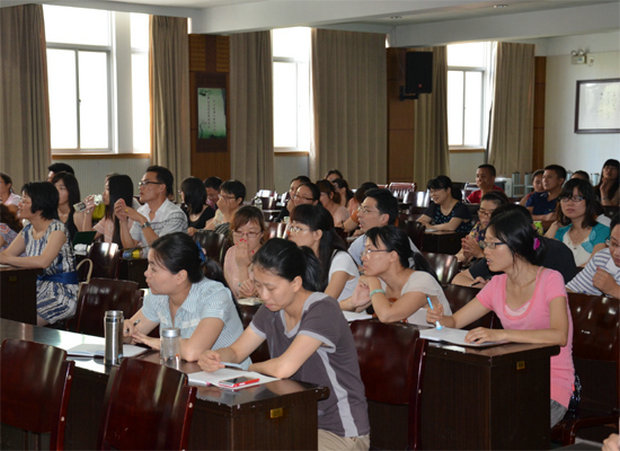
When we arrived at Jinsha Senior High, we were immediately ushered into what I later referred to as “the big room”—a cavernous space, with mahogany desks as far as the eye could see and a platform on which sat three officials who would run the opening ceremonies. As we entered the big room, we were greeted with a wall of eager, smiling faces—our students. The four of us looked at each other and whispered the same two thoughts. 1. “They are so young!” (we found out later that indeed they were not—most were married and had already had their government-allotted one child. If there is a fountain of youth, the Chinese have it) and 2. “Wait, we don’t have any time in our classrooms before we get started?” (This expectation that we would have time alone in our space to prepare and set up is rooted in American teaching culture, we soon discovered. The Chinese teachers do it on the fly, reflecting this general culture of sudden changes in plan).
Opening ceremonies were done mainly in Chinese, so Debbie served as our translator. This time was spent welcoming us and, more prominently, establishing expectations for our students, the teachers of Jinsha (be on time; no cell phones; participate actively in all activities). We chuckled that it sounded like a Principal Stratton speech to our own student body rather than to a group of professionals, but then again, teachers are notorious for being the worst students, so perhaps it was necessary (we would find out as the week progressed that it was).
Find out what's happening in Odenton-Severnfor free with the latest updates from Patch.
After opening ceremonies, we had to fight our way through the mass exodus of our one hundred students and various government officials in order to get to our classrooms before our first class began, later than planned and shortened to make up for that fact. Ah, changing plans!
Lessons Learned
By the time I arrived at my room, it was already half full with my first class of the day. I greeted everyone with what I hoped was a warm American smile that masked the apprehension I felt as I frantically began plugging in my technology. With the Chinese lecture about being punctual ringing in my head, I promptly started class with a rapid-fire, adrenaline-fueled introduction that left all my poor students sitting there stunned, having comprehended probably 1% of what I had said.
Lesson Number One— The Chinese actually rarely hear spoken English or have the opportunity to practice speaking it themselves. English classes in China consist of a Chinese teacher speaking in Mandarin to a room-full (read sixty-plus) of students, who repetitively read and copy things from handouts and books (if they are lucky). Therefore, we all learned to speak slowly, using as many one-syllable words as possible (or providing multiple synonyms for larger words), and pairing everything we said with charade-like gestures. We also adopted the Chinese-English syntax so that, by the end of the trip, we had a difficult time conversing normally with native-English speakers, as evidenced by the puzzled, annoyed looks we received from our significant others when video chatting.
After repeating my introduction much slower, already adopting the Chinese-English pattern of speech, I carefully described in detail, complete with mime-like motions, the ice breaker I had planned—Two Truths and a Lie. Each participant needed to come up with three statements about themselves, but only two would actually be true. It would be the class’s job to discern which was the lie. In my borderline-arrogant confidence in my new understanding of the classroom paradigm/culture, I thought it would be a good idea to employ the ever-popular teaching strategy of “Think-Pair-Share,” which allows for individual reflection, followed by partner discussion, and finally full-class participation. Pleased with my adaptability and with the way the activity was scaffolded in order to optimize the student’s comfort with sharing out, I checked for understanding and let loose my students to brainstorm individually and write out their two truths and one lie. Thus the echo-ing classroom erupted in a cacophony of Mandarin chatter.
Lesson Number Two—In the high-stakes educational environment in which all Chinese students learn, it is a common practice for students to, ahem, collaborate in order to get ahead. Moving forward, I had to be explicit in my expectations, whether I wanted my students to work individually or if cooperative learning was permitted.
I decided to allow the collaboration for this first activity so, after an appropriate amount of time, I asked the students to find a new partner to test out their truths and lie and instructed them to speak only in English. Another jumbled roar of Mandarin rose through the classroom, punctuated by the occasional English truth or lie. One of the more seasoned gentlemen teachers sat in the back of the room with his arms crossed over his chest. Trying to engage him got me a death stare. I backed off. Another gentleman decided it was time for a smoke break. A few others had out their phones and a couple even stepped into the breezeway to take or make phone calls.
Lesson Number Three—Teachers are the worst students. It doesn’t matter what culture, what language, we teachers want to be in charge of the classroom, doing what we do best. Sure, we love learning but on our terms. Mandatory professional development workshops are not on our terms. And when we don’t see the relevance, the merit, or frankly when we just don’t want to be there (and really, who wants to be forced to sit through lessons on how to use foreign teaching strategies when you are supposed to be on summer vacation?), we do things like fake important phone calls so we can step outside, pass notes like middle schoolers, and spend the given amount of collaboration time talking about things we find more interesting and then share out something profound that we come up with off the top of our heads, because, as teachers, off the top of our heads is an area in which we excel. In order to keep these teachers’ attention, I was going to need to be consistently explicit in how what they were going to learn in my classroom over the following ten days was going to immediately impact and improve the way they taught in their own classrooms.
With that noted, I refocused the class and explained how ice breakers were great ways to build relationships and breakdown walls in the classroom and how, specifically, “Two Truths, One Lie” could foster their students’ creativity and improve their comfort with the English language. Feeling satisfied that I had finally overcome the main obstacle to the overall success of my sessions, I asked for volunteers to share either their own truths and lie or their partner’s, if that would make them feel more comfortable… Not even crickets chirping. Dead silence. Blank stares. Averted gazes.
Lesson Number Four— In China, the general population love Americans. They recognize that we are leaders in creativity and ingenuity. Nearly every Chinese parent wants to send their precious little emperor or empress to America to go to school. And they recognize that, in order for their children to be successful in America, they need to learn to speak English, so much so that we were like celebrities everywhere we went in China but especially in Jintan, where westerners are extremely uncommon. At the grocery store, Sarah Lynne and I caused a traffic jam in the produce section as people openly stared at us. At the mall or our hotel when we rode elevators with families, the parents would vehemently nudge their children into speak to us. Even just strolling around in the open market or admiring tourist attractions, we were stopped by people wanting to take a photo with them. They love Americans. So I was puzzled at my students’ silence until I realized that it is a truly a daunting task to speak a foreign language to a native speaker. No one wanted to be the one to make that grammatical mistake or mispronounce a word in front of my colleagues and I. Moving forward, I had to acknowledge that what I was asking of my students would indeed make them uncomfortable and move them outside their comfort zones (one of many common phrases they didn’t quite grasp at first). I also rewarded students who took risks, mainly with Berger cookies and Old Bay (both huge hits). Some may call it reactive bribery. I call it positive reinforcement.
As my class progressed and we finally moved past the ice breaker, I gave my students a pre-test to assess their current level of knowledge about western drama constructs and vocabulary. My students freaked out and began talking in rapid-fire Mandarin to their colleagues. Hands frantically shot into the air and, as I began walking around to address each student’s concern, I realized that they were all incredibly stressed out by the simple idea of a test, despite the fact that I had emphasized its purpose as an assessment of their knowledge so that I could shape my instruction for the remaining nine days. They heard the word “test” and their collective blood pressure sky-rocketed.
Lesson Number Five— There are two truths I learned about Chinese education during my time in Jintan. The first is that, in China, there is no differentiated instruction, no individualized education plans, and no accounting for unique learning styles. Creativity is not important. That is one of the reasons they so admire Americans (that we do value and encourage creativity). During the time we were at Jinsha Senior High School, there was a 2000-student art camp running on the floors above us. We had the opportunity to visit those classrooms, where we saw hundreds of students in a room, each drawing or painting the same image as every other student, being scrutinized by a master teacher. Every other subject is taught in the same fashion. Each student does the same thing as his/her peers and hopes to come out on top. Pre-tests do not exist in China. No one cares what you already know. The teacher’s job is to teach his/her curriculum and to get you to pass the test… Which brings me to the second truth I learned about school in China… Chinese education is rooted in high-stakes testing. Most Chinese students spend an extra two or three hours at an additional school learning how to pass the exam that will determine if they will continue on the more lucrative path toward higher education or be sidelined to a technical or vocational school. Once a student has been put on that path, there is no turning back-- no American dream of doing or being anything you want to be. The test basically determines the rest of a student’s life path and so it is the focus, always.
After I finally calmed down the group as a whole, I began going over the pre-test with the class, asking for volunteers (which never worked. There were never volunteers. I always ended up having to call on some poor soul who was trying desperately to look preoccupied with anything that didn’t involve eye contact with me) to demonstrate the depth of collective knowledge there was in the class. The last part of the test was an excerpt from the script from The Sound of Music. It was the scene where Maria and the VonTrapp children enter from a day of merriment, dressed in the old drapes from Maria’s room. In the ensuing scene, the Captain and Maria have a confrontation about their differing child-rearing philosophies. The purpose of the script was to make sure everyone knew how to read it and, since we had a few minutes remaining, I decided we would use it to practice our initial drama skills. Again, there were no volunteers and so I softened the blow by agreeing to play the Captain myself and allowing my Maria to stay standing (cowering, really) at her desk. After we had broken that barrier, I was able to coerce a number of people into attempting a rendition of the scene. Nearly everyone read the script like little robots in broken monotone, the terrified expressions on their faces hidden by the script that they held all of four inches away from their eyes. I admit, based on these initial performances, I was a bit nervous for the next nine days but still optimistic that I could coax some dramatic zeal from my wonderful students.
That is, until I met Alexander (whom I nicknamed after an Arundel teacher who shall remain nameless, who is notorious for being crotchety and reticent to try anything that smells even remotely like different or new). Al, as the guys called him, was that seasoned teacher who sat in the back with the scowl on his face that I mentioned earlier. At the end of class, he approached me and said something to the extent that, while he was sure that I am a very good teacher (gee, thanks), I need to realize that the Chinese are a reserved people, unaccustomed to expressing themselves or their feelings and that perhaps I should reconsider my plan for the next nine days. Oof!
Lesson Number Six—The Chinese are indeed a reserved people. Unless they are under the influence of too much rice liquor, which is a practice mostly reserved for business men sitting around the lazy-susan-of-plenty, the Chinese are subtle in their expressions and extremely aloof when it comes to any extreme feelings, whether positive or negative. Aside from Al’s initial scowling, every face I saw in my classroom on that first day was a mask of calm and dignity. Even their driving is decorous— no road rage or familiarly-explicit hand gestures here. Instead, roads are a jumble of an organized chaos that everyone calmly accepts. These well-paved highways are littered with cars careening through intersections and scooters piled high with entire families that totter precariously close to the speeding automobile next to them and are only occasionally punctuated by what to American ears sounds like the most demure of honks, simply alerting fellow motorists to their presence. I imagine the message of that honk saying something like “Excuse me, I am here. Please take care as you travel next to me.” When I honk at people back home, it is not so decorous (or appropriate for a blog on educational travels).
So, Al had a point. We Americans are much more adept at expressing our feelings. We are rather confrontational about it by comparison to the Chinese. But on stage, there can be no reservations. You have to make the audience understand your feelings, your thoughts, simply through your facial expressions, your body language, and sometimes by what you say. It seemed like a daunting task, but I wasn’t about to give up. I had nine days of discomfort planned for my Chinese students and, while I would take into consideration all that I had learned about the culture in which I was to be immersed for the next two weeks, I suspected that there was so much unmet potential lurking under the surface of those prim, modest exteriors I saw in my classroom that first day. And I was by no means disappointed.
Next time… from a rocky start to Broadway-worthy performances, how animals eat their food, and lesbian fairy tale princesses.