Politics & Government
Heroin State Of Emergency: Maryland In Crisis, Governor Says
Maryland's governor said the number of fatal opioid-related overdoses doubled in the last year, with threat increasing at "alarming rate."


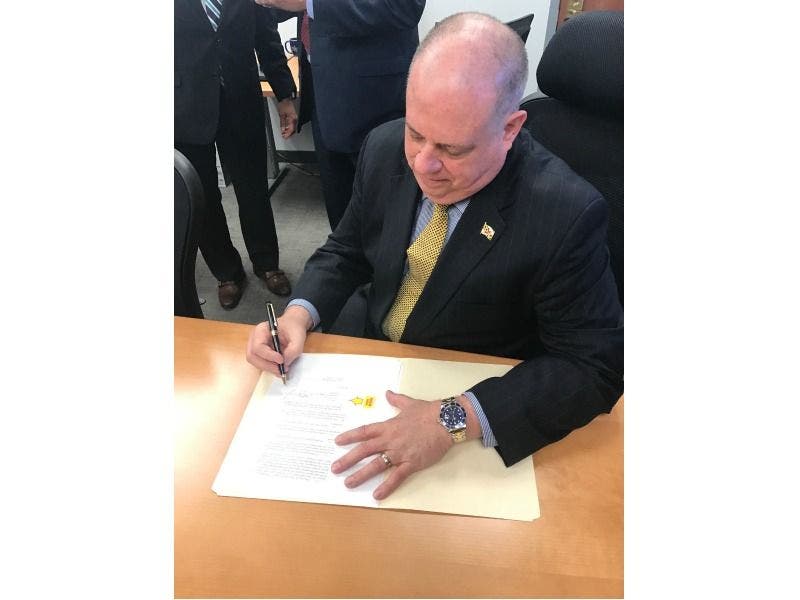

REISTERSTOWN, MD — Governor Larry Hogan signed an executive order Wednesday declaring a state of emergency in Maryland due to heroin.
"Heroin and opioid-related deaths have doubled in the last year in our state," Hogan said during a press conference at the Maryland Emergency Management Agency (MEMA) in Reisterstown.
There were 1,089 opioid-related deaths in Maryland in 2015, state health officials report. While 2016 data has not yet been released, Hogan's statement indicates there were at least 2,000 opioid-related deaths.
Find out what's happening in Owings Mills-Reisterstownfor free with the latest updates from Patch.
"The reality is that this threat has rapidly escalated with the introduction of fentanyl, which is 100 times more powerful and is far more deadly," Hogan said.
Fentanyl is an opioid that is 50 to 100 times more potent than morphine. Some drug users who think they are buying heroin are actually buying fentanyl or heroin laced with fentanyl.
Find out what's happening in Owings Mills-Reisterstownfor free with the latest updates from Patch.
“We need to treat this crisis the exact same way we would treat any other state emergency," Hogan said. "This is about taking an all-hands-on-deck approach so that together we can save the lives of thousands of Marylanders."
Opioid-related deaths in Maryland (opioids include heroin, prescription opioids, fentanyl):
| 2010 | 2011 | 2012 | 2013 | 2014 | 2015 |
| 504 | 529 | 648 | 729 | 888 | 1,089 |
Data from Maryland Department of Health and Mental Hygiene. The 2016 data has not yet been released.
The executive order signed Wednesday delegates emergency powers to state and local emergency management officials so they can fast-track coordination among government agencies and community organizations, including private sector and nonprofit entities, to address the opioid crisis, according to Hogan.
“We must cut through the red tape," Hogan said. "With this continuing threat increasing at such an alarming rate, we must allow for rapid coordination with our state and local emergency teams."
To lead the state’s coordinated effort to combat the crisis, the governor appointed his senior emergency management adviser Clay Stamp, who managed the response to the Baltimore riots in 2015 in his previous role as executive director of MEMA.
"We have a lot to do," Stamp said. "We have people dying every day in this state right now. There's probably no more important endeavor that I've been involved in...than what we are facing."
- Heroin Crisis: Overdose Deaths Take Record Toll in Maryland
- $3M Targeted at Fighting Maryland's Heroin Epidemic
Stamp said that "because of the scale of this crisis and its devastating impact" across Maryland, he would be partnering with MEMA and engaging local emergency managers to track the crisis using the National Incident Management System.
There will be $50 million in new funding over a five-year period allocated by the state to address the crisis, Hogan and Lt. Gov. Boyd Rutherford announced.
The funding will support Maryland’s prevention, recovery and enforcement efforts, according to a statement from the Hogan administration.
The order signed Wednesday is the latest in a series of actions by the governor to address the crisis:
- In January, Hogan and Rutherford rolled out the 2017 Heroin Prevention, Treatment and Enforcement Initiative, which included $4 million in funding and three pieces of legislation: the Prescriber Limits Act of 2017, the Distribution of Opioids Resulting in Death Act and the Overdose Prevention Act.
- The governor raised the opioid crisis as a top priority for Maryland during the National Governors Association winter meeting in February.
- Hogan signed a regional compact with the governor of Virginia and the mayor of the District of Columbia to coordinate a regional response to the crisis in 2016.
- Hogan signed an executive order in 2015 that created the Heroin and Opioid Emergency Task Force, which was chaired by Rutherford and has issued 33 recommendations to combat the crisis through prevention, treatment and enforcement.
- A standing order was issued by the state which allows all Maryland-licensed pharmacists to dispense naloxone without a prescription to anyone trained and certified under the Department’s Overdose Response Program in 2015. The life-saving drug can reverse opioid-related overdoses. As of December, more than 39,000 people had been trained by these organizations since the program began in March 2014.
The Maryland Good Samaritan Law, which protects users from arrest for possession of controlled dangerous substances and calling 911, has also encouraged people to call 911 if a user has overdosed.
Where to Get Help in Maryland
Maryland residents who need help finding substance abuse treatment resources should visit the Department of Health website for links to substance abuse treatment facilities. Or call the Maryland Crisis Hotline, which provides 24/7 support, at 1-800-422-0009.
If you know of someone who could use treatment for substance abuse, treatment facilities can be located by location and program characteristics online.
With reporting by Patch editor Deb Belt.
Photo of Gov. Larry Hogan courtesy of the governor's office. Heroin image via public domain.
Get more local news delivered straight to your inbox. Sign up for free Patch newsletters and alerts.