Schools
Superintendent Introduces Buffer Areas to Fix Over-Crowding Issue at Elementary Schools
At the third meeting of the Redistricting Committee for Arlington Elementary Schools on Tuesday night, Superintendent Kathleen Bodie brought the idea of buffer areas into the argument.

Tuesday night had the Redistricting Committee commence its third meeting to alleviate the problem of potential over-crowding at .
The School Committee and a few dozen parents listened to a presentation by Superintendent Kathleen Bodie concerning the third draft of redistricted zones in comparison to a new draft map and a fresh idea: buffer areas.
What are Buffer Areas?
Find out what's happening in Arlingtonfor free with the latest updates from Patch.
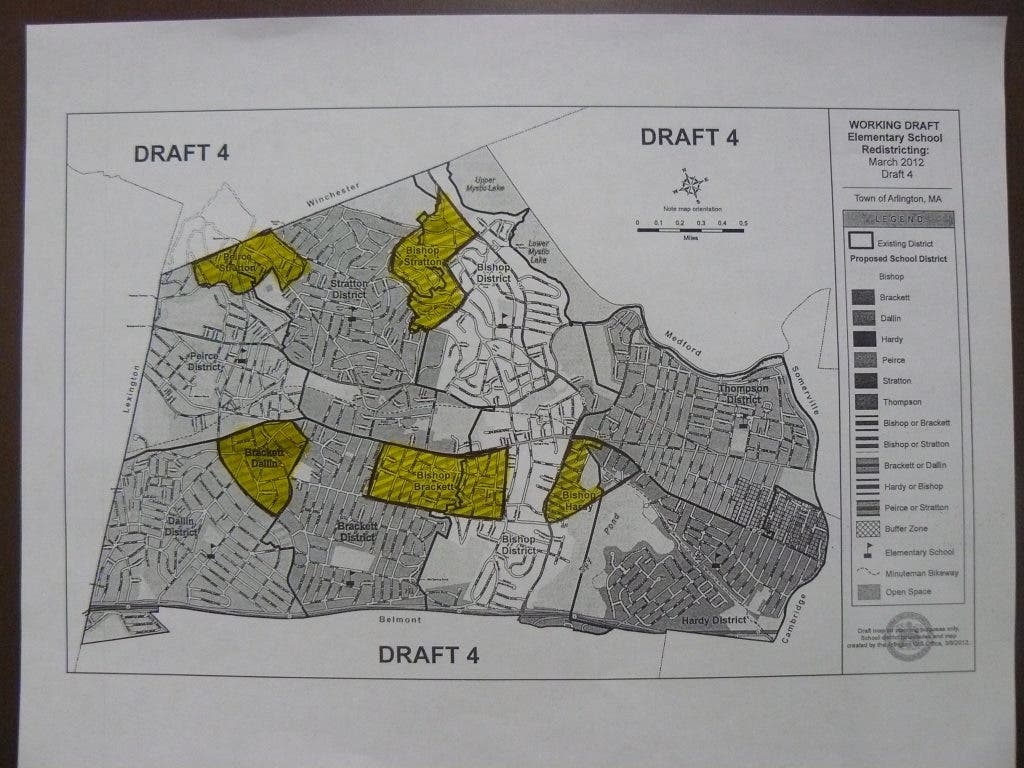
Buffer areas are would-be zones between school districts that aren't specifically mapped into one abutting district or the other, but instead flow into both. These areas would give school administrators the ability to decide which school is better suited to accomodate any student living within the buffer, and would allow for elementary school capacities to be better delegated.
Bodie started off her presentation on the buffer areas by explaining that trying to accurately predict school capacities from one district to another is proving fruitless. “If we can't predict the way we can balance these schools, what makes sense is to make buffer areas or not move people right now, but instead over time,” she said.
Find out what's happening in Arlingtonfor free with the latest updates from Patch.
The idea for buffer areas while discussing over-crowding with administration in the Brookline Elementary School system, according to Bodie. Brookline has had success with reducing over-capacity issues using buffer areas, although these areas are expanding over-time, she said.
School Committee Member Lauren Boyle attempted to sum up the School Committee's thoughts on the matter. “I think we are all in agreement, we should have some kind of these buffer areas if they work so well," she said.
Although not totally enthusiastic with this response, the School Committee did murmur their agreement with Boyle's statement.
Comparing Draft 3 Redistricting to Draft 4 Buffer Areas
After initial discussions of buffer areas commenced, Superintendent Bodie had a back and forth with the School Committee regarding the comparisons of a strict redistricting plan as shown in the Draft Map 3, with the new idea of buffer zones as seen in Draft Map 4.
Concerning straight redistricting, School Committee member Leba Heigham said, “Fixed district lines is a bad idea and created the problem we are in now.”
The School Committee seemed to agree with Heigham, although members mentioned grandfathering in these new lines may eventually reduce some of the negative impacts that goes with strict redistricting, such as having families go to new schools, loss of neighborhood cohesion, more children bused to school and preventing walkers crossing major streets.
The advantages of redistricting discussed in Draft 3 are included furthering the goal of the best possible physical learning environment, schools close to target capacity numbers, further district's goal of equal specialist rooms, anticipation of further growth and supports district policies with regard to special needs of children with disabilities.
Discussion of disadvantages of buffer areas and Draft 4 focused on larger mixed-school neighborhoods, a conceptual change from current school districts, possible expanded busing in the Bishop district, uncertainty of placement for new families and possible increased walking distances.
Concerning this last sentiment, School Committee members agreed with a statement by Heigham, who said, “If it's not a reasonable walk, say over a mile, we could think of expanding the buffer areas.”
But the advantages included keeping most students and parents engaged in their current schools, providing a mechanism to balance enrollments over time, brining Thompson Elementary to its target number, involving all schools and providing a plan to ensure equity of specialist rooms.
The Road Ahead and Meeting Schedule
There's still a ways to go before this issue is settled.
More exacting items brought up were the ideas of whether to allow open enrollment or not (parents wanting to enroll their children across district lines) and what to do with children that move into or around town mid-school year. Details like these were tabled.
Bodie described this third meeting as, “more of a concept meeting at this time” than a meeting designed to deliver concrete decisions. She also mentioned that meeting with parents to get their ideas on the matter could help direct the decision into an area that suits the most residents.
Although the next Redistricting Committee Meeting isn't scheduled until March 27 -- from 7 to 9 p.m. on the sixth floor of -- parents and others interested in voicing their opinions on the matter can attend any of the Parent Redistricting Meetings, which will be taking place from March 7 to March 21.
Below is a list of the exact meeting dates, locations and times:
- Brackett Parent Meeting – Wednesday March 7 (6:30 – 8 p.m. in the Brackett Cafeteria)
- Hardy/Thompson Parent Meeting – Tuesday, March 13 (6:30- 8 p.m. in the Hardy School Gym)
- Bishop Parent Meeting – Wednesday, March 14 (7-8:30 p.m. in the Bishop School Gym)
- Dallin Parent Meeting – Thursday, March 15 (6:30-8 p.m. in the Dallin School Cafeteria)
- Stratton/Peirce Parent Meeting – Wednesday, March 21 (7:15-8:45 p.m. in the Stratton Cafeteria)