Politics & Government
BDTC Garden Party Features Candidates Past and Present
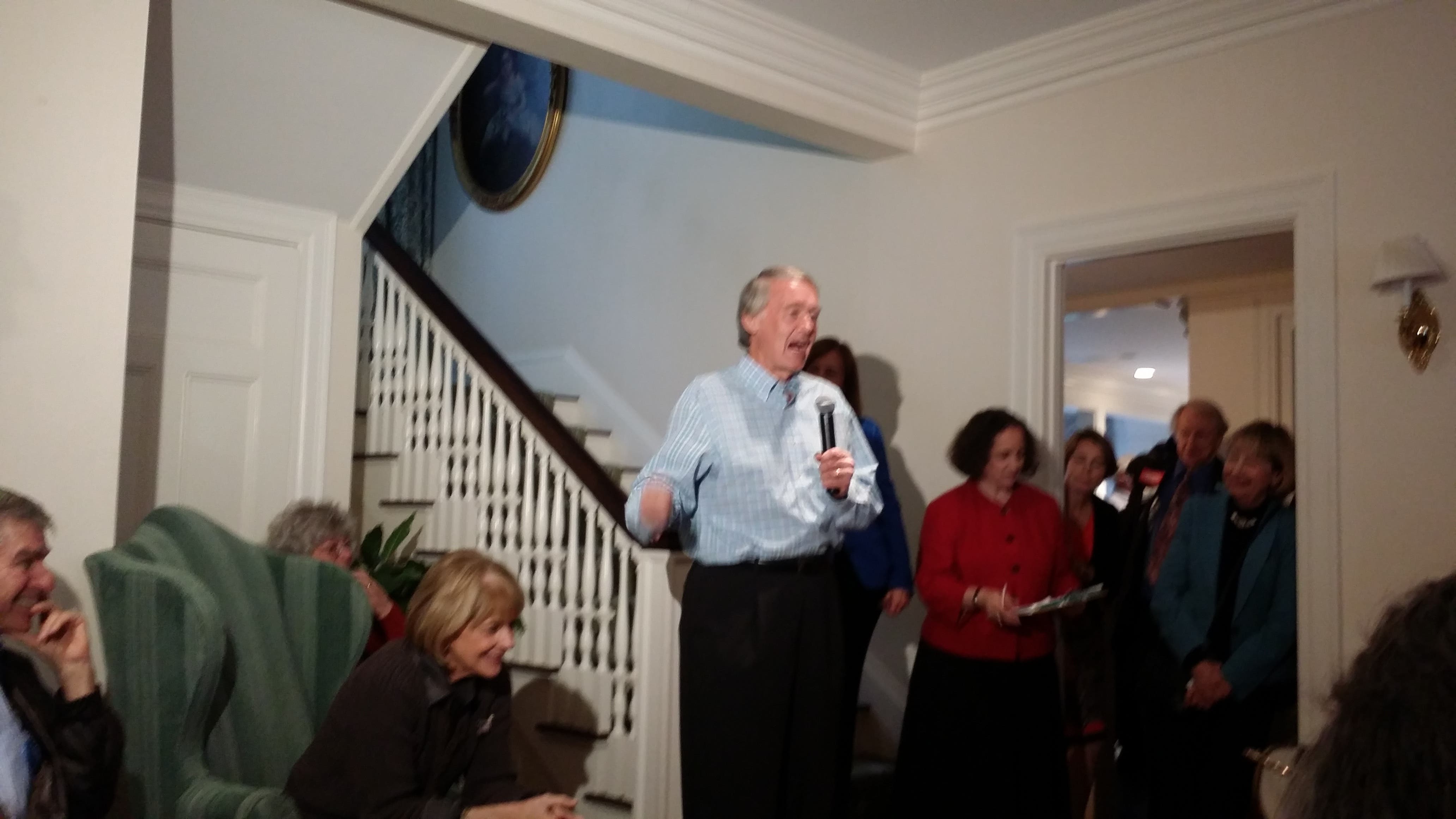
Gov. Michael Dukakis and Sen. Ed Markey, candidates speak on 10/13 at annual Garden Party at Treasurer candidate Deb Goldberg's home

Annual Garden Party a serious love fest for all things Democrat
By Susie Davidson
“I’m a lot of fun to have as a wife,” joked Deb Goldberg, in full self-deprecation mode. “I’m honored to have this every year, and so is my husband – right, Michael?” The candidate for Massachusetts Treasurer pondered her journey to that moment. “A year ago, I said ‘one year from now, I’d like to be your Treasurer nominee’ – now who would have thought?”
Find out what's happening in Brooklinefor free with the latest updates from Patch.
She made these remarks from the staircase of her Brookline home at Monday’s annual Brookline Democrats Garden Party, a reliably well-attended and star-studded rallying event set scant weeks before Election Day (this year, Nov. 4).
Indeed, this year’s celebrated cast, which included Governor Michael Dukakis, Secretary of State Bill Galvin, Democratic gubernatorial and lieutenant gubernatorial candidates Martha Coakley and Steve Kerrigan, and Attorney General candidate Maura Healey, feted the rapt attendees. US Senator Ed Markey stopped by, and state senators Cindy Creem and Frank Smizik, Norfolk District Attorney Michael Morrissey, Governor’s Councilor Marilyn Petitto Devaney, Norfolk County Commissioner Peter Collins, state senator and Massachusetts Democratic Party Chair Thomas McGee, and other elected officials mingled about.
Find out what's happening in Brooklinefor free with the latest updates from Patch.
Outside Goldberg’s home, campaign operatives disseminated literature, bumper stickers, lawn signs, and generally pumped up the assembled, who arrived from varied towns, but mostly from Brookline.
“Brookline is so important, and we are so important, that we make sure that people are elected who reflect our values and understand that government has a critical place to play in people’s lives, and it makes a difference,” said Goldberg.
Galvin spoke first, but not before Brookline Democratic Town Committee Chair Cindy Rowe thanked everyone, from the cleanup crew to local elected officials like Brookline Selectmen Ben Franco, Nancy Daly, Ken Goldstein and Neil Wishinsky, School Committee members Barbara Scotto, Susan Ditkoff and Helen Charlupski, Constable Tommy Vitolo, former state representative John Businger, Massachusetts Governor’s office Communications Director Jesse Mermell, Massachusetts Democratic State Committee member Ted Gross, Democratic National Committeewoman Kate Donaghue, and Rowe’s cohorts in the Newton and Somerville City Democratic Committees. Clearly, there was a lot of civic cred in the room.
However, Galvin said he was concerned about what he termed a “distinct enthusiasm gap” on both sides. “We’re running a voter registration at the Topsfield Fair, and usually I’m assaulted by all these Republican signs in the area, but I didn’t see any,” he said. That was the good news. “The total number of absentee ballots requested is only 52,000, and only 423 in Brookline,” he said, relating the interest deficit to recent politically inexperienced nominees. “Gabriel Gomez got 45 percent of the vote, and he no more belonged in the United States Senate than my left shoe,” he said, turning to the current gubernatorial race. “Charlie Baker is a sincere guy, but he’s sincerely wrong on a few things,” he said, casting a foreboding outlook on social concerns such as the MBTA Ride program, public education, and early education. “To those who need help, he’s not there,” he said, before stumping for Democratic candidates. “It’s important to have an attorney general who knows criminal justice and economic justice as well – we need Maura Healey. To have the progressive direction of the state Treasury, we need Deb Goldberg. We have 21 days to get them to win, and we’ll have 4 years to celebrate this victory,” he said.
In her earlier remarks, Goldberg also alluded to the quality of the current party slate, but said they could not do it alone. “We have the background and skills to do the job, but we need the support,” she said, thanking her guests. “All of you have always been at my back, and have helped me and supported me, and will help us get elected on November 4,” she said, turning to edible matters at hand. “We have a ton of food,” she said. “I’m a mother - please eat!”
Rowe held up membership applications for the Democratic Town Committee and told the crowd that there were just 21 days left as she announced upcoming phone banks, canvassing and other get-out-the-vote opportunities.
“I think I’m the oldest person in the room,” said Dukakis, who turns 81 in November. “But part of what age does for you is to give you - if you can hang on to it – memory,” he added, to room-wide laughter. “When I was a kid, this town was 5 to 1 Republican,” he recalled. “We didn’t have en elected Democratic legislator for a century. The reason that changed is because we’e had two of the best town Democratic leaders in the country,” he said, praising the late Joan Hertzmark and Rowe.
This legacy was evident, as Rowe continuously and enthusiastically passed out sign-up sheets, applications for membership in the BDTC, and other campaign materials.
Like Galvin, Dukakis is concerned, both nationally and locally. “The best defense is a good offense,” he said. “I remember FDR and I remember Truman – they never let us forget Herbert Hoover. And 2009 was very close to 1929. We’re not all the way back, but we’re pretty close,” he said, reminding them of Ronald Reagan’s treatise, “Are you better off now than you were four years ago?” Clearly, Dukakis conveyed that Americans are. “New jobs? Yes - wage levels aren’t what they ought to be, but when you get full employment, then wages rise. But 21 million Americans now have health care, and 85 percent of them are members of working families - these are working Americans who didn’t have health insurance until this administration did something about it,” he said.
Dukakis noted that Coakley was a gubernatorial nominee who knew Western Massachusetts, a part of the state on which the state needed to focus. (“And we have a lieutenant governor candidate from Central Mass.” added Coakley, seated to his right.) “I really can’t believe we’ve got a Republican nominee who’s talking about welfare reform,” said Dukakis. “In my administration, we had an ET (Employment and Training) program, placing 15,000 welfare mothers into work who never saw welfare again. It was a national model.” And a model, he said, that Charlie Baker killed. He touched upon the recent political ad placed by a GOP-supporting PAC that attacked Coakley on her record on child protection. “Got you mad, didn’t it?” he smiled at her, before informing the crowd, again drawing from that vintage memory, that eight foster children died while Baker was the secretary of health and human services under former governor William Weld, and that Baker’s Department of Social Services (the state child welfare agency at that time) was also plagued with unmanageable caseloads. A commission set to overhaul the agency found deep negligence and abuse among its young clientele (according to an April 1 Boston Globe article by Michael Levenson, during Baker’s secretarial tenure, each social worker had a caseload of 19 to 21 children, with many handling over 22 cases each. By contrast, this year, in the wake of recent tragedies, caseloads are being reduced from an average of 18 per social worker). Dukakis said that Baker’s commissioner, Linda Carlisle, was ultimately fired.
He turned to mental illness, saying that he and many others, including those in the room, have experienced it in their families. “Let’s deal with these folks who are in prisons or under bridges,” he said, recalling a past effort to build a network of psychiatric hospitals that was endorsed by the legislature. “But Charlie Baker killed it,” he said. He left with words of praise for Governor Patrick’s terms in office. “This state is not in great economic shape by accident – we’re the envy of the country,” he said.
“The Greeks invented democracy, but Mike Dukakis invented grassroots organizing,” said Markey, whose appearance was announced the previous day. “That’s why we’ve been so successful in electing Democrats,” he added. “Democrats do not agonize, Democrats organize!” he proclaimed, to wide applause. He lauded, to her chagrin, Goldberg’s superior academic merits and qualifications, as well as Healey’s success in arguing the national case against the Defense of Marriage Act. “When the Obama administration needed a little push on climate change, to make sure there was a little action on Massachusetts vs. EPA to reduce greenhouse gases, who brought that suit to make sure that there would be implementation,” he asked, turning toward Coakley. “Mortgage consumer ripoffs? You don’t have to wonder what she will do - she’s already done it!” he said, “And now, Maura Healey shows up right out of Central Casting, to follow the great footsteps and continue this great legacy.”
Massachusetts, said Markey, was only 2 percent of the country. “But we’re leaders,” he said. “On health care we went first. On education of grades 4-8, we’re number one in math and science. We’re the most energy efficient state in the country. And despite that we are more like the Perfect Storm than the sunny state, we’re number four in solar,” he said. “But we won’t be happy until every child has education, until global warming is countered, until no one faces discrimination.” He called the Democratic slate “one of the greatest All-Star teams ever put together, in one state.”
But he told his audience that it was not about them. “It’s about you. All we are is the embodiment of all the hopes and dreams that you want,” he said, waxing poetic: “Martha will help us to lift our gaze to the constellations of possibilities,” he said, quoting Martin Luther King, Jr. “’The arc of the moral universe is long, but it bends toward justice,’”adding, “toward the environment, toward education, toward health care for all!”
Healey noted that it was one year ago at the same event when she told people there that she was thinking of running for attorney general. “Some of you looked at me sideways, knowing how improbable and unlikely it was,” she said. “But it will always hold a very special place in my heart that it was here that we kicked off this campaign. And it’s great to be back in Brookline,” she said. “Brookline is Ground Zero for this race.”
Kerrigan broke the time remaining to Nov. 4 down further. “There are 520 hours till the polls open,” he said. “We don’t want to wake up on Nov. 5 and feel we could have done more.” He spoke of his childhood, when his father went on strike three times. “If it wasn’t for the union and the Commonwealth of Massachusetts, I don’t know where we would have been,” he said. “The other side will fight for themselves and make sure they look good, but we have to fight for the people.” Turning to Dukakis, he hypothesized with optimism. “It’s going to be very exciting for me for four, maybe eight, maybe 12 years – we’ll try to go for a Dukakis record – to be introducing Martha Coakley.”
Rowe referenced a recent controversial remark made by Baker. “He said to the reporter, ‘Last question, Sweetheart,” she said. Universal grimacing among the attendees soon turned to laughter, however, when she pulled out a poster and badges that stated, “I’m not your sweetheart, Charlie!” and began passing them out to women.
It was then Coakley’s turn to praise the mentor in the room. “You have to go back from Patrick to this guy to realize what we’ve gone through in this state,” she said, as she heaped praise on the assembled as well (“Last year you signed and promoted petitions to raise minimum wage – you did that!”) and her co-candidates (“Any one of the five of us would make a better governor of Massachusetts than my opponent, Charlie Baker”), as well as her former primary Democratic rival, Steve Grossman.
But it was the state’s youngest residents that truly inspired her passions. “Most of the people in this room get that opportunity to go to good schools,” she said. “That’s not the case around the state. I’ve worked with kids most of my life – it makes a difference. We need to give kids a chance to find a dream and go follow it,” she said, stating that in 2020, 70 percent of our jobs would require skills in science, technology, engineering, and math. “And Barbara Grossman will help to bring in arts,” she said, relating her recent time spent learning coding in teacher Paul Marques’ class at Malden High School. “The students speak 70 different languages, and they are doing very well,” she said.
“We know that Massachusetts is a great state right now – but I hear my opponent say let’s be great,” she said. “I’ve spent most of my life looking out for kids who need early education, computer science, those kids whose parents need earned sick time and minimum wage to help them make a decent living.” She painted a stark difference in outlook between the two parties. “Republicans see those at the top, CEOs. There’s nothing wrong with that, but we want that opportunity for everybody,” she said.
“This is about managing – and I can put my management skills up against his anytime - this is about leadership and moving in to the 21st century, so that Massachusetts will continue to lead,” said Coakley. “Women have been overlooked, called sweetheart, and ignored. That’s not going to happen in my administration,” she said. “And if you have my back for the next three weeks, I’ll have yours for the next eight years.”
Democrat State Party chairman and state senator Tom McGee spoke about what inspired him to be a Democrat and chair of the party. “My grandmother, my dad (Thomas W. McGee, former state representative and speaker of the House)‘s mother, worked in a shoe factory in Lynn, before there was a minimum wage. She worked to unionize the Stitchers and Packer’s union in Lynn,” he said. “We all have similar stories.”
Smizik, who said he had been going door to door “for the Democratic party, not for myself,” and Norfolk County Commissioner Peter Collins spoke, as well as Devaney, who told a heart-rending tale of what inspired her to be on the Governor’s Council, which she said did not have committees or a chairman, and didn’t vote on legislation, but rather, on people. “We represent you,” she said, choking up emotionally as she told the audience about a friend she had 16 years ago who had a restraining order on her boyfriend, and went to court with a police officer who testified on her behalf. “The judge told her ‘you’re wasting my time, and wasting the court’s time,’” recalled Devaney. “Two weeks later, she was killed by her boyfriend.” It was the Governor’s Council that had elected this judge, and she then decided to join it.
“We’ve come a long way – we have five women on this ticket,” Devaney said.