Neighbor News
Officials Knew Offshore Wind Would Double Electric Rates
Officials were aware of the notorious Falmouth project—which would violate state noise regulations

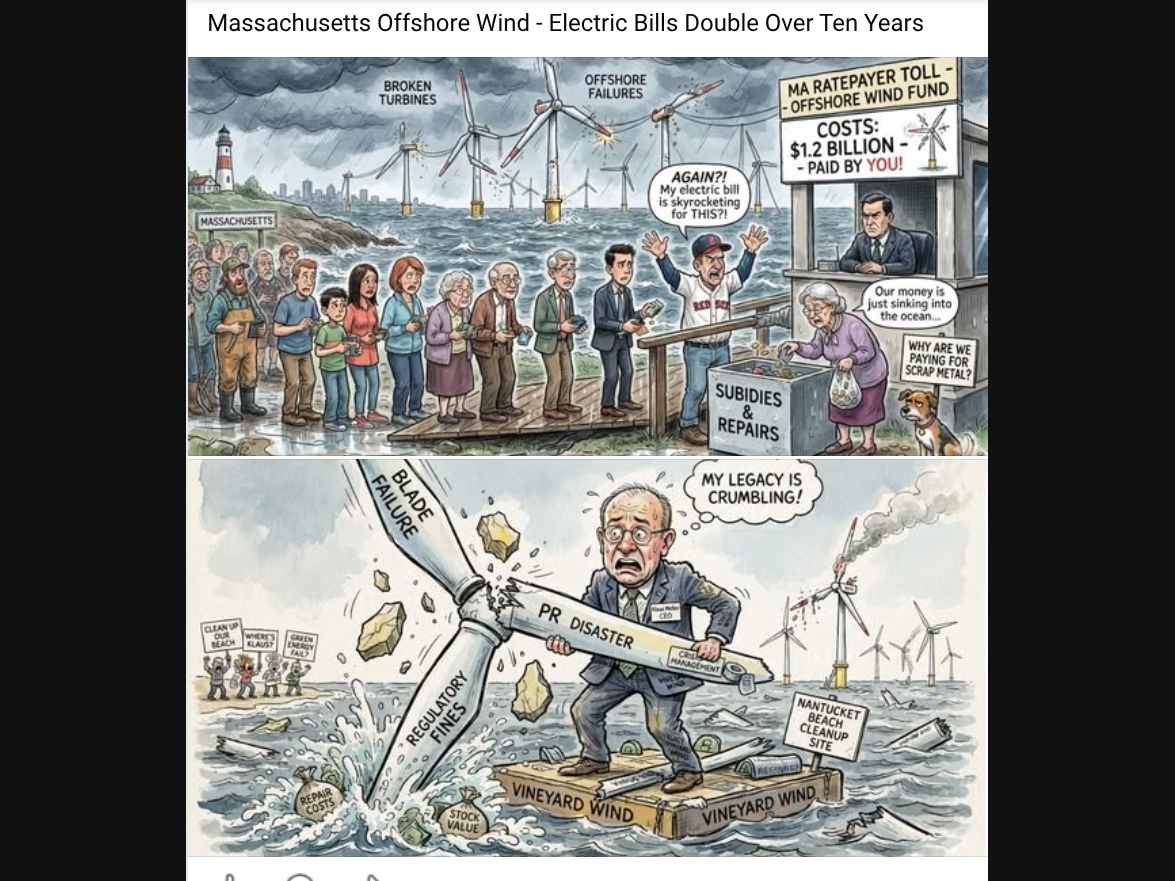
First, the land-based wind fiasco;
In January 2009, Massachusetts set a clean energy goal to install 2,000 megawatts of land-based wind power capacity by the year 2020, enough power for 800,000 homes. Today, most of those projects have been removed or failed. The state never built more than 100 megawatts of onshore wind projects.
Massachusetts officials and state agencies had explicit warnings about the severe noise and regulatory violations of land-based commercial wind projects before building them.
Find out what's happening in Falmouthfor free with the latest updates from Patch.
Internal documents later revealed that the Massachusetts semi-quasi Massachusetts Clean Energy Center and turbine manufacturers warned that early installations—like the notorious Falmouth project—would violate state noise regulations, yet warnings were withheld from local voters.
Former Governor Charlie Baker eventually admitted to Congress in 2019 that the state "screwed up" the implementation. Maura Healey served as the Massachusetts Attorney General for almost the entirety of Republican Governor Charlie Baker's two terms in office.
Find out what's happening in Falmouthfor free with the latest updates from Patch.
Governor Maura Healey, who was attorney general during the screw-up, has faced criticism from political opponents and analysts who claim Massachusetts retired fossil fuel capacity and blocked natural gas pipelines before replacement renewable projects like offshore wind fully materialized, causing the high electricity rates.
Last, the offshore wind fiasco
Ten years after the land-based wind screw-up, Massachusetts set a goal for the Vineyard Wind 1 project to generate 800 megawatts of clean, renewable energy to power over 400,000 homes and businesses in New England.
The project failed because the blades were defective and broke. Again, officials failed in due diligence.
In the late 1990s, LM Glasfiber (now LM Wind Power) experienced serious stress cracking in wind turbine blades due to violent edgewise vibrations..
Rather than embedding internal sensors to prevent cracks, they advised installing external vibration detectors to shut down turbines during extreme oscillations and later added mechanical dampeners and edge modifications.
General Electric (now GE Vernova) purchased LM Wind Power (formerly known as LM Glasfiber) for $1.65 billion. The acquisition was officially completed in the first half of 2017.
The LM Wind Power facility in Gaspé, Quebec, manufactured 150 wind turbine blades for GE Vernova, the majority of which were designated for the Vineyard Wind 1 project. Following a July 2024 blade failure caused by a manufacturing defect, federal regulators ordered the removal and replacement of these Canadian-made blades.
The Vineyard Wind "torsion problem" in LM Wind Power blades (specifically the 107-meter models used in GE Vernova’s Haliade-X turbines) stems from massive, varying rotational and aerodynamic forces that cause classical torsional (twisting) failure.
After the Vineyard Wind blade failures, GE Vernova deployed a new safety monitoring algorithm that uses existing blade sensors to automatically trigger a safe, precautionary shutdown if it detects unusual stress or anomalies.
Investigations revealed manufacturing deviations and adhesive bonding issues at GE’s Gaspé, Canada, plant, affecting 68 of 72 installed blades, which required extensive replacements. Investigations revealed allegations that plant "executives" falsified quality control testing data to prioritize production speed.
Vineyard Wind filed a lawsuit against GE Vernova subsidiary GE Renewables in April 2026 in Massachusetts Superior Court.
AKA what happened in 1998 happened 25 years later in 2024.
Déjà Vu: Vineyard Wind is producing less than half the power it was rated for.
Note: The Bureau of Safety and Environmental Enforcement (BSEE), a federal agency, has not completed the investigation of the Vineyard Wind blade failures. On July 10, 2026, federal officials changed the name of BSEE to the Marine Minerals Administration (MMA)..