Community Corner
DeSorgher: Your Street was Given a Special Honor
Last week's article told of the five Honor Squares in Medfield. This week we honor those killed in time of war, so honored in other ways.


Medfield has a long history of its citizens answering our country’s call in time of peril or war; from the earliest battles of the American Revolution to our soldiers today in Afghanistan.
The Committee to Study Memorials has worked hard to make sure these individuals are not forgotten by time. An aggressive plan has been in place since 1987 of having an Honor Square, Civic Square, street, sports field or park named after those who have given their life in service to our country or who have contributed above and beyond the call of duty to their community. Last week’s article told of the five Honor Squares in Medfield. This week we honor those killed in time of war, so honored in other ways.
Revolutionary War
Find out what's happening in Medfieldfor free with the latest updates from Patch.
Cole Drive………Boyden Road
Samuel Cole and Jabez Boyden were in the Medfield militia. They had marched to Lexington, taken part in the siege of Boston and were on Dorchester Heights during the Liberation of Boston by George Washington. In the summer of 1776, they were sent to reinforce the Continental Army, which had been severely beaten in the Battle of Quebec in Canada. They were sent to Fort Ticonderoga, which the Americans had captured earlier. The fear was that the British would soon be marching on the fort in an attempt to secure the Lake Champlain area.
Find out what's happening in Medfieldfor free with the latest updates from Patch.
The troops were forced to camp outside the fort, exposed to the weather in cramped quarters with poor sanitary conditions. There job was to build a new fortification opposite Fort Ticonderoga across the narrowest part of Lake Champlain. This new fortress would become known as Fort Independence. Many became sick with contagious diseases, especially small pox. Letters from Doctor Samuel Wigglesworth reported that: “it would make a heart of stone melt to hear the moans and see the distress of the sick and dying. I scarce pass a tent but hear men solemnly declaring that they will never engage another campaign without being assured of a better supply of medicines."
During that period of less than one month, September of 1776 -both Medfield boys died of disease and were buried in unmarked graves in the Garrison Cemetery outside Fort Ticonderoga, the first from this little town of Medfield to die for their new country, still fighting a war of independence that at the time must have seemed hopeless.
Civil War
Kingsbury Drive
After the Confederate attack on Fort Sumter, President Abraham Lincoln issued a call for 75,000 volunteers to defend the Union. Upon hearing President Lincoln’s request, 20-year old Allen Alonzo Kingsbury did not wait to be called, he left his family farm on South Street, said goodbye to his mother Mary, his dad James, his 7-year-old sister, and two teenage brothers and he walked to Chelsea to enlist. Allen enlisted as a private in the First Massachusetts Volunteer Infantry. From Boston, they worked their way into Washington, D.C. In his journal dated July 19,1861, he writes: “Yesterday we had an awful fight in a swamp called ‘Bull Run.’ Company’s H and G were shockingly cut to pieces, about half of the two Company's were killed or wounded, a spent cannon ball struck me in the leg, and felled me to the ground. I was also wounded internally by having a wounded man fall on me. I am in the hospital at Centreville, there are twenty here, some are fatally wounded and some are shot through the arms, legs and feet. One man had his ear shot off by a cannon ball, one was shot through the abdomen, he cannot live. One had his leg taken off by a rifled cannon ball; one was struck by a cannon ball in the thigh, he cannot live. Six of our Company are dead, six wounded and 11 missing.”
Kingsbury was hospitalized for a brief time before being released, to be sent home. Kingsbury could have stayed in Medfield, he had served his country, was wounded in battle; no one would have expected any more. But with that strong sense of duty to country, Kingsbury re-enlisted. He returned to action on Sept. 11, 1861. After seven months of drilling, marching and fighting, Kingsbury was killed on April 26, 1862 in a charge on Confederate works near Yorktown, Virginia.
Derby Lane
Richard Derby was the son of Elias and Mary Derby and grew up on the corner of Frairy and Cottage Streets. His father died when he was just six. Richard spend many summers along the water with relatives in Salem. He attended school in Groton Academy. After working a short time in Boston, he went west to Wisconsin and Minnesota where he worked as a salesman in a store but spending much time with nature and the then wilderness. In the spring of 1859 he returned to Boston. When the war broke out he enlisted in the 15th Massachusetts Regiment. Commissioned a 2nd Lieut., he was mustered in the service on July 12, 1861. Richard Derby was killed in the battle of Antietam, near Sharpsburg, Maryland, the bloodiest single day battle of the war.
World War I
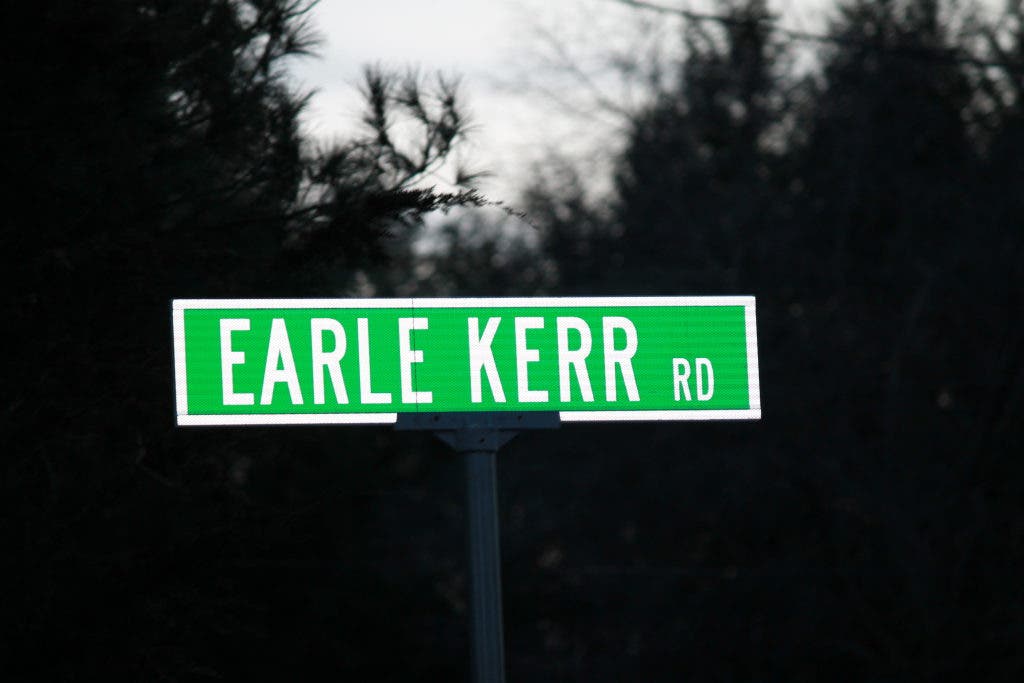
Earle Kerr Road
John “Earle” Kerr of Company C, 14th Engineers, American Expeditionary Force, was the first Medfield man killed in action during WWI. He was killed Sept. 16, 1918, less than a month before the end of the war, by enemy shell fire while on detached service at Chery Chartreuves, France. He was buried in the cemetery back of the church of that village.
Beckwith Post 110, American Legion
The first soldier to die in WWI, William Beckwith, age 18, died on March 6, 1918 at Fort Sheridan, Ill., of appendicitis. His funeral was held in and his body was brought to Vine Lake Cemetery with a military escort. His brother, Wesley Beckwith, age 17, private in the Coast Artillery, was drowned on Oct. 6, 1918, when the British Transport Ontario and the Transport Kashmir collided in the North Channel between Ireland and Scotland. A military funeral was later held at St. Edward Church in 1920 and his body was conveyed from the church to Vine Lake Cemetery on a gun carriage drawn by four black horses. The local post of the American legion, now located on Peter Kristof Way, was named in honor of the two Beckwith brothers.
World War II
Joseph Pace Road
Joseph Wilson Pace was born in Portsmouth, N.H. on Nov. 1, 1917. Known as Joe, he was the son of Dorcas and Ralph Pace. Ralph died when Joe was just 12 years old. The family, which included younger brothers John and Ralph moved to Saugus, Massachusetts, where Joe graduated from Saugus High School. Finding a job at the Medfield Hat Factory, Dorcus moved the family to Medfield and settled at 6 Green St. In 1938, Joseph enlisted in the United States Navy.
As a radioman third class, he was stationed aboard the USS Pennsylvania. Due to increasingly rising tensions between the United States and Japan, Roosevelt had our Pacific Fleet moved from San Diego to Pearl Harbor in the Hawaiian Islands. On Sunday morning, Dec. 7, 1941, Joseph Pace was asleep on board the Pennsylvania.
Suddenly and with complete surprise, Japanese dive bombers and torpedo bombers roared out of the high overcast. The USS Pennsylvania was one of the first ships in the harbor to open fire. Her 50-caliber machine gun crew had their guns in action even before “general quarters” was sounded. The intensity of the fires was now all around the Pennsylvania. Bomb fragments pockmarked the battleship. Joseph Pace raced as fast as he could to the upper deck to his radio post. On his way up the ladder he was hit by flying shrapnel from the Japanese planes flying overhead, strafing the deck with bullets and with exploding bomb fragments. It was from these injuries that Pace died.
A total of 2,388 men, women and children were killed during the attack. Twenty-one vessels of our Pacific Fleet lay sunk or damaged. The attack on Pearl Harbor brought the United States into WWII and will always be remembered by the words of President Franklin Delano Roosevelt as a “date which will live in infamy.”
Robert Sproul Road
Robert Sproul moved to Medfield with his family in 1938. The Sproul family resided at 378 Main St. Robert graduated from Medfield High School with the Class of 1939 — he enlisted in the Army Air Corps on Jan. 7, 1943 at the height of WWII. Robert received his pilot wings and commission in November 1943. He attained the rank of Second Lieutenant and served as a pilot on a B-17. His squadron was sent to England where they flew bombing runs over German occupied Europe. On Aug. 1, 1944, during the great allied breakout of Normandy and the campaign to liberate France, Robert’s B-17 was shot down over France. All on board were killed. Lt Robert Sproul was buried in the American Military cemetery over looking Omaha Beech. A memorial service was held in Medfield at St. Edward’s Church.
John Crowder Road
John Crowder was born in Boston on Dec. 27, 1920. He was the son of Helen and Philip Crowder and later the step son of Clarence Palady. John enlisted from Medfield into the army nine days after the Japanese attack on Pearl Harbor, he was 20 years old. John became a trooper with the 101st Airborne Division “Screaming Eagles.”
Sgt. Crowder was part of the D-Day invasion of France, June 6, 1944 in what would become the greatest invasion force ever assembled. The invasion on the beaches of Normandy, France was an attempt to gain a foothold in Europe so Allied forces could begin to push back the forces of Hitler and liberate the Nazi occupied countries in Europe. Sgt. Crowder’s division had left England shortly after midnight before the start of the invasion.
They were dropped into German occupied France to secure the roads leading into and out of Normandy. They were given the task of preventing German re-enforcements form entering Normandy and stopping escaping Germans from fleeing the battle area. Sgt. Crowder was killed shortly after landing in France early on the morning of June 6, 1944.
Thomas Clewes Road
Thomas Clewes was born on Sept. 6, 1914 in Framingham, the son of Frank and Katherine Clews. He grew up in Millis and graduated from Millis High School with the Class of 1934. In 1939 he moved to Medfield, living on Hospital Road and later on Brook Street, During WWII Clewes served in the United States Army, 164th infantry, obtaining the rank of Sgt. Thomas Clewes died from wounds suffered by Japanese machine guns during an attack on Jan. 1, 1944 near the Torokina River in Bougainville, Solomon Islands. Clews lay wounded and while pinned down by gunfire, he continually coached his men through the action. Clews was finally dragged to safety, through Japanese fire, by fellow soldiers.
After arriving back at company headquarters, Clews died of the wounds he received in battle. He was buried in the American cemetery in the Philippines next to his brother Corporal Ernest Clewes of the 5th US cavalry, who also died of wounds received in action in April of 1944. Thomas Clews left behind his wife and 3-year-old daughter.
Lee Road
Earl W. Lee, a graduate of Medfield High School, Class of 1939 was killed over France in July of 1944. He was an aerial engineer in the 707th Bombing Squad.
Korean War
Snyder Road
In June of 1950 the North Koreans with their armored divisions, led by Soviet made tanks, struck suddenly across the 38th parallel. With the backing of the UN Security Council, President Harry Truman sent American planes and ground troops into action.
George Snyder was born in Tennessee and came to Medfield to live with his sister Reather Ours on Harding Street. Snyder enlisted in the Army from Medfield and was sent to Korea. While on duty he was killed in a jeep accident. He would become the only one from Medfield to be killed in the Korean War. All told, by the time it was over, it had produced 157,000 American causalities, including 54,200 dead.
Vietnam War
Corporal Stephen Hinkley Memorial Park and Pond
Medfield first casualty in the Vietnam War was 19 year old Stephen Hinkley. Stephen was born and brought up in Medfield, living his entire life on Harding Street. He graduated from Medfield High School with the Class of 1967. He enlisted in the US Marines directly after graduation along with two of his buddies, Michael DiNapoli and Richard Carlson. After basic training he was sent to Vietnam. He arrived in Vietnam on Dec. 10, 1967. He was serving with the 4th Marine regiment. Stephen was mortally wounded, in the vicinity of Quang Tri, the day before he was to celebrate his 20th birthday. He sustained fragmentation wounds to the head and body from hostile mortar fire while in a defensive position. Shortly before his death, Stephen had been made platoon leader in the motor section. Almost the entire student population of Medfield High School walked in mass to the Old St. Edward’s Church on Main Street to attend the Hinkley’s funeral.
Peter Kristof Way
Medfield’s second youth to be killed in Vietnam was 19 year-old Peter Kristof of Belknap Road. Peter graduated from Medfield High School the year after Stephen Hinkley, Peter was in the Class of 1968. He enlisted in the United States Marines in October after his graduation. He too was sent to Vietnam and was located in the Quang Tri Province when he was hit by grenade fire and suffered fatal multiple head and body wounds. For the second time in two years the students in this small close-nit high school were devastated with the loss of a popular well known former student and the town again laid to rest another 19-year-old, who had given his life for his country.