Schools
Medfield High School Students Attend Bullying Awareness Assembly [Video]
On Friday, the Massachusetts Aggression Reduction Center talked about bullying, cyberbullying, and the importance of an online profile. Students were asked: "If you could have a billboard on Route 27 in Medfield, what would you like it to say?"


Max Quinn knows what it’s like to be bullied.
When he was growing up in a nearby town, the bullying was so bad, he said, that his family had to leave that school district.
"When I was kid, I was bullied," Quinn told freshmen and sophomores at a bullying awareness assembly on Friday. "It was so bad that I wanted to leave, I wanted to move.”
Find out what's happening in Medfieldfor free with the latest updates from Patch.
The family ultimately relocated to Medway.
Today, Quinn is a graduate student at Bridgewater State University where he is working with the Massachusetts Aggression Reduction Center to raise awareness about bullying and Cyberbullying – what it is and what it is not.
Find out what's happening in Medfieldfor free with the latest updates from Patch.
Each class listened intently during Quinn’s 45-minute presentation, in which he defined the difference between fighting (typically a one-time incident, sometimes between friends) and bullying (a repeated offense meant to harm the target), and discussed the roles of eggers (those who encourage the bully) and bystanders (those who witness abuse but do not help the victim).
He encouraged students who see bullying to “help squash this culture … You have the power to make a difference.”
Online Private Information, including photos
A large portion of the assembly detailed the importance of information posted on the Internet and how it is never “private” despite profile preference settings.
“Nothing online is ever truly private. If you have something that you truly don’t want someone to see, don’t put it online,” said Quinn, noting that 25 percent of college admission boards, and 75 percent of potential employers, now conduct online reference checks.
He said this applies to photographs as well, adding that any one of your social media “friends” has access to your photographs and can easily manipulate them, if they so choose.
Quinn encouraged students to “treat your [online] password like your toothbrush and don’t share it,” adding that if a student shares his password with someone who is a friend today and they later have a falling out, the former friend can cause a lot of damage online.
He stressed the importance of hacker-proof passwords (symbols are safer than characters of the alphabet), and highlighting the first impression an e-mail address can make (citing the example of alwaysstoned@” and “cutiewithabootie@” as poor choices).
Sexting
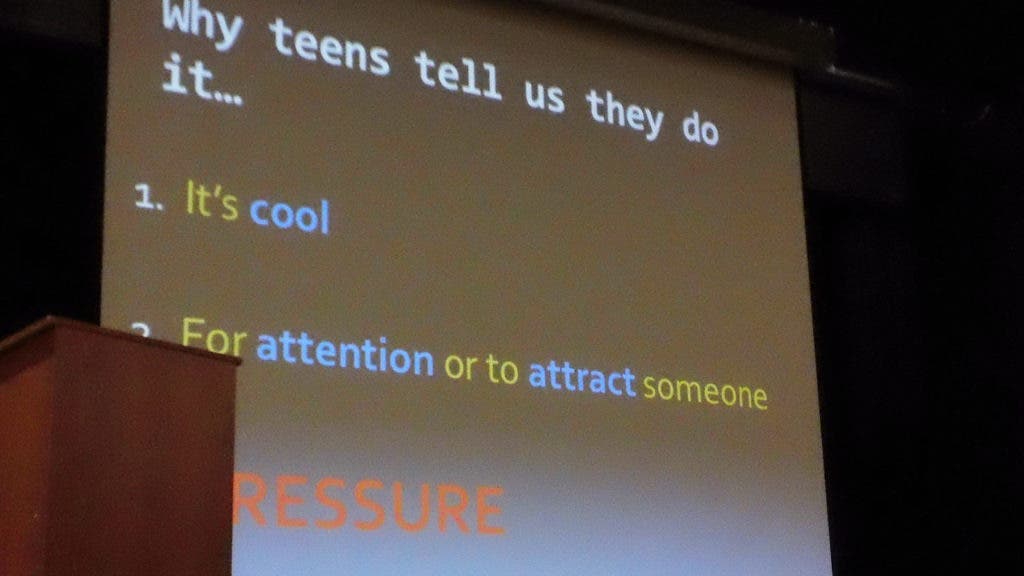
MARC research shows that students sext mostly under duress or because they think it is cool. Quinn assured Medfield that it is not cool and one such sext can literally change their life forever.
“You might say, ‘It’s my body, what’s the problem?’” said Quinn.
First and foremost, he said, possessing naked photos of anyone under the age of 18, including yourself, is a crime and could result in having to register as a sex offender for eternity.
Also, once a sext is sent, said Quinn, it is in cyberspace forever to be forwarded to and by any recipient, posted on social networking sites, or saved for future reference.
“You can’t control who people send it to,” he said, adding anything posted online by a student or one of his friends (or enemies) and could end up on a student’s online ‘billboard.’
“You need to treat your profile like a billboard. If you could have a billboard on Route 27 in Medfield, what would you like it to say?," posed Quinn. "That’s the impression you put out there.”
MHS Dean of Students, Jeff Sperling, said the school has used many of MARC’s nationally-recognized programs.
“I think it is important to give them the information about Cyberbullying, what it is and what it isn’t,” said Sperling. “Between the images that they’re putting out and everything online, I think this is perfectly appropriate for them,” he said.
MARC director and founder Elizabeth K. Englander told Medfield Patch that “the purpose of the MARC assembly is to help raise awareness among the kids in a school. It is not intended to dramatically change a school all by itself, but to start the ball rolling.”
MARC is a non-profit organization that provides low or no-cost programming to K-12 communities throughout Massachusetts.