I recently hosted a small afterschool playdate with some of Ruthie's newer friends from her Girl Scout Troop. As the moms sat around the kitchen table and counted the days until summer vacation (and cried), the question of how we handle GF living in our family came up. Specifically, the other moms wondered if we all ate gluten-free all the time.
The short answer is, "No." But of course, there is a longer answer.
When Ruthie was diagnosed, we felt it important that she gain the tools and tactics to live in a world where gluten exists. As such, we felt the best first place to learn this was in her own home.
Find out what's happening in Medfordfor free with the latest updates from Patch.
Identifying the food groups that contain gluten is only half the battle. The other half is what I affectionately call "Crumb Control." Yes, even little crumbs of gluten need to be avoided, because over time, little crumbs add up to bigger crumbs, add up to a gluten reaction. And I know you believe me when I tell you that a gluten reaction Is. Not. Pretty.
The best way to deal with Crumb Control is to, well, control it. So we adopted the following practices:
Find out what's happening in Medfordfor free with the latest updates from Patch.
1. Separate toasters: I tend to point this out to people as the first example. Because cross-contamination is our biggest concern, we cannot let Ruthie's bread come in contact with gluten bread products. Hence, her own toaster.
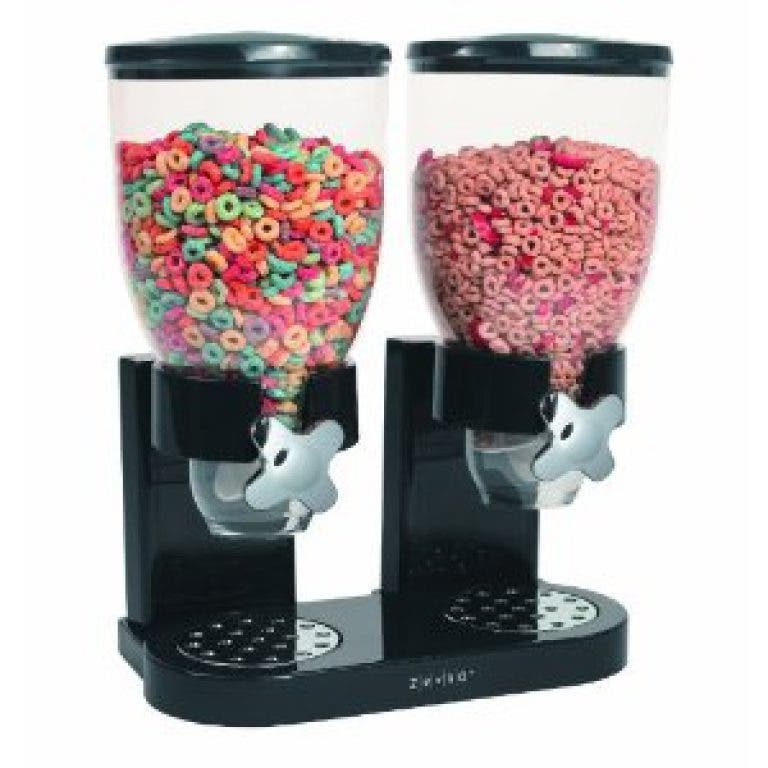
2. Dedicated cereal dispenser: Our dual cereal-dispenser (pictured to the right) is quite the conversational piece. Many people, when seeing it in my kitchen, have confused it for a dispenser for pet food. No, I am just determined to A) teach my kids to fix breakfast and B) gain 15 minutes extra sleep in the morning. The only rule is that these dispensers can only contain GF cereals (of which there are plenty, and you probably eat most of them already).
3. Divided counter space: There is a specific area on our counter where only GF products can be prepared. There is also a specific area for non-Gf products. The girls make their own lunches, and the table prep is a GF area. If Zoe wants to make a gluten sandwich, she knows she must make it on the gluten part of the counter. Yes, my kids make their own breakfasts and lunches. As Meat Loaf says, "Two out of three ain't bad."
4. Dedicated cutting boards: I have green cutting boards which coincided with our "green light food" labeling. No gluten products can be prepared on these boards.
5. Separate containers for spreads and condiments: Since trying to institute a "no double dipping utensils" policy proved impossible in practice (e.g. everyone was in the habit of sticking the knive back into the peanut butter regardless of what bread it touched), we now keep separate containers of the following items: butter, peanut butter, jelly, mayo, mustard. Ruthie's items are marked with a label or with a sticker with Ruthie's name. We also use more squeeze bottles than jars now, which has helped cut down on the risk of glutening Ruthie (see, I told you I'd make up more than one word in this column).
6. Eating in the kitchen only: This has always been my rule, but it is particularly important in managing a gluten allergy. Keep the crumbs in one place and you only have one place to clean up. Plus, no dishes all over the house. It's a two-fer!
7. No gluten on the couch or in the car: Kids (and some adults) think the world is their napkin. Enough said.
That said, there is a line I have drawn on how far we took this "Division of Gluten" in the house. For example, we all eat gluten free pasta. So much easier than preparing two separate pots of it. I also ceased buying a lot of gluten products such as goldfish, cheeze-its, and many kinds of crackers. We didn't really need them anyway, so this was a great excuse to stop consuming them at home.
I know as you read this, you are probably thinking, "Wow, this all sounds like a royal pain in the tush." (Or maybe you are using a more colorful phrase, but this is a family publication.) Truthfully, at first, it was difficult. I had to stop and think before preparing anything for mealtime, and doing so nearly doubled my prep time. But now? It's a habit that literally cannot be broken.