Community Corner
Now's the Time To Plan for Severe Weather
Could a tornado hit Needham? Local storm tracker Greg Conlan answers the question and provides tips for staying safe in a variety of situations.


Greg Conlan, a Needham resident and 23-year Boston firefighter, is a storm enthusiast who has been documenting severe weather for more than 35 years. He has one of the most advanced radars (GR2Analyst) available to the weather community and has documented more than 470 3D images from tornadoes just this year. Follow his severe weather Tweets at @BOSTON_FF_L29.
Unfortunately, New Englanders live by the “It won't happen to me attitude.” We have grown accustomed over the years to winter storms being over-hyped and hurricanes going out to sea, even when it appears that a landfall strike is imminent. Just look at last summer’s Hurricane Earl and Hurricane Igor.
But Mother Nature just reminded some personally in Western Massachusetts that severe weather can happen here, and it can have severe life-or-death consequences if the warnings are not adhered to.
Find out what's happening in Needhamfor free with the latest updates from Patch.
Don’t wait until a warning is issued to make a safety plan; by then, it may be too late.
In Westfield, MA on June 1, no warning was given. The storm intensified too rapidly and produced a supercell thunderstorm, which in minutes became the deadly Southwestern Massachusetts (Westfield to Charlton) Tornado, rated by the National Weather Service as a major, top-end EF3 tornado with winds up to 160 miles per hour.
Find out what's happening in Needhamfor free with the latest updates from Patch.
The NOAA defines a supercell thunderstorm as “a thunderstorm consisting of one quasi-steady to rotating updraft which may exist for several hours” and it is one of the most dangerous of the convective storm types. Supercells have generated the majority of long-lived strong and violent tornadoes, as well as downburst damage and large hail.
This major tornado struck Westfield to Charlton while three quarters of Massachusetts, including the above mentioned towns, fell under a tornado watch issued by the National Weather Service. Problem? This supercell thunderstorm went tornadic before a warning could be issued. Many people were caught off guard. There was no 12-minute advanced warning for this tornado; law enforcement in Westfield was the first confirmation of the Tornado. The National Weather Service quickly put out a tornado warning for Springfield and areas east of the tornadoes’ track upon being notified.
This is why tornado watches need to be taken seriously. Tornadoes do not play by any set of rules and can appear without warning.
Getting back to the question of “Can it happen here in Needham?,” the answer is yes, and it has.
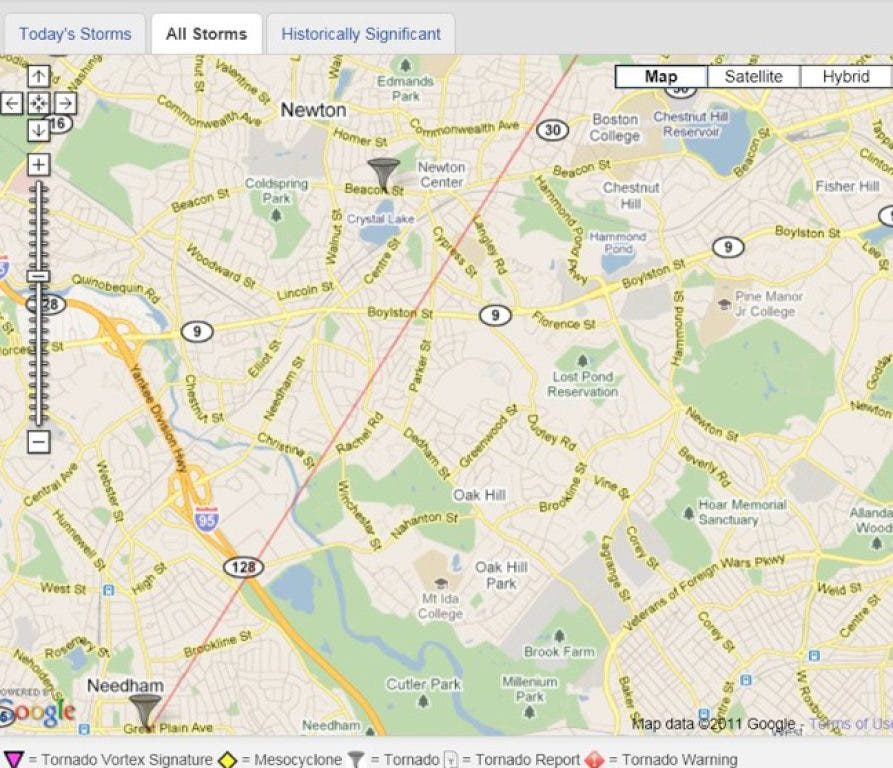
On Aug. 9, 1972 at 3:30 p.m., a killer tornado, which the National Weather Service rated as an EF1 on the Enhanced Fajita Scale, struck Needham. This storm originated around Great Plain Avenue and Webster Street and travelled for approximately 4.9 miles through Newton and into the town of Brookline.
The Needham Tornado killed one person in Newton and injured six.
So knowing that Massachusetts has had years with up to 12 confirmed tornadoes and the fact that a deadly tornado hit our town and another one hit the neighboring city of Newton on Beacon Street, it is wise to heed the warnings given by the National Weather Service and local meteorologists and to be prepared if a warning is issued.
Would you know what to do the next time a severe weather watch is issued by the National Weather Service, whether it’s a tornado, severe thunderstorm or flash flood? If you’re like most New Englanders, when it comes to these three types of severe weather watches and warnings, you won't pay much attention to them, until you actually see the proof outside your front door.
Here is a look at 10 questions you should be asking yourself before any severe weather occurs—as well as the answers:
1. Do you know the difference between a watch and a warning?
The National Oceanic and Atmospheric Administration, or NOAA, provides the following definitions:
• Watch: A watch is used when the risk of a hazardous weather or hydrologic event has increased significantly, but its occurrence, location or timing is uncertain. It should provide enough time for people in potential danger to make plans to ensure their safety.
• Warning: A warning is issued when a hazardous weather or hydrologic event is occurring, is imminent or has a very high probability of occurring. A warning is used for conditions posing a threat to life or property.
• Tornado Watch: Tornadoes are possible in and near the watch area. Review and discuss your emergency plans and check supplies and your safe room. Be ready to act quickly if a warning is issued or you suspect a tornado is approaching.
• Tornado Warning: A tornado has been sighted or indicated by weather radar. Tornado warnings indicate imminent danger to life and property.
• Flash Flood Watch: Issued to indicate current or developing hydrologic conditions that are favorable for flash flooding in and close to the watch area, but the occurrence is neither certain or imminent.
• Flash Flood Warning: Issued to inform the public, emergency management and other cooperating agencies that flash flooding is in progress, imminent or highly likely.
2. What would you do if the NWS upgraded the watch to a warning?
If it’s a severe thunderstorm warning then you should immediately get into a safe area of your home, not near a window and if possible on the lowest floor. If outside, seek shelter immediately. If no shelter is available, seek the lowest area not under a tree, avoid being near trees in an open space and remove any metal cleats or spikes. If you are in an automobile and no shelter is available, stay inside the vehicle and move away from your windows and avoid parking under trees, seek an underpass, garage, etc.
If it’s a tornado warning then you should go immediately underground to a basement, storm cellar or an interior room (closet, hallway or bathroom).
If it’s a flash flood warning, you should avoid walking near flowing water, seek higher ground when near creeks, streams and dry riverbeds, especially if you’re in an automobile, and avoid driving through any water in a road. A small automobile can be moved by as little as 6 inches of moving water. Twelve to 18 inches of moving water can move an SUV or large automobile.
3. When will a warning be issued and how much time do I have before the severe weather will hit my area?
Basically, a warning means the storm is imminent, has been sighted by law enforcement, NWS storm spotters or picked up on radar by the National Weather Service. According to NOAA, on average, 12 minutes is the most advanced warning time technology will currently predict. So, as you can see, basically you needed to have prepared for the warning when the watch was first issued. You now need to go to your prepared shelter or safe room.
4. Are you prepared for a warning?
Hopefully, you haven’t waited until a warning is issued to become prepared. This should be done now, not once a watch or warning has been issued. Here are some tips from the American Red Cross on what to do before a warning has been issued; in this case, a tornado warning, but some of the suggestions are good for thunderstorms, too:
During any storm, listen to local news or a NOAA Weather Radio to stay informed about watches and warnings.
• Know your community’s warning system. Communities have different ways of warning residents about tornados, with many having sirens intended for outdoor warning purposes.
"Should a more immediate threat concerning a tornado occur, the town-wide (SwiftReach) notification system may be utilized to notify residents of a more immediate threat of a tornado," Baker said in an e-mail. "Town officials continue to monitor and re-evaluate weather conditions and weather service information."
SwiftReach is an automated phone system used to alert residents of a targeted area when important information must be disseminated quickly. Residents can submit their updated emergency contact information for the SwiftReach system on the town Web site.
• Pick a safe room in your home where household members and pets may gather during a tornado. This should be a basement, storm cellar or an interior room on the lowest floor with no windows.
• Practice periodic tornado drills so that everyone knows what to do if a tornado
is approaching.
• Consider having your safe room reinforced. Plans for reinforcing an interior room to provide better protection can be found on the FEMA Web site.
• Prepare for high winds by removing diseased and damaged limbs from trees.
• Move or secure lawn furniture, trash cans, hanging plants or anything else that can be picked up by the wind and become a projectile.
Watch for tornado danger signs:
• Dark, often greenish clouds—a phenomenon caused by hail
•Wall cloud—an isolated lowering of the base of a thunderstorm
• Cloud of debris
• Large hail
• Funnel cloud—a visible rotating extension of the cloud base
• Roaring noise
5. Do you have a plan for severe weather?
As noted in the above answer, a plan should be made in advance of any storm and practiced a couple times annually.
6. Does your family have a plan?
You may be home alone or with some family members not home. Do you have a plan for that scenario? This is the most likely scenario to occur. When severe weather is forecast, it is a good idea before anyone leaves the house to have a plan of what action to be taken if a watch or warning is issued. One good idea is to have a designated check-in. Designate one family member as the go-to person and have everyone call that one person and update them of their location and about how long they will be there. If there is a change by any one person, they are to update their location and approximate times again.
If the whole family is home it’s a good idea to contact a relative living in an area not under the storm warning. I’ll explain more about this later on.
7. Do you have a safe place to ride out the severe weather?
As I answered above in question 4, having a safe place is extremely important and should be acted upon now. Don’t wait until it’s too late to set up a safe place. Designate a room or area of your home today.
8. Do you know what to do if you’re caught in the severe weather in your car or while you are outside?
Depending on the type of warning, some shelters can and cannot be used. For instance, a severe thunderstorm warning, you may seek shelter in your vehicle under an overpass, but absolutely do no seek shelter in a tornado warning under an overpass. In this case, the winds can actually be amplified and you stand the risk of airborne debris or being sucked out from under the overpass. Here is what the American Red Cross recommends to do if you are stuck outside in a tornado warning:
• If you are caught outdoors, seek shelter in a basement, shelter or sturdy building. If you cannot quickly walk to a shelter, immediately get into a vehicle, buckle your seat belt and try to drive to the closest sturdy shelter.
• If flying debris occurs while you are driving, pull over and park. Now you have the following options as a last resort:
• Stay in the car with the seat belt on. Put your head down below the windows, covering with your hands and a blanket if possible.
• If you can safely get noticeably lower than the level of the roadway, exit your car and lie in that area, covering your head with your hands.
• Your choice should be driven by your specific circumstances.
Remember, if it’s a thunderstorm or flash flood warning, seek shelter as I mentioned in the answer to question 2.
9. Do you know where your family members are when the severe weather watch or warning has been issued?
The reason I ask this question is that during a tornado it is imperative to know where all family members are located in case that area is struck and damaged by the storm and accountability can be attained after the storm has safely moved out of your area.
10. Do you have a relative, friend or co-worker who lives out of town to use as an emergency phone contact?
When tornadoes have struck and damaged towns, local phone service is usually disrupted or knocked out of service. Having an out-of-town contact who is not necessarily a family member but could be a co-worker or family friend will come in handy, especially if you become trapped and need assistance. Studies have shown that long distance phone service isn’t as likely to be knocked out in a storm, and having that contact could be a lifesaver.
To learn more about Greg's radar images, visit here. You can also follow his weather Tweets on Twitter at @Boston_FF_L29.