Neighbor News
Newton Financial Forecast: Get Ready for Another Override
City of Newton Financial Forecast calls for increased taxes, spending and debt, as well as growing underfunded pension and OPEB liabilities

Submitted By Joshua Norman
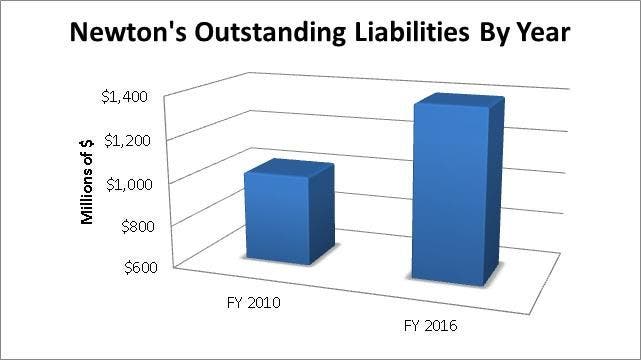
Earlier this week, Newton Mayor Setti Warren announced the City of Newton’s 2018-2022 financial forecast. During his two terms as Mayor of Newton, he has managed to increase Newton’s outstanding debt and other obligations from $1.02 Billion in 2010 to nearly $1.4 Billion; this represents an increase of nearly $373 Million (37%), which exceeds the amount of revenue in Newton’s general fund in the last fiscal year. Yes, Setti Warren increased Newton’s outstanding obligations by a level exceeding Newton’s annual operating revenue since he became mayor. It is clear that fiscal responsibility and stewardship is not a priority for his administration because he is focused on future employment opportunities in Washington either in the Clinton administration or in Congress if Elizabeth Warren joins the Clinton Administration and Joe Kennedy succeeds her as Senator from Massachusetts.
Newton’s increase in debt and other obligations can be broken down as follows.
Find out what's happening in Newtonfor free with the latest updates from Patch.
· OPEB ($187.5 Million)
· Pensions ($109 Million)
Find out what's happening in Newtonfor free with the latest updates from Patch.
· Bonded Debt ($71.25 Million) and
· Other Liabilities ($5.1 Million)
Over the next six years, although Newton expects to increase its adjusted annual operating fund revenue by $77 Million (21%) in 2022 versus 2016, it expects to increase its annual operating expenditures by nearly $97 Million (26%) during the same time period. As a result, the city is projected to incur $43 Million in cumulative operating fund deficits between now and 2022. Mayor Warren and his administration must be hoping that the rapid revenue growth that Newton has enjoyed due to the booming real estate marketplace continues, which would cover the rapid spending increases that he has projected out to 2022.
This should represent a concern for Newton’s beleaguered taxpayers as Newton’s annual operating expenditures and debt continues has grown at a rate exceeding the growth rate in inflation, population growth and median household income. What that means to Newton’s taxpayers is that the cost of government is growing at a faster rate than you can afford to continue funding it. It’s clear that this must change if we want to keep Newton affordable to its existing residents, which is part of life, liberty and the pursuit of happiness, and in doing so without having to resort to government-funded and mandated “affordable housing”, which is more “government-imposed happiness”.
The management of school building projects is a concern, as Angier was initially projected to cost $30 Million in 2012 but has now cost at least $36 Million. Cabot was sold to Newton taxpayers as a $45 Million project during the 2013 override but now is expected to cost $49 Million. However, the real concern is that Mayor Warren insists that the Angier school building project was “under-budget”. We at the Newton Taxpayers Association do not think that a $6 Million cost overrun is in any way “under-budget”.
During the 2013 override campaign, Newton’s CFO Maureen Lemieux said that the administration did not plan on asking the taxpayers for another override for at least five years if Newton voters were to pass the 2013 $11.4 Million override package. Considering that the Administration wants to triple its spending on roadwork and spend an additional $171 Million on new building projects between now and 2023, the Newton Taxpayers Association expects that Newton government will try to sell Newton’s taxpayers on another eight-figure override tax increase package in about two years from now. And when they do, they’ll try to portray it as “reform from reformers” like they did in 2013 while refusing to acknowledge that Newton’s spending and debt problem has gotten worse since the last override.
Newton government made a mistake in giving lavish pay raises and fringe benefit packages to its unions as part of the 2014-18 labor contracts, as it assumed that the city would continue to generate above-average revenue growth up until 2018. When we consider the steadily growth in debt and other interest-bearing obligations (such as pensions and OPEB) and the $200+ Million wish infrastructure spending wish list by city government, we believe that total compensation growth should be at least 1% below revenue growth. Ensuring that compensation growth is below revenue growth would help free up funds to underwrite infrastructure projects without having to ask taxpayers for override tax increases.
While the national general election on November 8th commands most people’s attention, Newton’s taxpayers should not overlook the cloudy financial forecast on the horizon for our city government. Fortunately, they can count on the principals of the Newton Taxpayers Association in standing up for principles of fiscal responsibility and stewardship of taxpayer assets.