Community Corner
Mary Hodgman, An Early Woman of Wakefield
A very early resident of the town, she left a tangible mark upon the landscape.

In 1640, a young girl was born in Roxbury. Her name was Mary Kebbe; her father, Edward had emigrated from England. Her mother, Deborah had been born in Boston in 1618; her family was one of the earliest to make their home here.
By 1661, Mary had found a husband; she married 25-year old Ezekiel Morrill and came to live here in the town then known as Reading, Massachusetts. Ezekiel’s family lived in Roxbury; in May of 1663, he traveled to that town and died during that visit. By the age of 23, young Mistress Morrill was a widow.
Mary was fairly well-to-do. Just the year before his death, Ezekiel had received 47 acres of land north of the Ipswich River. His house and lands, at his death, were worth £ 24. Added to his personal belongings, he had left the princely sum of £93 to his young widow. In the Redding of 1663, that was great wealth, indeed.
Find out what's happening in Wakefieldfor free with the latest updates from Patch.
She did not remain unmarried for long. Just three months after Ezekiel’s death, Mary married again. Young Thomas Hodgman was himself a widower. Born in 1640 in Chislet, Kent, England, he had married Katherine Moore of Salem in 1661. After Katherine’s death, he married Mary Morrill on August 12, 1663. The speed of the remarriages seems heartless to today’s sensibilities, but in 17th century New England, marriage was considered the most natural state for a young man or woman. In this pioneer village, a working farm would require the extra hands and labor that could be expected from a spouse.
The couple made their home here in the town of Redding, deciding in 1664 to purchase lands owned by William Hooper, on the side of the pond, near the road to ‘Oburn, as Prospect Street was sometimes called. They built a home there.
Find out what's happening in Wakefieldfor free with the latest updates from Patch.
It’s significant that the purchase of the property was made with Mary’s money. In Puritan New England, once a woman married, she did not automatically share in her husband’s property, but neither did he share in hers. Her dowry, or marriage portion, or lands and property left to her, remained a woman’s own property. Thus Mary Kebbe Morrill Hodgman purchased William Hooper’s property in her own name. One of a family of ten children, she was probably not schooled, since she signed the deed with a mark instead of a signature. It was only Mary’s name that was on that deed.
In the relative scarcity of records from the early town, it’s remarkable that we know so much about Mary and Tom Hodgman. We know that Mary was fair, because in the early years of her first marriage, two young men were publicly rebuked in separate episodes for making ‘attempts’ upon her. Mary and Tom themselves, along with some other townspeople, were fined in 1671 for ‘uncivill carriages in an unseasonable time of night’ at the tavern or ‘ordinary’ of Thomas Clark, located approximately at Prospect and Park Streets.
Mary’s sister had married another young man in this town, Thomas Parker. She lived nearby. Her father and younger sister would also relocate here. Tom Hodgman went on to become a Sergeant in King Philip’s War, and would serve the town in various capacities (“hog constable,” for one, and surveyor). The couple bought more land and thrived, but they had no children of their own. They would adopt young Josiah Webber and raise him as their son, enjoying an affectionate relationship with his family, and ending their days in his care. Thomas died in 1729, and Mary died in 1735, at the age of 95.
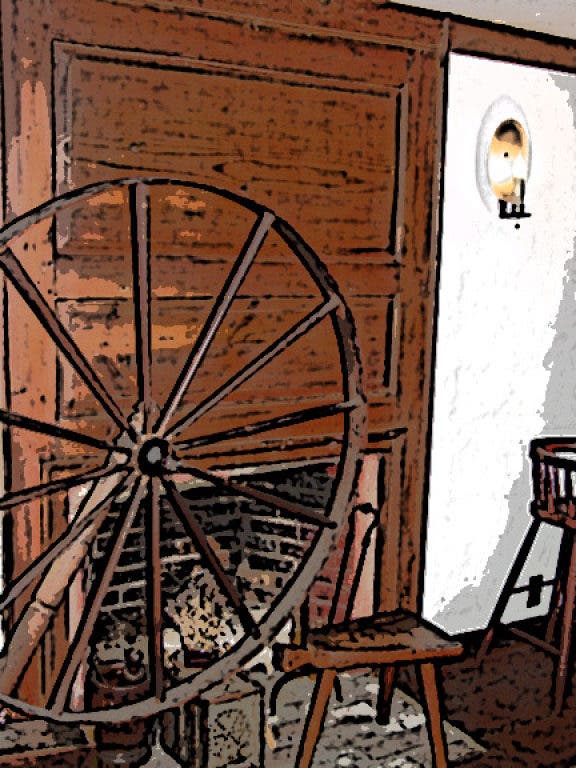
They were ordinary people, working hard in this pioneer town to carve out a life here. What makes their story more compelling is the fact that the home that they built and lived in remains intact at 41 Church Street. The house that they built had additions in later years, but can still be seen and visited.
The house is named after the man who purchased it in 1803: James Hartshorne. The westernmost rooms, downstairs and up, and the ‘summer kitchen’ under a sloping ceiling behind them, made up the home of Mary and Tom Hodgman. Mary’s gravestone can be visited in the Old Burying Ground on Church Street.
For more information about the Hartshorne House, and the Association that works to preserve and protect it, visit http://www.hartshornehouse.org.