Community Corner
Ghost Of Opulent Michigan Theater Haunts Detroit Parking Garage
A picture of the dome of the opulent Michigan Theater, now the state's only Italian Renaissance parking garage, causes a stir on Reddit.


DETROIT, MI — In its day, the Michigan Theater was a special, magical place, as anyone can clearly see if they use a Detroit parking garage carved from the gutted interior of what was called “one of the most impressive first-run movie theaters in the world” in a Detroit Reddit thread. A picture on the social media site shows the ghost of the gilded grand dame — ornate plasterwork on what was once the soaring dome over a four-story theater lobby resplendent with climbing pillars and mirrored walls.
The lobby dome Reddit users are chattering about is one of several vestiges of opulence that were saved in 1977 when the theater was converted into Michigan’s only Italian Renaissance-style parking garage. Still partially intact are the ticket booth, the upper balcony and the proscenium arch.
(For more local news, click here to sign up for real-time news alerts and newsletters from Detroit Patch, click here to find your local Michigan Patch. Also, like us on Facebook, and if you have an iPhone, click here to get the free Patch iPhone app.)
Find out what's happening in Detroitfor free with the latest updates from Patch.
The Reddit user who raved about the Michigan’s world-class status also called it “the Fox on steroids.” When the Fox opened in 1928, it was billed as “the most magnificent temple of amusement in the world,” and it’s difficult to argue it hasn’t fulfilled the promise. But the Michigan surpassed its opulence, according to a Reddit commenter, who said:
“This has actually always been really depressing to me. … And they gutted it for a parking structure.”
Find out what's happening in Detroitfor free with the latest updates from Patch.
Someone who uses the garage regularly at events noted: “One night before we got in our car we walked around and looked at everything, it is so strange to look down into the orchestra pit and see the stage. It is almost frozen in time.”
“It's the perfect metaphor for Detroit," someone else wrote, taking a jab at the Motor City. “Cars above all else.”
The 4,038-seat theater at the corner of Bagley Street and Cass Avenue opened in 1925, according to the HistoricDetroit.org website. It drew big-name stars of the era — the Marx Brothers, Frank Sinatra, Jack Benny, Louis Armstrong, Red Skelton, Glenn Miller, Artie Shaw, Benny Goodman, Doris Day, the Dorsey Brothers, Bette Davis and others — and is inextricably linked to Detroit’s glorious past as an elite American city.
Author Dan Austin tells an amusing tale about Bob Hope in his account of the Michigan’s rise and fall. The comedian thought he was headlining a show at the Michigan, only to arrive and see his name second on the marquee to Joe Mendi — a local celebrity. The joke really was on Hope. As it turned out, Joe Mendi was a trained chimpanzee performer at the Detroit Zoo.
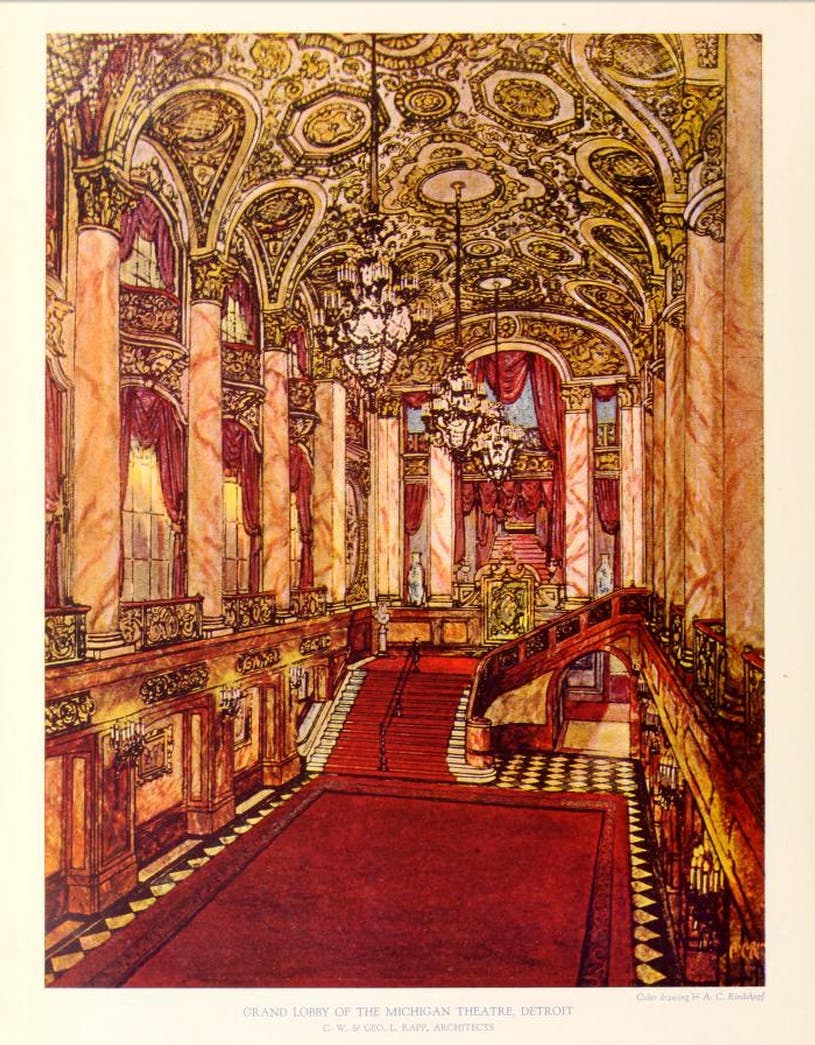
The Michigan was part of a chain of theaters that failed during the Depression, and new owners United Detroit Theaters operated it mainly as a movie studio, embracing new technologies that made it one of only a dozen in the United State with the 3D capabilities to show films like Vincent Price’s “House of Wax.”
An antitrust lawsuit busted up United Detroit Theaters in 1955, but the owners managed to hold on to the flagship Michigan, but by the 1960s, suburban movie theaters and television were cutting into the Michigan’s audience. When the Michigan closed in 1976, the owners of the adjacent Michigan building were poised to take it down with a wrecking ball until Nicholas George, who already had 11 movie theaters in Detroit, stepped in.
He made a valiant effort to revive it, reopening in 1968 with “Valley of the Dolls.” Renting the film, he reportedly said, cost more than the theater itself, but the theater closed for good in 1971.
Under a new Michigan Palace name, other businesses tried to make it a go: a supper club and, later, a rock-and-roll venue that drew some of the top acts of the 1970s. Neither venture ended well, but the last one in particular dulled the once shimmering showplace.
Describing his angst at the condition of the Michigan in a letter published in the Theatre Historical Society’s book on Michigan, Bret Eddy wrote:
“For the first time I saw the Michigan Theatre as a dowdy old lady; some of the red velvet railings had been ripped out, and the floor was littered with much debris. … We mounted the grand stairway with its red carpet littered with mashed paper cups and some of their contents, to the once elegant mezzanine, where we found vodka bottles and beer cans piled in corners. … My mind, rebelling at the sordid scenes we had witnessed, thought of ancient Rome having reached new heights of architectural beauty, only to be invaded and ravaged by barbarian tribes.”
Michigan Palace went dark again in 1976, this time for good. The buildings owners decided to raze it to provide parking for workers in the adjacent office building, but doing so would have compromised the structure of the building, so it was converted to a garage in 1977 at a cost of about $525,000.
The “ghost” of the Michigan’s beauty is by design.
“We wanted to leave some of the theater’s beauty intact,” Leo Cooney, president of the Charge Card Association, told the Free Press in September 1978.
Feature photo by Rex Brown via Flickr Commons
Get more local news delivered straight to your inbox. Sign up for free Patch newsletters and alerts.