Community Corner
Carpenter Bees: Destructive Home Invader
Carpenter bees are a beneficial pollinator, but can also damage your home's wooden structure.


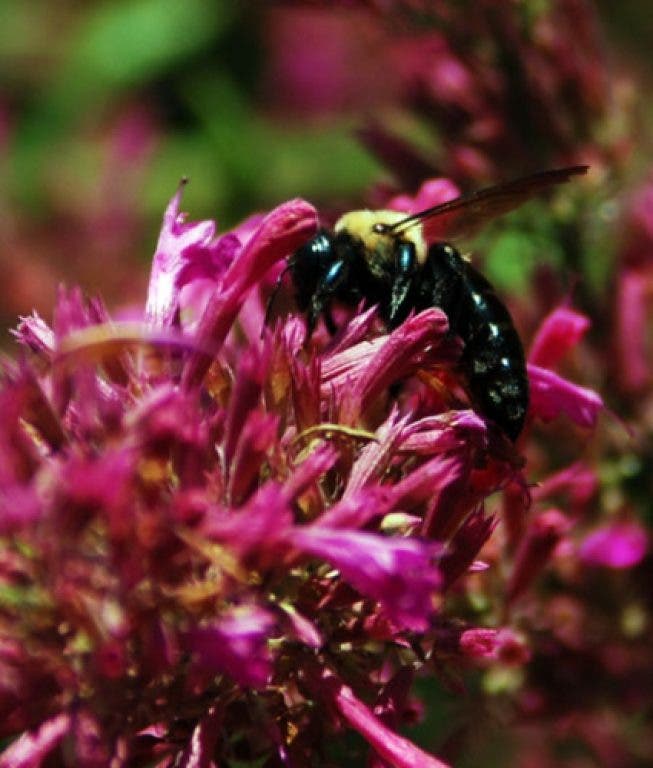


Carpenter bees, Xylocopa and Ceratina species (Hymenoptera: Xylocopidae), may look like the humble bumble bee, but their burrowing habit to protect their offspring can cause havoc with a wood structure like your home.
The most common carpenter bee in Michigan resembles many of the closely related, large, yellow and black bumblebees we have here. The top of the abdomen of a carpenter bee is bare and shiny, whereas the abdomen of bumblebees is covered with black and yellow hairs.
Also, effective pollinators, other species of carpenter bees may be black, green or somewhat purplish with various markings of whitish, yellowish or reddish hairs, and may be considerably smaller. Even though their native nest of choice would be an old tree, carpenter bees can be serious, wood-destroying insects if they choose your home to build their nest galleries. The tunnel created by the boring bee is so perfectly round it appears to have been drilled by a tool. Carpenter bees seem to prefer softwoods like cedar, redwood and clear pines used in window trim, screens, soffits and fascia boards and decks.
Find out what's happening in Farmington-Farmington Hillsfor free with the latest updates from Patch.
These bees do not eat wood like a termite does, but they use their galleries to raise a brood of youngsters. Each larva is provisioned with a ball of pollen and then sealed into a single cell until it completes its development the following spring. Most species of carpenter bees in Michigan have a single generation per year.
Carpenter bees can be controlled by applying a registered insecticide to the gallery opening. If only one or two gallery openings are involved, then an aerosol bee and wasp spray should be enough to kill off the bees. If large areas are affected, then a persistent insecticide like cyfluthrin (sold as Bayer Advanced Garden Insect Control for homeowners or Tempo for commercial applicators) or bifentrhin (sold as Ortho Home Defense Max) can be used to treat the entire area. Painting, or otherwise sealing, the wood is reported to discourage the bees from chewing their holes.
Find out what's happening in Farmington-Farmington Hillsfor free with the latest updates from Patch.
Be sure to read and follow all the instructions and safety precautions found on the pesticide label before using any pesticide.
-- by Howard Russell, MSU Diagnostic Services, Department of Plant Pathology. This article was published by MSU Extension. For more information, visit msue.msu.edu.
Get more local news delivered straight to your inbox. Sign up for free Patch newsletters and alerts.