Community Corner
United Health Foundation’s America’s Health Rankings® Finds Michigan Ranks 37th Compared With Overall Health of Other States
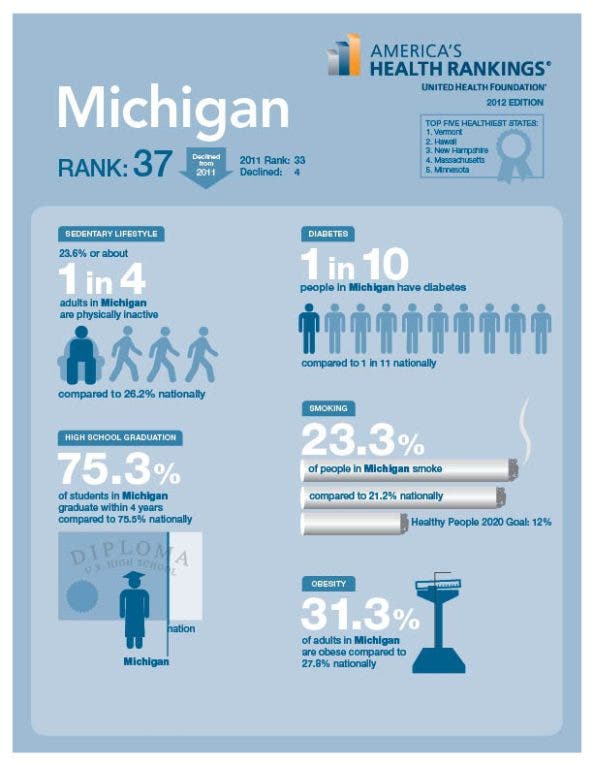
- Michigan Ranks 37th in Overall Health in 2012, down four spots from last year’s Rankings
- Vermont is the healthiest state for the 6thyear in a row; Mississippi and Louisiana tie for last
- Nationwide, nearly 28 percent of the population is obese and more than 26 percent get no exercise, resulting in increasing prevalence of diabetes and high blood pressure
Americans are living longer due to several medical advances, but unhealthy behavior and preventable illness threaten quality of life, according to United Health Foundation’s 2012 America’s Health Rankings®.
While premature, cardiovascular and cancer deaths have declined since 1990 by 18.0 percent, 34.6 percent and 7.6 percent, respectively, Americans are experiencing troubling levels of obesity (27.8 percent of the adult population), diabetes (9.5 percent of the adult population), high blood pressure (30.8 percent of the adult population) and sedentary behavior (26.2 percent of the adult population).
UnitedHealthcare watches America’s Health Rankings closely to better understand the health of individuals and communities nationwide and in Michigan and has several programs in place designed to address these needs. Programs educate U.S. and Michigan citizens on how to live healthy lives and empower individuals to advocate for public health improvement.
Find out what's happening in St. Clair Shoresfor free with the latest updates from Patch.
“America’s Health Rankings from United Health Foundation is an incredibly valuable tool for us to clearly understand health trends facing us as a nation and here in Michigan,” said Richard Gajdowski, M.D., medical director, UnitedHealthcare of Michigan. “By identifying the key opportunities we face as a state we can pursue innovative solutions to those opportunities.”
Michigan’s Bill of Health
Find out what's happening in St. Clair Shoresfor free with the latest updates from Patch.
According to the 23rd Edition of America’s Health Rankings, Michigan is 37th this year compared to 33rd in 2011 when compared with the health of other states. This year’s report finds that, similar to every other state, Michigan has its share of strengths and challenges.
Michigan’s Strengths
Low prevalence of sedentary lifestyle
Low rate of uninsured population
Low occupational fatalities rate
Michigan’s Challenges
High prevalence of obesity
High prevalence of smoking
Low immunization coverage
UnitedHealthcare Programs Address Michigan’s Health Needs
UnitedHealthcare has several programs in place that seek to address the health concerns underscored in this year’s America’s Health Rankings.
“While we celebrate the improvements our state has made in a variety of areas, we still have a long way to go to reverse the direction of many health trends,” said Dr. Gajdowski. “The good news is that there are programs and initiatives underway in Michigan that can benefit those looking to make positive, healthy changes to their way of life.”
- Obesity and Diabetes: This year’s Rankings identified that 2,373,000 adults in Michigan are obese and 758,000 adults have diabetes. But programs and partnerships across the state are helping to steer Michigan adults and children in a healthier direction.
- UnitedHealth HEROES is a service-learning, health literacy initiative designed to encourage young people, working with educators and youth leaders, to create and implement walking, running or hiking programs aimed at helping fight childhood obesity. Grants of up to $1,000 are awarded to youth-led programs in Michigan that include both an activity element, in which kids count their steps, and a service component that increases awareness, provides direct service, enables advocacy on behalf of a cause, or features youth philanthropy around the issue of childhood obesity.
- Smoking: With tobacco use as the number one modifiable risk factor in adult mortality in the United States, UnitedHealthcare strongly supports national and local initiatives encouraging tobacco use identification and cessation. Additionally, the United Health Foundation in 2011 awarded a three-year, $2.8 million grant to the Campaign for Tobacco-Free Kids to fund its “For Youth By Youth” program. The grant will recruit and train student anti-tobacco advocates in at least 20 states who will work with their peers to help achieve the goal of reducing the youth smoking rate from 20 percent to 15 percent by 2015.
- Immunizations: While progress has been made in prevention of many vaccine-preventable diseases, some of those diseases still occur because some populations at risk are not adequately immunized. UnitedHealthcare covers as a preventive service all immunizations recommended by the Advisory Committee on Immunization Practices of the Centers for Disease Control and Prevention, including pertussis, measles and hepatitis A.
The United Health Foundation is continuing to enhance its website, americashealthrankings.org, with a variety of tools to help individuals make healthy choices, including customizable reports, enhanced social media and other innovative online resources.
All 50 States: Vermont Still the Healthiest; Mississippi and Louisiana tie for last.
For the sixth year in a row, Vermont is the nation’s healthiest state. Hawaii is ranked second, followed by New Hampshire, Massachusetts and Minnesota. The five least healthy states are South Carolina (46), West Virginia (47), Arkansas (48), and Mississippi and Louisiana, which tied for the 49th slot. States that showed the most substantial improvement in rankings include: New Jersey (nine slots), Maryland (five slots), and Alabama, Colorado, Massachusetts, Nebraska, Oklahoma and Rhode Island (three slots).
Nationwide: Improved survival rates offset by escalating rates of chronic illness.
This year’s Rankings show that national death rates have improved in several key areas, including:
- Premature Death declined 18.0 percent in the last 23 years, from 8,716 years of potential life lost before age 75 per 100,000 people in 1990, to 7,151 years of potential life lost before age 75 per 100,000 people in 2012. Premature deaths, like several other metrics, have leveled off in the last decade compared to gains in the 1990s.
- Cardiovascular Death declined 34.6 percent since 1990, from 405.1 deaths in 1990 to 264.9 deaths per 100,000 people in the 2012 Edition. This continues a relatively constant improvement of 2 percent to 3 percent each year.
- Cancer Death declined 7.6 percent from 197.5 deaths in 1990 to 182.5 deaths per 100,000 people in the 2012 Edition. This continues to show a more rapid improvement in the last few years than earlier in the century.
However, while the Rankings show notable improvements in survival rates, the quality of these lives are threatened by epidemic rates of preventable chronic illness, including:
- Sedentary behavior, which is defined as not doing any physical activity outside of work for the last 30 days, is at dangerous levels, affecting 26.2 percent of Americans. Rates of sedentary behavior are as high as 35.0 percent of the adult population in Mississippi, Tennessee and West Virginia.
- Obesity is at epidemic proportion. The national median of obese adults is 27.8 percent or 66 million adults – more than the entire population of the United Kingdom. Even the thinnest state, Colorado, has one-fifth of its population obese.
- Diabetes is also at epidemic proportion. The national median for adults with diabetes is 9.5 percent. This does not include cases of undiagnosed diabetes, which would increase this rate significantly.
To see the Rankings in full, please visit: www.americashealthrankings.org.
About United Health Foundation’s America’s Health Rankings®
America’s Health Rankings® is an annual comprehensive assessment of the nation’s health on a state-by state basis. It is published jointly by United Health Foundation, American Public Health Association and Partnership for Prevention.
The data in the report come from well-recognized outside sources, such as the Centers for Disease Control and Prevention, American Medical Association, FBI, Dartmouth Atlas Project, U.S. Department of Education and Census Bureau. The report is reviewed and overseen by a Scientific Advisory Committee, with members from leading academic institutions, government agencies and the private sector. A key America’s Health Rankings data source – a telephone survey by the U.S. Centers for Disease Control and Prevention that accounts for seven of the 24 measures in the index – was changed this year to include cell phone-only households as well as a household-weighting process that better reflects increasing diversity within states. As a result of the new techniques, the rates for following seven measures cannot be compared to previous years: smoking, obesity, binge drinking, sedentary lifestyle, diabetes, poor physical health days and poor mental health days.
America’s Health Rankings is the longest running report of its kind. For 23years, the Rankings has provided an analysis of national health on a state-by-state basis by evaluating a historical and comprehensive set of health, environmental and socioeconomic data to determine national health benchmarks and state rankings. The Rankings employs a unique methodology, developed and annually reviewed by a Scientific Advisory Committee of leading public health scholars. For more information, please visit www.americashealthrankings.org.
About the United Health Foundation
Guided by a passion to help people live healthier lives, United Health Foundation provides helpful
information to support decisions that lead to better health outcomes and healthier communities.
The Foundation also supports activities that expand access to quality health care services for those in challenging circumstances and partners with others to improve the well-being of communities. After its establishment by UnitedHealth Group [NYSE: UNH] in 1999 as a not-for-profit, private foundation, the Foundation has committed more than $200 million to improve health and health care. For additional information, please visit www.unitedhealthfoundation.org.
About UnitedHealthcare
UnitedHealthcare is dedicated to helping people nationwide live healthier lives by simplifying the health care experience, meeting consumer health and wellness needs, and sustaining trusted relationships with care providers. The company offers the full spectrum of health benefit programs for individuals, employers and Medicare and Medicaid beneficiaries, and contracts directly with more than 650,000 physicians and care professionals and 5,000 hospitals nationwide. UnitedHealthcare serves more than 38 million people and is one of the businesses of UnitedHealth Group (NYSE: UNH), a diversified Fortune 50 health and well-being company.