Politics & Government
Lockhart: 'If Hillary Thinks It's Funny, It's Funny:' Behind The Funniest Night In Politics
President Clinton's former press secretary: The value of the dinners is to show the media and public a different version of the president.

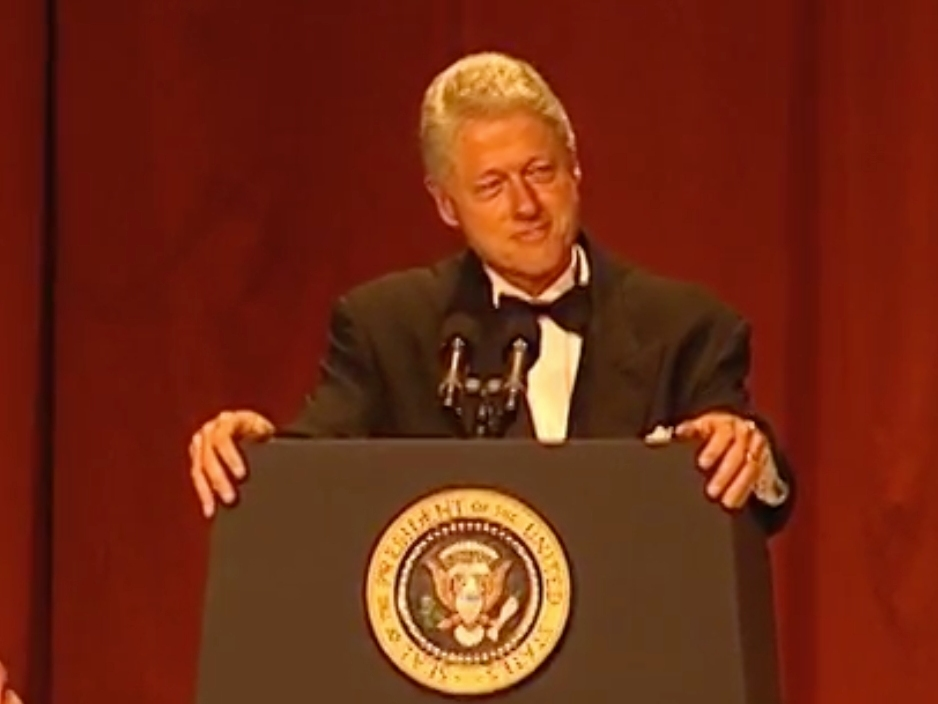
This weekend, Washington will perform its annual rite of spring – Nerd Prom, or more commonly called the White House Correspondents’ Dinner. There will be the usual multitude of parties, each designed to be different but drawing the same crowd, culminating in a display where anyone even tangentially associated with journalism shows up in formal attire — formal attire defined generously.
This year’s dinner is generating more buzz than usual because President Trump is reportedly attending for the first time since 2015, before he was even president. The last time he attended one of these dinners, he was roasted so memorably by President Obama that some believe he vowed to run for president in revenge.
Find out what's happening in Across New Hampshirefor free with the latest updates from Patch.
Trump’s potential attendance aside, these dinners are always remembered for the speech. An enormous amount of work goes into making the least naturally funny people in the world — presidents — seem like seasoned stand-up comics while maintaining their presidential dignity, of course. Though every president approaches this task differently, prepping for President Clinton’s last WHCD speech in 2000 was one of the more memorable moments of my time as his press secretary.
The first White House Correspondents’ Dinner was held in 1921, and President Coolidge was the first to attend in 1924. The dinner was designed to bring the president and the press together for one night of fun and light ribbing. They remained that way for more than half a century until the late 1980s, when Hollywood celebrities started attending, and the competition for the best table became secondary only to the competition for the best joke. In 1976, the cast of “Saturday Night Live,” which had built its reputation mocking President Ford, was even invited to attend. It certainly foreshadowed what was to come.
Find out what's happening in Across New Hampshirefor free with the latest updates from Patch.
While serving as President Clinton’s White House press secretary in April 2000, we were faced with the challenge of how to go out with a bang after eight years, topping the string of very successful White House Correspondents’ Dinner speeches Clinton had given over the years. We had already used video for the first time at the Radio-TV Correspondents’ Dinner earlier that month — three professionally produced ads supporting Al Gore that were all about President Clinton. That led to the idea of doing something bigger. Producing a full-blown video for the WHCD was floated, but in the hustle and bustle of the White House, the idea was shelved to be discussed later.
Then everything changed.
Susan Page, president of the White House Correspondents’ Association, called to tell me she had invited the cast of “The West Wing” to the dinner. They were thrilled to be invited and had a suggestion of their own: They wanted to create a video to show at the dinner. An exclusive piece from the creator of Washington’s favorite TV show, Aaron Sorkin, for your little dinner party? You wouldn’t say no to that.
To my surprise, their idea involved me. Earlier that month, the Los Angeles Times had run a story about the real West Wing’s reaction to the fictional West Wing. I had said something to the effect that the show was both entertaining and educational, though I wondered who all those people were, walking so quickly through the hallways.
That commentary got their attention, and Sorkin wrote a skit about those fast-walking staffers and asked if I’d come out to Los Angeles to shoot with the cast. A very fun day unfolded with the cast of alternative West Wingers — C.J., Josh, Sam, Toby and President Bartlet — and I quickly learned it was a Sorkin project when I tried to change one word in the script and was hit with the first rule of “The West Wing”: No one changed Aaron’s words.
After 16 hours, I was flying back to Washington, but somewhere over Nebraska I realized I had a big problem. I knew it was going to be funny — really funny. And the worst thing you can do at one of these dinners is to be funnier than the president.
Back at the office the next morning, I pulled a small group together and explained the crisis. While the general sentiment in the room was to leave me to suffer, we quickly agreed we needed a video of our own — one that was funnier than the Aaron Sorkin production.
You might not think that was possible, but we were confident we had a chance. Sorkin and “The West Wing” had me, but we had the president of the United States.
The problem was that we had no idea what the video should be about. The best speeches and videos capture the mood and vibe of D.C. and make fun of it. That mood inside the building at the time centered on two things: Hillary Clinton running for Senate, and President Clinton being alone in the White House. Joel Johnson, Clinton’s senior adviser for policy and communications, reminded us of President Nixon in his final days at the White House talking to the portraits. We liked the image but needed more.
I had a brilliant idea. The hottest show on television was “The Sopranos,” where a mafia boss, Tony Soprano, worked out his issues with a therapist. How funny would it be to have the president sit with Dr. Melfi to deal with the loneliness of the White House? The producers of “The Sopranos” even offered to write it themselves. The show agreed to work up a script and make Lorraine Bracco available for a “session” with the president. Problem solved!
But one day common sense came to visit. Having the president sit with a TV therapist to talk about his problems was not something we could do, at least not as we left the 20th century.
The next morning, we convened to discuss an alternative. Once again, Joel Johnson came to the rescue. He stuck his head in my office door and said two words: “Home Alone.” “The Final Days” was born.
It takes a fair amount of work to go from concept to finished product, whether it’s a speech or a video — more than most people imagine. Previous administrations had relied on outside joke writers and professionals to provide the bulk of the one-liners.
In the eight years of Clinton’s presidency, we had learned that to really find the humor in presidential life, you had to live it. The media loved nothing more than jokes about themselves, and only those steeped in it could capture that. It was one of the few presidential speeches written for the people in the room, not the massive audience watching on their various screens. We relied heavily on a variety of staff around the building. The White House is filled with brilliant people; it was no surprise that many of them were wickedly funny.
Our concept: the president alone and adrift in the White House, gradually discovering how much fun that freedom could be. All we needed were ideas to bring that to life and actors to play their parts. And to get the president to sign off on all this, of course.
I wish I could say I wrote, produced and directed the entire video. That is not true. However, I did have some important jobs. First and foremost: convince the president to participate. I got his approval while he was distracted, and I’m pretty sure he wasn’t listening to me.
I also had to convince the scheduling office to give me presidential time, which was almost as difficult. I had spent 16 hours on set with “The West Wing” cast shooting, but I was given 90 minutes on a Tuesday and 90 minutes on Saturday — the day of the dinner — to get our video completed.
My final and easiest task was recruiting a supporting cast, which proved to be simple given the great script. The basic storyline was a lonely president with not enough to do wandering aimlessly around the White House. A White House news conference with only one reporter attending — Helen Thomas, asleep in the briefing room. Cameos from TV stars like Sam Donaldson and Tim Russert breaking news that there was nothing left to cover.
Senior staff all wanted in after word got around about John Podesta’s killer performance explaining his worry about the president because he’d shown up to the Oval in his pajama bottoms.
The shift to a joyous, free, relaxed president also needed a supporting cast. Again, no problem. The chairman of the Joint Chiefs of Staff was delighted to travel to the Situation Room to play Battleship with the president. An Academy Award-winning actor was ready to take the red-eye to shoot one scene. He called back to ask if he should bring his Oscar. (We said yes.) And no surprise, Terry McAuliffe was up for a bike ride inside the Eisenhower Office Building. Simple tasks like cutting the White House lawn with a manual mower drew praise from Al Gore.
Unburdened by the loneliness of the White House, the president even ventured out himself to wash the limo and hit golf balls from the South Lawn that magically landed in the Republican members of Congress’ parking lot.
But we were missing one key player — the first lady, whose travels had created the mythical and ridiculous idea that the president had nothing to do. A polite call to her office on Tuesday to participate was quickly rebuffed by her staff without a lot of explanation.
Then word got around the White House that the first day of shooting went very well and was shaping up to be very funny. On Friday night, the night before the dinner, I got a call from her office looking for an explanation for Hillary on why she wasn’t invited to participate.
I did what most staffers do in that circumstance and said the script was done and would be sent over after one final proofread, and gave instructions for the first lady to show up at the South Portico at 10 a.m. the next morning.
Not a word of that was true. Unfortunately, the main writers — Joel Johnson, chief speechwriter Jeff Shesol and his team, and Jim Kennedy, Jake Siewert and Jennifer Palmieri on my team — had all left for the night. I had only a few minutes to deliver the non-existent script to be passed along to Hillary.
I wracked my brain for an idea and rejected many. But I kept coming back to the interview she gave “60 Minutes” in 1992 — that she was not the “stand by your man” woman who bakes cookies all day at home — and an idea was born.
The next morning, Hillary sat in the presidential limo that was preparing to leave the White House, but then she paused, rolled down the window and said to the camera, “I’m worried about Bill. He doesn’t seem to have enough to do.” On cue, the president came running out of the White House chasing the departing limo, brown bag in hand, screaming, “Hillary, you forgot your lunch.”
Peter Hutchins, my oldest friend, directed the video, and Al Haehnle, a gifted photographer who is unafraid to ask anything, stopped the limo and convinced her to shoot a second take, this time with him in the limo to see it from her point of view. Though we hadn’t filmed a second take on any other scene given our tight schedule, she agreed and we got the perfect scene.
It served as the transition from unhappy, lonely president to the one who found joy in all the little things of being president.
By 1 p.m. the day of the dinner, shooting was done. All that needed to be done was the editing. Around 5 p.m., Peter called to tell me the computer had frozen. With only hours before it was time to leave, they had lost the whole thing. I calmly explained he was wasting time talking to me, because he was going to deliver the tape by 6 p.m. no matter what.
Putting something together that quickly under any circumstances was difficult, but not impossible.
Despite not having a video, my mind shifted to a completely different problem.
We didn’t have presidential approval to use the video, and we didn’t have a video to show him. The written speech was strong and funny but would have run too short without the video. Since everything had been shot out of sequence, Clinton had no real sense of what the video would look or feel like.
We needed the video — and I needed him to like it.
We had arranged time before departure to show him the video and convince him it was funny. We had a room in the East Wing, and we packed it with the loudest laughers on the staff. We had a tape machine and a TV; we just didn’t have any tape.
We stood around nervously with the president waiting for a video to show up. Around 6:30 p.m. — 10 minutes before departure time — Jennifer Palmieri came running through the northwest gate in her evening gown with the video in hand. She ran to the East Wing and, out of breath, threw the tape into the machine and hit play.
First scene. Second scene. Third scene. No reaction from the president. About a quarter of the way through the video, the first lady arrived. It was clear he didn’t think it was funny, and I wasn’t sure I could handle her not liking it either.
We restarted the tape and started over. All the staff laughed where they were supposed to, and finally, thankfully, Hillary began to chuckle. As the video played on, her chuckle became more of a cackle. She stood up at one point, doubled over laughing, announcing she had seen enough.
I looked to the president, who frankly still didn’t get it, but he turned to me and said, “If Hillary thinks it’s funny, then it’s funny. Let’s go.”
“The Final Days” was a success. For a few days, it was the talk of Washington. News clips arrived from outlets around the world. Some would call it the first viral video, setting a precedent for future administrations to create videos for the dinner.
President Trump is likely to land some jokes this weekend if he stays on script. As leader of the free world and with some good writers, it isn’t that hard. But what is almost always funnier than the speech is the behind-the-scenes work that goes into making that speech: the scrambled concepts, the last-minute recruits, the tape that almost didn’t exist.
The real trick at the White House Correspondents’ Dinner has never been writing a killer one-liner. It’s making fun of yourself as president, and having the permission to gently make fun of everyone else in the room. We’ll see if Trump has that in his playbook. I wish his staff well and hope they get the case of antacid I sent over.
Jokes aside, the real value of these dinners is to show the media and the public watching a different, more accessible version of the president. Anytime a president can have a human moment, the media is well served and the public gets just a little closer to understanding who their president is.
Buckle up — Saturday is going to be fun for one reason or another.
Joe Lockhart is President Bill Clinton's former White House press secretary and a managing director at Rational 360.
This story was originally published by the NH Journal, an online news publication dedicated to providing fair, unbiased reporting on, and analysis of, political news of interest to New Hampshire. For more stories from the NH Journal, visit NHJournal.com.