Schools
Concord Board Of Education Member No Longer Resides In District, Refuses To Resign
Kate West, who moved out of a Jackson Street apartment in September, is using the "domicile loophole" to hold onto the Ward 1, 2, 3, 4 seat.


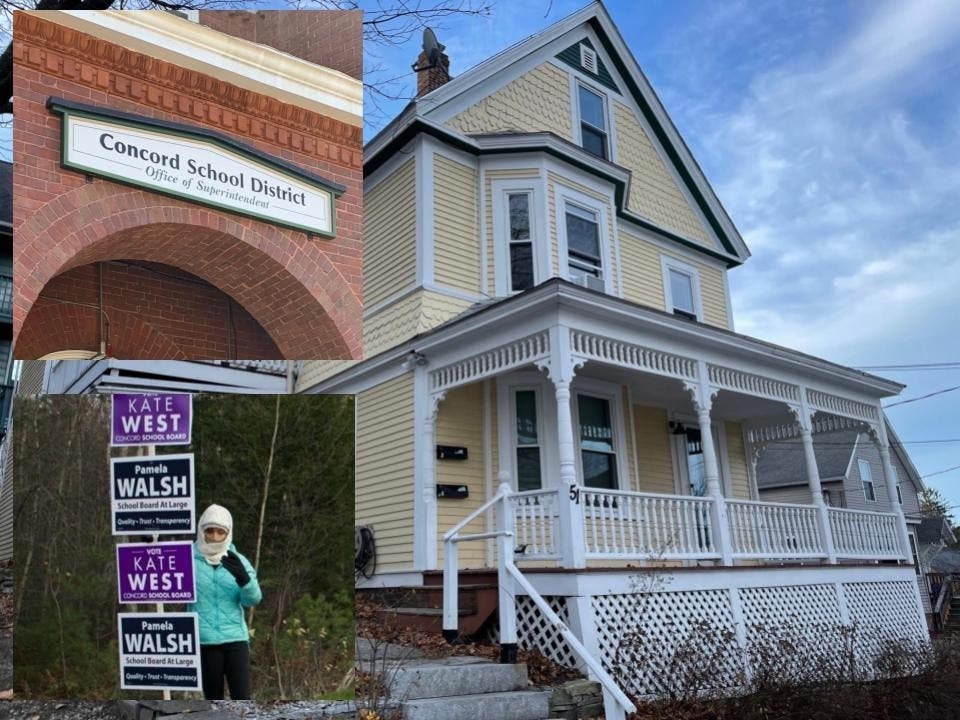

CONCORD, NH — A district SAU 8 board of education member, who vacated her apartment in September, is refusing to resign, using a loophole in state law to hold onto her seat, even though she no longer lives in the district she was elected serve two years ago.
Kate West, who was elected to represent District A, which covers Wards 1, 2, 3, and 4 in November 2020, left her apartment on Jackson Street in the North End in early September. For about a week, school district officials and board members could not reach her. Later, they found her and found out she had moved out of the district's wards but was staying elsewhere in the city.
According to officials, West abandoned her apartment after her landlord told her the building would be sold and the rent might increase. According to city assessor records, the building was sold to a couple from Brighton, Massachusetts, in late October. It is currently vacant.
Find out what's happening in Concordfor free with the latest updates from Patch.
Jim Richards, the board president, said the district connected with Patrick Taylor, a former member who is now the clerk and responsible for ensuring the board followed the charter. After reviewing the current charter, and speaking with Dean Eggert, an attorney for the district, as well as the Secretary of State’s office, West was designated as “temporarily homeless” and allowed to still able to serve since her “intention” was to remain in District A.
“The law pertaining to domicile is set out in the election statutes and depends greatly on the intent of the individual as evidenced by their actions and statements,” Richards said.
Find out what's happening in Concordfor free with the latest updates from Patch.
In the past, board members who moved out of their elected districts or out of the city, even temporarily or planned in the future, either were requested to resign or did so on their own. West believed she could stay on even though she no longer lived in the district’s wards.
“Ms. West informed the board that it was her intent to remain in District A as a resident,” Richards said.
Kathleen Murphy, the school district superintendent, confirmed attorneys told the board and district state law allowed West to hold onto the seat.
“We asked them to provide guidance,” she said. “The district’s attorney believes the RSAs provide guidance relevant to (a board member’s) domicile, which allows a person to continue to hold that residence until they find a (new) permanent residence. Basically, that is what our attorneys are telling us.”
Murphy said West’s insistence to stay on, and even hiring her own lawyer, instead of just resigning and running again, at a future date, when she found new housing, put everyone in a difficult position.
“Any time the board is put in that position,” she said, “it isn’t good. I went through that with them; I know what they are trying to accomplish.”
Richards added, since West had not “at this time, taken another permanent residence,” the attorneys believed she could remain seated. The charter, he said, also did not have a provision to remove a duly elected member of the board.
If West had moved to another community or established a permanent residence in wards other than 1, 2, 3, or 4, she would need to resign.
Current Charter Requires 'District' Residency
Another part of the confusion appears to be language in the current charter and whether it is speaking of the district seat or the school district.
Section 5, Qualifications, of the school district charter, changed and approved by voters in 2011, stated, “Whenever a board member ceases to be a resident of the District, the board shall declare his seat vacant and shall fill the vacancy as herein provided.”
Since it is under the Qualifications section of the new charter that created “district school board seats,” it is clear to most it is speaking of the seats, not SAU 8 school district. It is, however, being interpreted differently now.
At the end of December, a new charter will be implemented. The new charter changes the name of “School Voting District” A, B, and C seats to “School Voting Zone” A, B, and C, to alleviate any confusion between “ward seat districts” and “the school district” — something that had never been an issue until now.
The new charter also changes the language of 5. Qualifications section.
The new language requires a candidate for a zone seat to be a registered voter and domiciled in the wards. And, to hold office, “a person must maintain, during the term of office, a domicile in that School Voting Zone.” If a board member ceases to maintain a domicile in the zone wards or otherwise resigns from office, the board will “declare the office of such person vacant and shall appoint a qualified person” to serve for the remainder of the calendar year until a new person can be elected.
“The Secretary of State's office and our legal counsel have responded that based on the revised charter, Ms. West will have to establish a residence in District A or leave the board,” Richards added. “The board is awaiting written confirmation of this requirement from the Secretary of State’s office.”
If West were elected citywide, her residency in different locations around the city would not be an issue.
Originally, the 2021 SAU 8 charter commission changed the 5. Qualification section to allow for what West is partially doing — continuing to serve in a district seat until the next election, even after moving out of the district, so long as they remained a resident of Concord.
Both the New Hampshire Attorney General’s Office and the Secretary of State’s Office rejected the change. So, the commission removed the language and replaced it with the vacancy after the member moves out of the zone seat wards.
Some School Board Members React
Five school board members — Virginia Cannon, Brenda Hastings, David Parker, Pamela Walsh, and Jonathan Weinberg were emailed requesting comment but did not respond at post time.
Barbara Higgins, however, who has been both a district and at-large school board member, said she had felt “extremely uncomfortable” about West staying on and was relieved the issue was finally being addressed.
“As a four-term board member, who arrived on the board after a job loss, I have paid attention to the aspects of public service that are non-negotiable,” she said. “Kate was elected by people in District A … if she is not living there, she should not serve. The circumstances matter not.”
Bob Cotton, another at large school board member, said it was his understanding the matter would be resolved when the new charter is put in place on Jan. 1, 2023, due to the new language concerning members no longer residing in a zone area.
“Thus,” he said, “I think if Kate is no longer residing in Zone A on Jan. 1, that she will need to resign and, assuming Jim is still the board president, he will need to appoint a new Zone A resident to serve.”
West did not respond to a phone call, text message, and an email requesting comment.
West easily bested Roy Schweiker, who did not actively campaign for the seat, by a three-to-one margin, as one of several Young Democrats elected to municipal and legislative offices that year.
According to the city clerk’s office, West voted in the general election in November from the Jackson Street address, even though she no longer lives there.
Janice Bonenfant, the city clerk, said state law allows people who serve in the military, are expatriates who may be living or working overseas, and elderly residents who may have moved into senior centers, to vote from their prior addresses even though they may no longer live at the property or it was occupied or owned by someone else.
West falls under none of those categories.
Prior legal decisions allow voters between residences to vote at the last locations they were registered via the “domicile loophole.”
Prior Resignations
In the recent past, most school board members have resigned whenever their residency was questioned or they moved or planned on moving out of district seats or the city.
Back in March 2014, at-large school board member Nick Metalious resigned after he was featured in a news story with WMUR-TV concerning a car crash he was involved with and was labeled as a Manchester resident in the interview.
At the time, he was spending a lot of time at his girlfriend’s home but still maintained an apartment in the city. Metalious had not decided whether to run at large again that November or move in with his girlfriend but decided to resign after several people questioned his residency.
After he resigned, the board president at the time, Kass Ardinger, chose a replacement.
About five months after Metalious resigned, Melissa Donovan, who was serving in the District A position, offered her resignation after she and her family purchased a home in Pembroke. Even though she had not yet moved out of the district or city at the time, she told Patch she was resigning early, which was the right thing to do, to allow other candidates to sign up to run for the vacancy before the November 2014 election.
Donovan was also critical of the appointment process, saying a resident from the city's east side should have been chosen to replace Metalious.
Six years later, Jennifer Patterson, who was the board president at the time, also resigned before she needed to, knowing that she would eventually be moving out of state.
The 'Domicile Loophole'
This appears to be the first time the “domicile loophole” has been used to preserve a political position.
During court cases and other legal matters, the loophole has been used effectively to allow non-residents to vote in New Hampshire elections.
Part 1, Article 11, of the state constitution’s Elections and Elective Franchises clause, partially states, “Every person shall be considered an inhabitant for the purposes of voting in the town, ward, or unincorporated place where he has his domicile.” The clause was written in 1784, when the word “domicile” was considered a person's permanent residence.
For many years, the loophole has been used by non-residents, college students, and “visiting professionals,” such as political activists working on campaigns, to vote in the state’s elections instead of filing an absentee ballot from their homes.
New Hampshire is one of the only states in the United States that allows what is also described as “drive-by voting” and has looser residency standards with voting due to legal interpretations of the wording in the clause.
Since the state has same-day voter registration, dozens of incidents have been reported, even witnessed by former Secretary of State Bill Gardner himself, of people who do not live in New Hampshire voting here.
Got a news tip? Could you send it to tony.schinella@patch.com? View videos on Tony Schinella's YouTube.com channel or Rumble.com channel.
Get more local news delivered straight to your inbox. Sign up for free Patch newsletters and alerts.