Politics & Government
Sherrill's New Affordability Plan For NJ: Who Wins, Loses
Governor Sherrill presented her $60.7B spending plan Tuesday, which she described as "rooted in lowering costs for hardworking families."


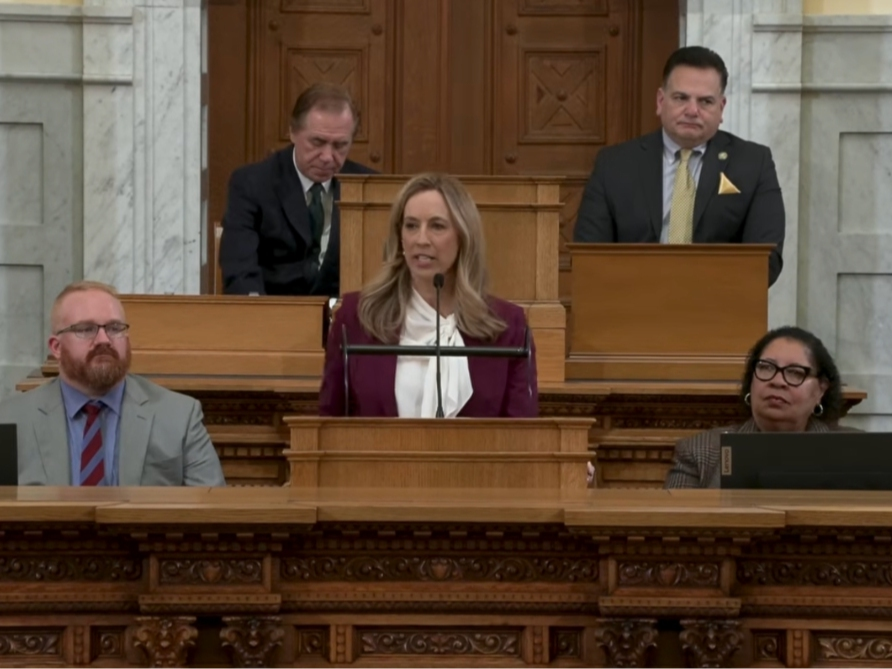
Affordability was the key theme that ran through Governor Mikie Sherrill’s first state budget address on Tuesday, as New Jersey looks to resolve rising costs and prevailing budget issues such as an estimated $3 billion structural deficit.
Property taxes, utility costs, health care and housing all feature into the proposed $60.7 billion spending plan.
In her address for the 2027 Fiscal Year, Sherrill outlined details that include a $5.4 billion surplus and $2 billion in cuts.
Find out what's happening in Across New Jerseyfor free with the latest updates from Patch.
Though Sherrill is proposing significant cuts in the budget, she described them as “tough-but-necessary,” adding that her budget is “rooted in lowering costs for hardworking families and making state government more accountable to the people we serve.”
“If we do nothing, our entire $7.2-billion-dollar surplus will be gone in less than two years – and we’ll be another $750 million in the hole,” Sherrill said.
Find out what's happening in Across New Jerseyfor free with the latest updates from Patch.
Here’s what you need to know about some of the key points of Sherrill’s plan, and her goals to keep New Jersey affordable:
Medicaid & Health Care
In her budget address on Tuesday, Sherrill floated changes that would increase the burden on corporations that employ people using Medicaid.
According to Sherrill, nearly half a million New Jerseyans will see their premiums triple this year because Affordable Care Act credits won’t be extended, and because the H.R.1 law “makes people jump through hoops” to stay on Medicaid, 300,000 more residents will be kicked off.
“To prevent that, this budget invests in new technology to help people meet Trump's burdensome paperwork requirements,” Sherrill said. “...Instead of asking taxpayers to foot that bill, this budget looks to large employers.”
“It asks any company with 50 or more employees on Medicaid – companies like Amazon and Walmart – to cover their workers, which they should do anyway; or pay a fine,” she continued. “That helps warehouse workers, cashiers, healthcare aides – people who keep our economy running.”
In addition to keeping residents covered, Sherrill’s budget also includes $7.2 billion in state funding for NJ Family Care (which provides health care to over 1.8 million residents), and reforms to PBMs (Pharmacy Benefit Managers) that may drive up prescription costs.
“Common-sense PBM reform is one of the most effective and immediate ways to lower healthcare costs, and we commend Governor Sherrill for her continued focus on New Jersey patients and affordability,” said Chrissy Buteas, the president and CEO of the HealthCare Institute of New Jersey.
“From her Congressional tenure to her campaign proposals, the Governor has advocated for PBM reform as a thoughtful and balanced approach to lowering costs, and she’s working with a true sense of urgency to deliver real savings for patients.”
Though some supported Sherrill’s reform plans, others disagreed with her remarks on Tuesday.
In a statement to ROI-NJ, the Pharmaceutical Care Management Association described Sherrill’s statements on PBMs as “simply untrue and misleading to New Jersey patients,” adding that the mission of PBMs is to “reduce prescription drug costs, and they do so highly effectively.”
“Contrary to Gov. Sherrill’s assertion, PBMs are working every day to lower prescription drug costs for New Jersey patients,” the association said. “PBMs save an average of $1,154 per person annually for the 8.3 million New Jerseyans they serve, and over the next 10 years, that work will save the state more than $37 billion.”
Though the association disagreed with some of Sherrill’s remarks during the budget address, they said they are still “eager to work together” to achieve a shared goal of lowering drug costs.
Property Taxes
During Tuesday’s address, Sherrill said her budget proposal would provide the most property tax relief in state history, including $2.3 billion for ANCHOR, $700 million for Stay NJ, and $350 million for the Senior Freeze Program.
Though Sherrill is promising relief on property taxes, she said some changes might still be coming for Stay NJ, which offers benefits to eligible homeowners aged 65 and older.
Under her proposal, eligibility for Stay NJ would be modified to cap the qualifying income threshold at $250,000, matching ANCHOR. Additionally, the maximum benefit amount for Stay NJ would be capped at $4,000.
“Stay NJ is a great program – it keeps seniors, so often living on a fixed income, in their homes,” Sherrill said. “But it benefits households that make as much as $500,000 a year. I'm changing that to safeguard Stay NJ for middle-class seniors.”
“If you make $250,000 or less, your tax relief is in this budget,” she continued. “That’s going to save taxpayers hundreds of millions of dollars a year.”
In a statement sent to Patch, AARP NJ State Director Chris Widelo urged a budget that protects affordability for older residents, pointing to property tax relief, renter support, and utility affordability as key priorities.
“For many New Jerseyans, property tax relief programs like Stay NJ, ANCHOR, and Senior Freeze are essential,” Widelo said. “They are the difference between staying in their homes or being forced to move…As policymakers consider adjustments, it is critical that the program does not reduce the annual benefit and continues to provide meaningful relief while keeping the promise made to the people counting on it.”
Utility Rates & Housing
During Tuesday’s budget address, Sherrill also hit on rising utility rates and affordable housing.
On her first day as governor, Sherrill declared a State of Emergency over the rising cost of electricity in the state, and signed an executive order authorizing the NJ Board of Public Utilities (BPU) to pause “any proceedings in which electric distribution utilities seek approvals for rate increases or cost recoveries.”
The order also directs the board to use existing funds to offset electricity bill increases coming in June.
“There’s no question that New Jerseyans are facing higher electric bills because our regional grid operator, PJM, has seriously mismanaged it,” Sherrill said Tuesday. “It’s failed to get enough power online to meet growing needs. It’s been too slow in finding a way to manage new demand from data centers.”
“...So I declared a State of Emergency to freeze utility rate hikes, and I signed an executive order to increase new power generation to lower costs long-term,” she continued. “We’re growing solar and battery capacity…and we’re modernizing natural gas facilities, and exploring the opportunities that new nuclear sites bring, because more power means more supply and lower cost.”
Patch has reached out to PJM Interconnection for comment on Sherrill’s budget address.
In addition to battling rising electricity costs, Sherrill also addressed affordable housing and said that her budget moves to bring costs down by protecting the Affordable Housing Trust Fund to “the tune of $70 million, so we can use that money as it was intended to build housing that’s more affordable.”
“It increases down payment assistance for people looking to buy a first home, sometimes the first in their families to do so,” Sherrill said. “It helps us to brace for the impact of federal cuts to emergency housing programs, expanding our work to end homelessness. And it supports programs to get vets into permanent housing, because this is the year we can effectively end veteran homelessness in New Jersey.”
In an online statement, Housing & Community Development Network of NJ Vice President of Policy & Advocacy Matthew Hersh said Sherrill’s commitment to building more affordable homes is “a welcome step in the right direction,” but with a shortage of over 200,000 affordable homes in the state, it’s “critical that the Affordable Housing Trust Fund be protected and used for its legally intended purpose: producing and rehabilitating homes for low- and moderate-income residents.”
“Fully funding the Trust Fund and directing the state’s new mansion tax toward affordable housing production, which is pending in legislation, are essential steps to making New Jersey more affordable for the families who call our state home,” Hersh said. “Additionally, we are urging the Legislature to increase funding for the Neighborhood Revitalization Tax Credit, which was advanced in the Senate last week.”
“At a time when far too many New Jersey residents are struggling to find safe, stable, and affordable housing, strong leadership and meaningful investment are essential,” Hersh continued. “The Network and our partners look forward to working with the administration and legislative leaders to fulfill that promise and to HouseNJ.”
This article contains reporting by Patch Editor Eric Kiefer.
Get more local news delivered straight to your inbox. Sign up for free Patch newsletters and alerts.


