Health & Fitness
All Of NJ Should Mask Up As 'Tripledemic' Spurs Hospitalizations: CDC
In a week, NJ endured 96 COVID deaths, rising COVID-hospitalization totals, and the flu season's 3rd pediatric fatality.


NEW JERSEY — It's time to mask up again in all of New Jersey, according to the latest guidance from federal health officials. The CDC's recommendation comes as the Garden State continues to weather the "tripledemic" — the simultaneous threat of COVID-19, flu and respiratory syncytial virus (RSV) that has filled emergency rooms and pediatric departments around the nation.
New Jersey's intensive care units continue to fare better than the nation's as a whole. But in the past week, the state endured 96 COVID deaths, its highest total of COVID hospitalizations since early February, and the flu season's third pediatric fatality from influenza-related illness, according to health officials.
All three child decedents were younger than 2 years old.
Find out what's happening in Across New Jerseyfor free with the latest updates from Patch.
As of Thursday, the CDC recommends masking up for indoor, public spaces in every New Jersey county. In recent weeks, the agency suggested face coverings for most of the state. But this marks the first time since late February, when the CDC adjusted its framework for mask recommendations, that the entire state has "high" COVID community levels.
.png)
The CDC updates its color-coded COVID maps each Thursday, recommending masks in counties with high levels. This week, six parts of New Jersey moved past the high threshold: Warren, Sussex, Morris, Somerset, Essex and Atlantic County.
Find out what's happening in Across New Jerseyfor free with the latest updates from Patch.
The mask recommendations don't trigger any mandates in New Jersey, and people may also choose to continue masking in any setting. A few school districts recently brought back mask mandates, but almost all of the state remains mask-optional. Read more: Masks Return To 3 NJ School Districts As 'Tripledemic' Takes Toll
As New Jersey's COVID levels rise, the XBB.1.5 variant continues to dominate the region. The omicron offshoot only made up 2.8 percent of total cases across the region during Thanksgiving week. But XBB.1.5's grasp increased to 72.7 percent of cases since Jan. 1. (The CDC produces variant-proportion data by "region." New Jersey's region also includes New York, Puerto Rico and the U.S. Virgin Islands.)
Because of the variant's unusual mutation, many antibodies developed through vaccination and prior infection are less effective at neutralizing the virus, according to The Guardian. But there's no evidence that XBB.1.5 causes more serious disease than other omicron strain, and the COVID vaccines continue to reduce the likelihood of severe illness and death from the virus. Read more: What To Know About The New COVID Variant Dominating NJ
Dalya Ewais, a spokesperson for the New Jersey Department of Health, told Patch the following via email:
"With COVID-19, flu, and other respiratory viruses circulating, the New Jersey Department of Health continues to encourage parents and caregivers to get their children vaccinated against the flu and COVID-19. Children under 5 years old, and especially those younger than 2 years old, are at higher risk for severe influenza. The Department also urges everyone to take everyday preventive actions like covering coughs and sneezes, handwashing, and staying home or keeping children home when sick."
Here's how the tripledemic continues to impact New Jersey.
State Of NJ Hospitals
State officials reported 1,701 hospital patients with confirmed or suspected COVID as of Thursday — 215 more than one week prior (1,486 as of Dec. 27). But the number of COVID hospitalizations fell from Wednesday's tally of 1,772 patients — New Jersey's highest total since Feb. 8, when last winter's omicron wave waned.
The recent increase in COVID hospitalizations has been gradual, with steady rises since the New Jersey Department of Health reported 976 patients on Nov. 18. The initial omicron wave brought a steeper surge of COVID hospitalizations during the same timeframe last year, going from 765 patients on Nov. 17, 2021 and peaking Jan. 11 with 6,089 hospitalizations.
The CDC reported 96 COVID deaths in New Jersey over the past week. The estimated national death toll from the virus totaled about 3,650 people during that span.
New Jersey's intensive-care units continue to fare better than the nation's as a whole, with 47.8 percent of the state's ICU beds in use as of Friday, according to federal data. Meanwhile, 79 percent of ICU beds in the U.S. are occupied.
Additionally, 71.4 percent New Jersey's in-patient beds are occupied, with 7.9 percent in use for COVID. The ratio becomes concerning when COVID patients exceed 10 percent of inpatient beds, representing "extreme stress" at 20 percent, according to a framework developed by the University of Washington's Institute for Health Metrics and Evaluation.
Fifty-two percent of New Jersey's pediatric beds were occupied as of Thursday, according to NBC News analysis of federal data.
Flu Levels High, 3rd NJ Child Dies
New Jersey continues to endure one of its strongest influenza seasons in recent memory, fresh off two years in which COVID restrictions minimized the flu's impact. Every part of the state had high flu levels as of Dec. 31, according to the New Jersey Department of Health's weekly influenza report.
State officials confirmed a pediatric flu death for the final week of 2022 — the state's third of the influenza season. Two babies in New Jersey died from influenza-related illness earlier this season, according to the state health department. One victim was an infant, while the other two decedents were younger than 2.
Before this season, New Jersey last reported pediatric flu deaths in the 2019-20 influenza period, when officials reported two fatalities. Six children in the state died from influenza-related illness in the 2018-19 season.
Children under 5 carry a higher risk than most of developing serious complications from influenza. High-risk groups also include people 65 and older, pregnant individuals and people with certain chronic health conditions, the CDC says.
So far this flu season, which began Oct. 1, the state has reported 75,786 cases and 50 outbreaks in longterm care facilities. New Jersey doesn't have a publicly available influenza death toll for this season. Since influenza surveillance doesn't capture all flu cases, the CDC merely has a wide-ranging, preliminary national estimate of 13,000-39,000 flu deaths from Oct. 1 through Dec. 27.
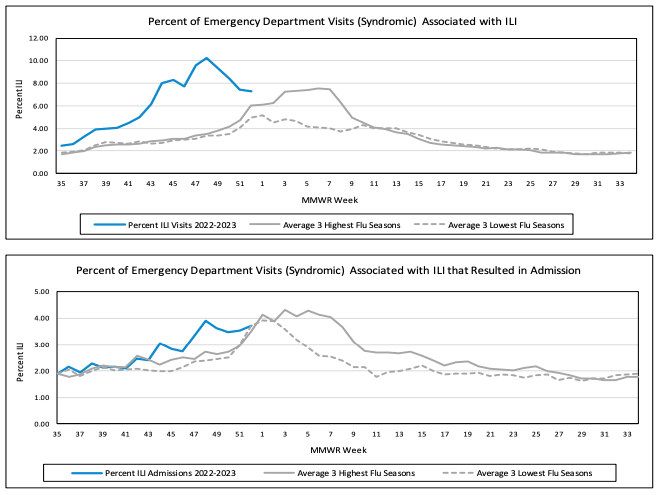
New Jersey continues to outpace its three worst flu seasons of the past decade in one key metric: the rate of emergency-department visits associated with influenza-like illness. However, the rate of those visits that result in admission no longer exceeds the state's most-severe flu seasons of recent years.
For a ninth-straight week, more than 15 percent of RSV tests administered in New Jersey turned up positive. RSV is a common respiratory virus that usually causes mild, cold-like symptoms, the CDC says. Most people recover in a week or two, but the virus can be serious, especially for infants and older adults.
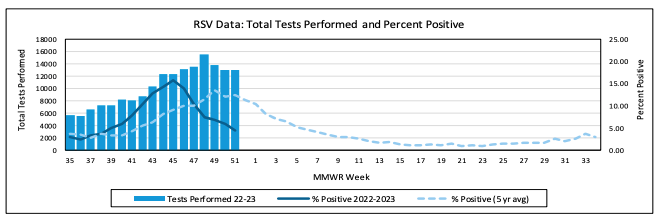
For more coronavirus numbers, visit the New Jersey Department of Health's COVID-19 dashboard, The New York Times data page for New Jersey, the CDC's data tracker and Biobot's wastewater webpage. Statistics on the flu and RSV come from the state health department's weekly surveillance reports on influenza and respiratory illness.
Get more local news delivered straight to your inbox. Sign up for free Patch newsletters and alerts.