Weather
Drought Expands In NJ Despite Rain, Floods This Week
New Jersey's 'severe drought' expanded, despite parts of the state getting nearly half a foot of rain. Here's the latest.


NEW JERSEY — It's going to take more than a bout of rain, or floods, to reverse New Jersey's dry spell. The state's drought expanded this week despite Monday's storms interrupting a stretch of arid conditions and bringing nearly half a foot of rain to parts of the Garden State.
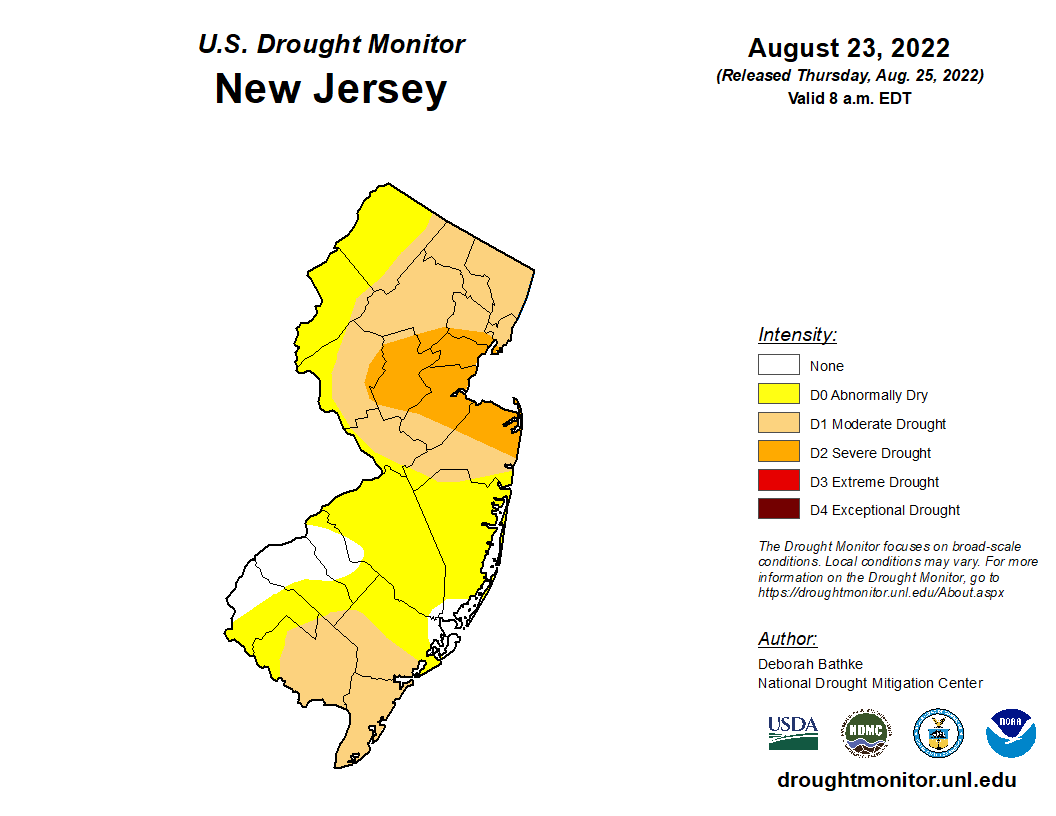
The latest weekly map from the U.S. Drought Monitor, released Thursday, showed drought conditions expanding from the prior week. A "severe drought" expanded into more of Middlesex County and part of Monmouth County, while also persisting in all of Union County, most of Somerset County and parts of Essex, Hudson and Morris Counties.
Meanwhile, a "moderate drought" expanded throughout North Jersey — except in the western portion, which has become "abnormally dry." A moderate drought also expanded in South Jersey, including all of Cape May County.
Find out what's happening in Across New Jerseyfor free with the latest updates from Patch.
State officials issued a drought watch Aug. 9. The action is meant to raise awareness of the stress on the water supply and encourage voluntary conservation measures. But if the hot, dry conditions don't improve, New Jersey officials could issue a drought warning and then a drought emergency, which could entail mandatory water-conservation measures from the state for the first time in two decades.
Here's the current map (view past data here):
Find out what's happening in Across New Jerseyfor free with the latest updates from Patch.
Monday's storms brought plenty of rain to parts of New Jersey, with as much as 5.77 inches measured in Surf City on the flood-prone Long Beach Island. But other parts of the Garden State, such as parts of Morris and Hunterdon Counties, got less than 2 inches of precipitation. Read more: 2 To 6 Inches Of Rain Hit Some LBI Towns Monday
Drought levels also derive from several factors, including 90-day measurements of precipitation and streamflow, reservoir levels and groundwater. Several of New Jersey's reservoirs have fallen below their average water levels, but the state's most recent data as of Thursday morning came before Monday's storm.
Gov. Phil Murphy's administration began encouraging residents and businesses to conserve water July 26, amid a stretch of hotter and dryer weather than the average Jersey summer. State Commissioner of Environmental Protection Shawn M. LaTourette issued a drought watch Aug. 9.
The "watch" has no mandatory conservation measures but puts New Jersey on notice. If conditions worsen, the Murphy administration could issue a warning, which could involve some restrictions, or declare a drought emergency with mandatory limits in place.
New Jersey last declared a drought emergency and restricted water use in March 2002, leaving it in place until January 2003. The state's climate conditions increase the potential for more frequent and prolonged droughts. New Jersey will experience a greater frequency of intense rain events, and the summer months may see less precipitation overall, according to the 2020 New Jersey Scientific Report on Climate Change.
Forecasters expect some stormy weather in the coming days though. Several rounds of thunderstorms and fierce winds could hit New Jersey on Friday and into Saturday, according to the National Weather Service. Read more: Thunderstorms, Fierce Winds In NJ Friday, Weekend Forecast
Get more local news delivered straight to your inbox. Sign up for free Patch newsletters and alerts.