Health & Fitness
Flu Arrives Early, Off To Worrisome Start: The Situation In NJ
Seasonal influenza cases are higher than they've been at this time of the year in more than a decade, officials said.


NEW JERSEY — Seasonal influenza cases are higher in the U.S. than they’ve been at this time of the year in more than a decade, federal health officials said Friday, underscoring fears that hospitals in New Jersey will get overwhelmed by a "tripledemic" of flu, the respiratory illness known as RSV and COVID-19.
The CDC warned the flu season, which runs between October and May and normally peaks in December and January, has arrived unusually early and hard. Among 880,000 lab-confirmed cases so far this season, 6,900 people have been hospitalized and 360 people, including one child, have died.
- Related article: COVID Hospitalizations Rise In NJ As 'Tripledemic' Concerns Mount
Flu activity is the highest in the South and Southeast, and is picking up along the Atlantic coast. Health officials recommend that everyone 6 months or older get an annual flu vaccine, especially those at high risk for severe complications from the virus, including:
Find out what's happening in Across New Jerseyfor free with the latest updates from Patch.
- young children
- pregnant women
- people with certain chronic-health conditions, such as asthma, diabetes or heart disease
- people 65 and older
Here's more info from the CDC on flu shots.
Flu seasons had a minimal impact over the past couple of years as people wore face masks and stayed out of crowded places to avoid COVID-19, which has killed more than 1 million people since early 2020. In the past week, 265,893 people in the United States have tested positive and 19,454 were hospitalized with COVID-19.
Find out what's happening in Across New Jerseyfor free with the latest updates from Patch.
New Jersey has "moderate" flu activity in all but one region — the Central West region of Hunterdon, Mercer and Somerset Counties shows low activity — according to the New Jersey Department of Health's most recent weekly report on flu and respiratory illnesses.
The percentage of emergency-room visits for flu-like symptoms have so far exceeded the rates from New Jersey's worst flu seasons in the past decade. The graph below shows how this flu season compares with the 2012-13, 2017-18 and 2018-19 seasons.
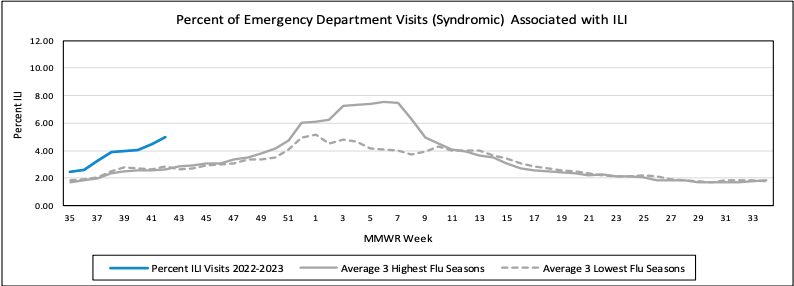
New Jersey's rate of admissions for flu-like illnesses remains relatively similar to those peak years.

The CDC report comes as children’s hospitals across the country are seeing a rise in RSV cases. Cases of respiratory syncytial virus, as the common childhood illness is officially known, also plummeted during the first two years of the pandemic, but doctors now report an alarming increase in what is normally a fall and winter virus.
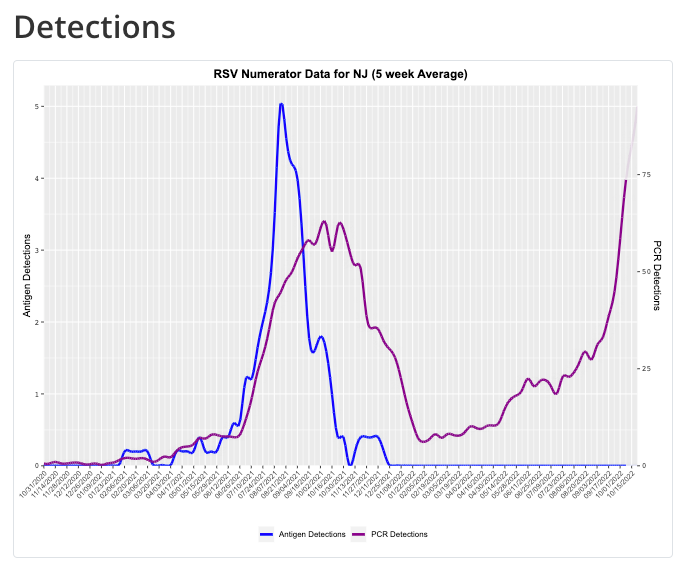
New Jersey has averaged 93 weekly RSV cases over the past five weeks, according to the CDC, and health officials expect case totals to continue rising in the near future.
State officials, meanwhile, reported 1,164 patients in hospitals with confirmed or suspected COVID as of Wednesday — New Jersey's highest total since Aug. 9.
"The data are ominous," William Schaffner, medical director for the nonprofit National Foundation for Infectious Diseases, told The Washington Post.
"Not only is flu early, it also looks very severe," he said. "This is not just a preview of coming attractions. We’re already starting to see this movie. I would call it a scary movie."
A couple of things are compounding the problem. Flu, COVID and RSV all have similar symptoms, making laboratory tests the only way to erase doubt about which disease should be treated. Also, less than a quarter of Americans have gotten flu shots, according to CDC data.
"That makes me doubly worried," Schaffner told The Post. The high burden of flu "certainly looks like the start of what could be the worst flu season in 13 years."
He and other medical officials worry influenza numbers could rival the H1N1 swine flu pandemic of 2009, when 60.8 million people were sickened, including nearly 12,500 who died.
Get more local news delivered straight to your inbox. Sign up for free Patch newsletters and alerts.