Arts & Entertainment
Black Colonial Soldier Stood Guard at Indian King
John Emory enlisted to earn his freedom.
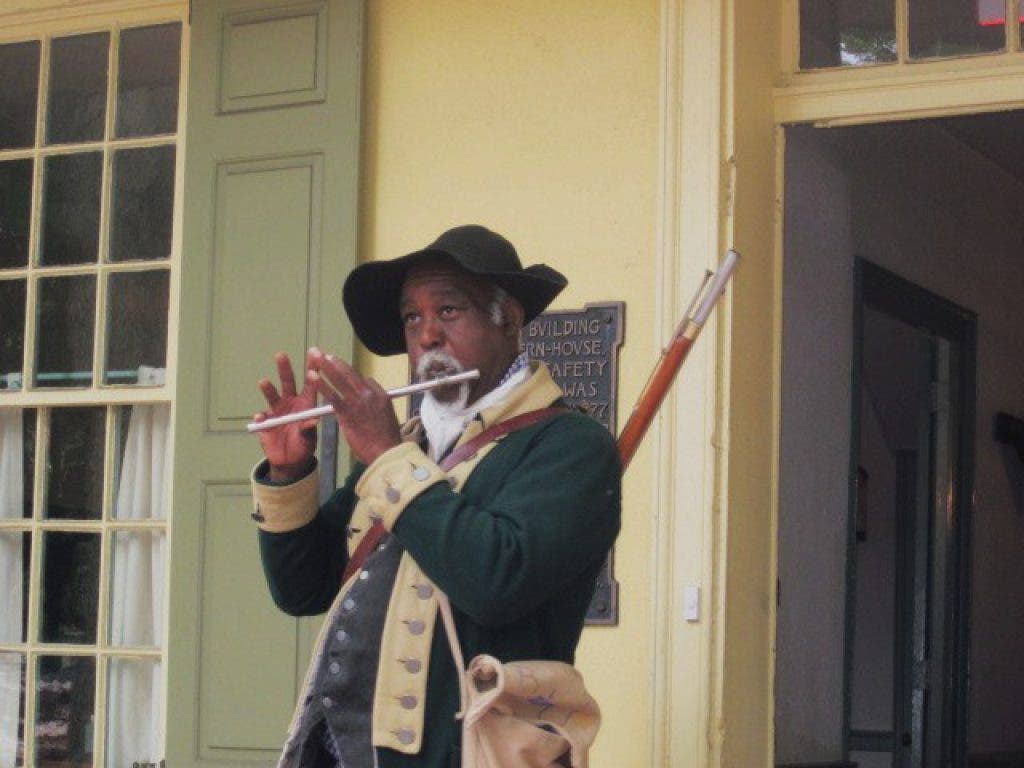


Dressed in a replica uniform of a Colonial soldier, Joseph Becton took a few minutes to nibble on burger from a fast-food restaurant early Saturday afternoon at the Indian King Tavern on Kings Highway.
Then he wrapped up the sandwich, stashing away the fragrance of the special sauce it came with, put on his felted wool floppy hat, and took on the persona of John Emory, a black private in the Revolutionary War.
Moments later he was standing on the brick steps outside the Indian King Tavern, playing a tin whistle to attract visitors to the building, which open for tours most Saturdays.
Find out what's happening in Haddonfield-Haddon Townshipfor free with the latest updates from Patch.
A long-time historic reenactor and a former history teacher, Becton, who lives in West Philadelphia, was a national park ranger at Independence Hall for 20 years, where one of his highlights was reading the Declaration of Independence to the crowd every July 4.
He was in Haddonfield to churn interest in the life of his character, a 30-year-old black man from Chester County, PA, who saw enlistment in the Colonial Army as his ticket to freedom.
Find out what's happening in Haddonfield-Haddon Townshipfor free with the latest updates from Patch.
Friends of Indian King Tavern regularly bring in speakers and historic reenactors. While most presentations have no fee, tickets at $5 are being sold for the next visitor, Benjamin Franklin, at 3 p.m. on Oct. 15. Tickets will be limited.
Emory had a few steps up on other African Americans of his day. He could read because the first purchases he made, from money earned chopping wood when his regular chores were over, were first a reading primer and, then, a Bible.
Emory joined the 5th Pennsylvania regiment with a promise of food, clothing and $6.66 a month in wages. “They gave me a new suit of clothes so I would be dressed to kill,” he told the group that was sitting on unpadded benches in a second-floor room of the landmark tavern. It’s the same room where the New Jersey Legislature met in 1777 to break from Britain and become an independent state.
Chiding women in the audience about the low status held at the time of the revolution by both blacks and women, he challenged all to fill in the blanks about some snippets of the nation’s history.
He reminded them that blacks were recruited by both the British and Colonial armies. When the war ended, many of those who enlisted with the British were returned to England where they were unable to find work and many first were imprisoned for petty crimes and then sent to South Africa.
“There are stories about the American Revolution that we never hear,” he said.
While Emory signed up to do battle, said Becton, he spent much of his time in the army in a hospital tent, plagued with dysentery. “Disease killed more than musket fire,” he said.
Because those muskets—known to the foot soldiers as Brown Bess—had to be reloaded for every shot, and didn’t fire with great accuracy, he said; most combat deaths were person-to-person, eye-to-eye, from bayonets.
Becton spoke of regiments of black Colonial soldiers from Rhode Island, where one of the most successful importer of slaves was based. Businessman along the East Coast, he said, had access to ships and went into the slave trade, but they had no plantations where slaves would be put to work, so “there was an excess of slaves,” and they sought refuge and hope for eventual freedom in the Army.
Becton said Emory had been encamped with Brigadier General Anthony Wayne, known as “Mad Anthony Wayne” because he actively led his troops to conflict instead of waiting on the sidelines of a battlefield.
He spoke of the Colonists’ loss under Wayne at Brandywine, and a retreat to Paoli where, in a September 1777 battle known as the Paoli Massacre, British troops took no prisoners, but killed Colonial soldiers, mutilating bodies.
He talked about what is known as the Battle of the Clouds, in what is now Malvern, PA, when a showdown between the revolutionary soldiers and the British faltered because rain storms were so severe that the gunpowder of both sides got wet, and both retreated.
When the war ended, Emory fared well, said Becton. He started a carriage company in Philadelphia and became a leader in his church. Census records show he lived on N. 8th St. in Philadelphia.