Politics & Government
Lake Hopatcong is the Canary in the Coal Mine
Lake Hopatcong Endangered by Failed Environmental Policies


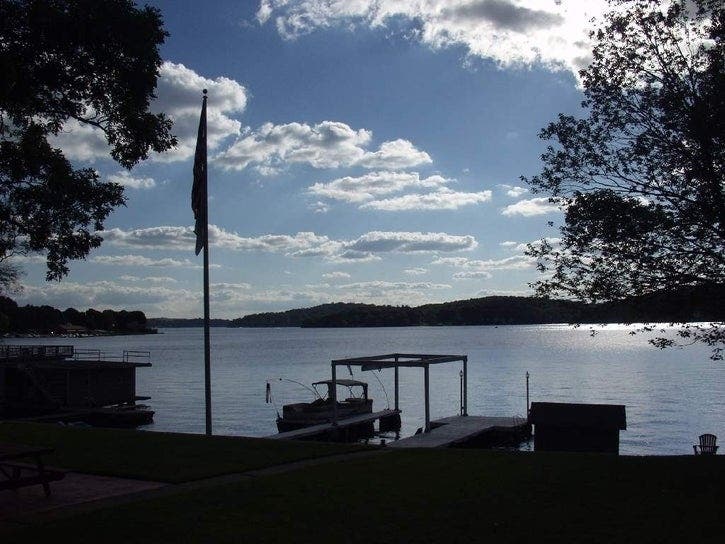
It is estimated that close to 300 people attended the Lake Hopatcong Commission meeting on July 8th. In the Hopatcong High School Cafeteria with no AC and just one large pedestal fan, people listened in the sweltering room for over 3 hours. All were drawn to this regular commission meeting for one thing -to get further information on the blue-green algae bloom, also called Harmful Algae Bloom (HAB) that closed the Hopatcong State Park Beach and gave out broadcast warnings to avoid water contact recreation. Over 30 minutes of statistical scientific presentation was given on the life of this bloom algae. The DEP told us it is not correct to refer to it as algae. They warned us that these “invaders are bacteria that can produce cyanotoxins which can produce harmful effects above certain levels. The most common problems are rashes, but heavy concentrations can result in kidney, liver, and nervous system damage”.
All the different Lake Hopatcong community groups that used the lake spoke of the impact that this HAB discovery had on - their marina business; the lake restaurants; their recreational vocations; their lake homes; their fishing coves; their private boat slips and their beach/yacht clubs. However, there were only two people that spoke up on behalf of the lake itself with the plea that it was a very seriously ailing creature that was long neglected.
It was resident and former Mayor of Hopatcong Cliff Lundin who stated in his allotted 2-minute time slot “The lake is telling us we must do more,” He added that “Everything that happened was mentioned 40 years ago,” He was a member of the commission’s forerunner and the Lake Hopatcong Regional Planning Board for its duration. Lundin concluded that he could recite chapter and verse the remedies proposed over the years: sewers, better storm water drainage, dredging, and more.
Find out what's happening in Hopatcong-Spartafor free with the latest updates from Patch.
Greg Gorman the Conservation Chair, NJ Sierra Club Chapter NJ Skylands and Sunrise Hub Coordinator was also allotted 2 minutes to present the July 8, 2019 press release letter from Jeff Tittel, director of the New Jersey Sierra Club that called out both the DEP and local communities for failing to acknowledge the that lake was heading towards an ecological disaster.
Here is the letter that was submitted by Greg Gorman from Jeff Tittel:
Find out what's happening in Hopatcong-Spartafor free with the latest updates from Patch.
Lake Hopatcong Endangered by Failed Environmental Policies
“Lake Hopatcong is headed toward an ecological disaster. People can’t have any contact with the water because of the toxic algae bloom. Swimming areas have been closed for more than 3 weeks, and they could stay closed the entire summer. This is a result of a series of failed policies at the state and local level. Those failures have allowed for increased runoff and stormwater pollution allowing the algae to thrive. If there isn’t fast action to combat this pollution, the entire lake could die.
“DEP’s failure to properly manage stormwater and overdevelopment is one of the major reasons that Lake Hopatcong is in bad shape. The state failed to do proper watershed management, managing stormwater, septics and sewers. They failed to implement Total Maximum Daily Load (TMDL) limits to eliminate nutrient pollution. They have not controlled overdevelopment. The Murphy administration has not reversed 8 years of Christie-era rollbacks. Those rollbacks have weakened protections for stormwater, allowed development in environmentally sensitive areas, and reduced protections for streams and stream buffers.
“Nutrients are washing into the lake with every new rainstorm as stormwater carries septics, lawn and garden fertilizer into the water. That, along with warmer temperatures, is allowing the algae to grow. The phosphorus level in the lake recently tested higher than at any time in 17 years of data. The lake has become a huge stormwater detention basin. Overdevelopment makes it worse. Buildings seem to be going up on every lot. If this continues, the water will eutrophy as algae sucks out oxygen. That will leave a giant, stagnant pool of water. The lake will suffer an environmental collapse. Aquatic life will die off. It will begin to stink. All of the people living around Lake Hopatcong won’t even be able to use it.
“This could be an environmental and economic catastrophe. If the lake collapses, fewer people will be using the marinas or eating in the restaurants. Housing prices will drop. Skimmers have been harvesting hundreds and sometimes thousands of tons weeds and algae from the lake for many years, but the root causes have been ignored. That’s the wrong approach to this problem – do nothing, wait until it collapses, and cry about it later.
“Local communities have failed Lake Hopatcong as well. They have done very little to control overdevelopment and the added stormwater runoff it brings. They have been unwilling to pay for improvements that would reduce pollution. They have not considered secondary impacts of sewer systems near the lake that reduce the amount of fresh water entering the lake. They have opposed establishing stormwater utilities that would charge a fee to property owners and businesses contributing to the pollution to help fund upgrades.
“We need to act quickly to save Lake Hopatcong. The state needs to reverse Christie-era rollbacks on watershed protections. We need to establish stream buffers, restore wetlands and enforce real TMDL standards in our lakes that include reducing phosphorus, nitrogen and other pollutants. We need to put back together watershed planning and toughen rules on stormwater management. We need to restore Septic Management Districts. We also need to reduce over development and sprawl in environmentally sensitive areas.
“Lake Hopatcong is a state park, and New Jersey’s largest recreational lake. The state has a direct interest in cleaning up the lake. They need to provide the funding for retrofitting and stormwater cleanup, as well for restoring stream corridors and wetlands. We need a holistic, comprehensive plan to watershed management before it’s too late. Lake Hopatcong is the canary in the coal mine, and the canary is about to die. That’s why we have to act and act now.”