Health & Fitness
Leverage GDL to Help Your Teen Driver Build Skill, Minimize Risky Behaviors
Teen-driver related fatalities declined 47 percent in the past six years. Researchers point to graduated driver licensing as key to addressing common risk factors.
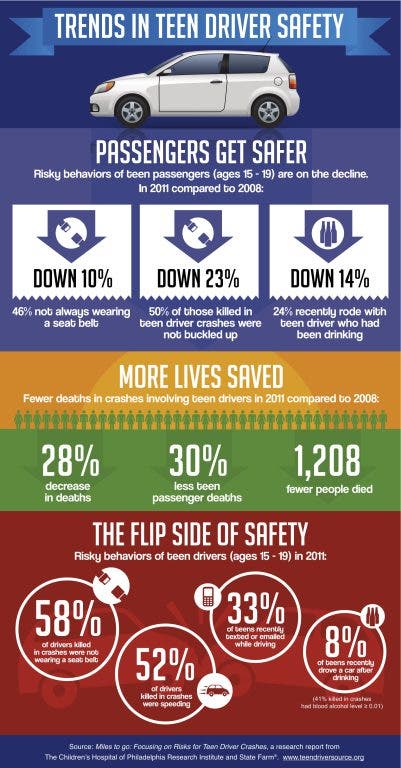
Teen driver related fatalities fell 47 percent in the past six years. That’s just one of the positive findings detailed in a new report released earlier this month by The Children’s Hospital of Philadelphia and State Farm.
The report, Miles to Go: Focusing on Risks for Teen Driver Crashes, also details encouraging trends among teen passengers driven by their peers. From 2008 to 2011, the number of teen (15 to 19 years of age) passengers killed in crashes not wearing seat belts decreased 23 percent; the number of teen passengers driven by a peer who had been drinking declined 14 percent; and 30 percent fewer teen passengers were killed in crashes involving a teen driver. Despite these gains, car crashes remain the number one killer of teens in New Jersey and nationwide.
Dr. Dennis Durbin, co-scientific director of the Center for Injury Research and Prevention at CHOP and the lead author of the report, pointed out that the driver is typically the focus when a teen crashes. However, teen passengers must be considered as well. “When you see the needle move, as we have in this report, it’s time to apply the gas on programs that encourage safe teen passenger behaviors as well as those that address what causes teens to crash.”
Find out what's happening in Long Valleyfor free with the latest updates from Patch.
There has been a great deal of research focusing on why teen drivers crash, with inexperience the leading factor. Dr. Durbin suggests that additional gains can be made in reducing the risk for teens by reducing the distraction caused by passengers and technology; focusing on building skills in scanning, hazard detection and speed management; and increasing seat belt use.
The report found that while gains are being made in novice driver safety, teens are still taking risks behind the wheel. For example, a third of teens indicated they recently texted or emailed while driving. While two-thirds aren’t engaging in this risky behavior (a positive social norm), making sure that all teens -- who have the highest crash risk of any age group on the road -- refrain from texting while
driving is essential.
Find out what's happening in Long Valleyfor free with the latest updates from Patch.
So what’s a parent to do? The CHOP report suggests that stronger Graduated Driver License (GDL) programs are critical for helping teens gain experience under low-risk conditions. New Jersey’s GDL program, considered one of the nation’s most progressive, allows teens to obtain a permit at 16. While there’s no requirement that teens log a certain number of practice hours during the learner’s phase, researchers suggest at least 50 hours of adult-supervised practice under varied conditions (e.g., at night, in inclement weather, on local roads and highways). Additionally, limiting passengers, restricting unsupervised nighttime driving, requiring seat belt use by everyone in the vehicle, and prohibiting cell phone use are also critical throughout the permit phase and first year of licensure.
All of these provisions are addressed in New Jersey’s GDL program. Not familiar with it? I urge you to get educated. GDL detractors call it another nanny state initiative. But this proven tool, which is place in all 50 states and many other countries, is responsible for 20 to 40 percent reductions in teen crashes. Since New Jersey’s GDL program was enacted in 2001, teen driver-related fatalities have decreased by more than 50 percent.
Take the time to learn how and why GDL works and then leverage the provisions to help your teen not only build skill, but survive his most dangerous driving years. Research proves that GDL not only works, but the safety gains for teens are even greater when their parents are actively involved in the process.