Health & Fitness
Pay Incentives for the Public Sector
Pay incentives for educators favors accelerated increases as one gets closer to retirement.


There is a debate going on across the country about the merits/drawbacks of “defined contribution” (DC) retirement plans for the public service sector. What makes the DC plan attractive is that it’s similar to a 401K in which the employer (the state) has no future obligation after retirement, thus holding out hope of limiting future liabilities to the tax payer.
The situation is quite different with “defined benefits” (DB) retirement plans in which the employer (you and I) are on the hook for a very long time. If the DB plan loses money on its investments or if the cost of living goes up (including medical costs), you and I are required to make up the difference for the retiree. You (the employer) really don’t know what the future liabilities will be. It’s no wonder that DB plans are going bankrupt.
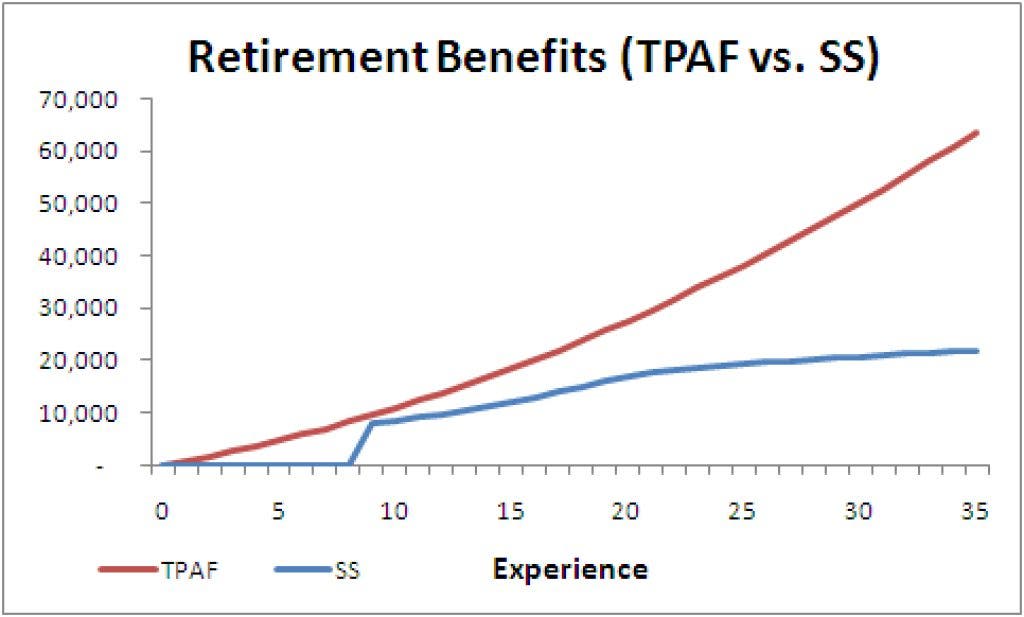
DB costs tend to baloon because of the “perverse incentives” they create (economically speaking). To illustrate my point, I present here some recent compensation data from our local K8 school district, which is under a DB plan. As you can see from the above graph comparing the percent pay hike to the level of experience, the general pattern of compensation seems to favor higher retirement benefits. Simply put, pay hikes accelerate as the educator approaches the twenty year mark (minimum retirement eligibility).
Find out what's happening in Long Valleyfor free with the latest updates from Patch.
It’s easy to guess what the incentive is here when you consider that retirement pay (under the DB plan) is 60-70% of what the retiree earned before retirement (compared to approximately 20-25% for Social Security benefits). The pattern suggests to me that there is an incentive to shift greater burden to the state after the employee retires. Thus the local tax payer must pay out of the left pocket (property taxes) for ever-growing local education costs, and pay again out of the right pocket (state taxes) for generous future retirement benefits, ad infinitum.
If, however, the DB plans were transitioned to DC plans (or some hybrid model), there would be less incentive to accelerate compensation as one gets closer to retirement. There would also be less incentive to retire after only twenty or twenty-five years of service. The DC plan effectively changes the rules in favor of the tax payer. I consider this a stop-gap measure only.
Find out what's happening in Long Valleyfor free with the latest updates from Patch.
The larger and more fundamental problem is that unions have "captured" (bought) legislators in order to monopolize the public service sector and to use the tax payers dollars against them to purchase largess from the treasury. "The state is the great fiction by which everybody seeks to live at the expense of everybody else." (Frederic Bastiat)
References/Notes:
- Make yourself familiar with the terms of use before posting. Keep it civil and stick to the topic.
- A lot of this data is difficult to find, interpret and compile, therefore it’s possible that I've made mistakes. This is why I post my references and work here for anyone to verify and correct.
- Pension Funds Strained, States Look at 401(k) Plans - NY Times
- Gov. Christie calls NJEA a 'political thuggery operation' in speech at Harvard, NJ.com
- The Teachers' Pension and Annnuity Fund (TPAF)
- 2010-11 pay rates for WT K-8 (published by the BOE)
- 2009-10 NJ Certificated Educator Salaries
- Spreadsheet used to derive the above statistics (also contains list of salaries).