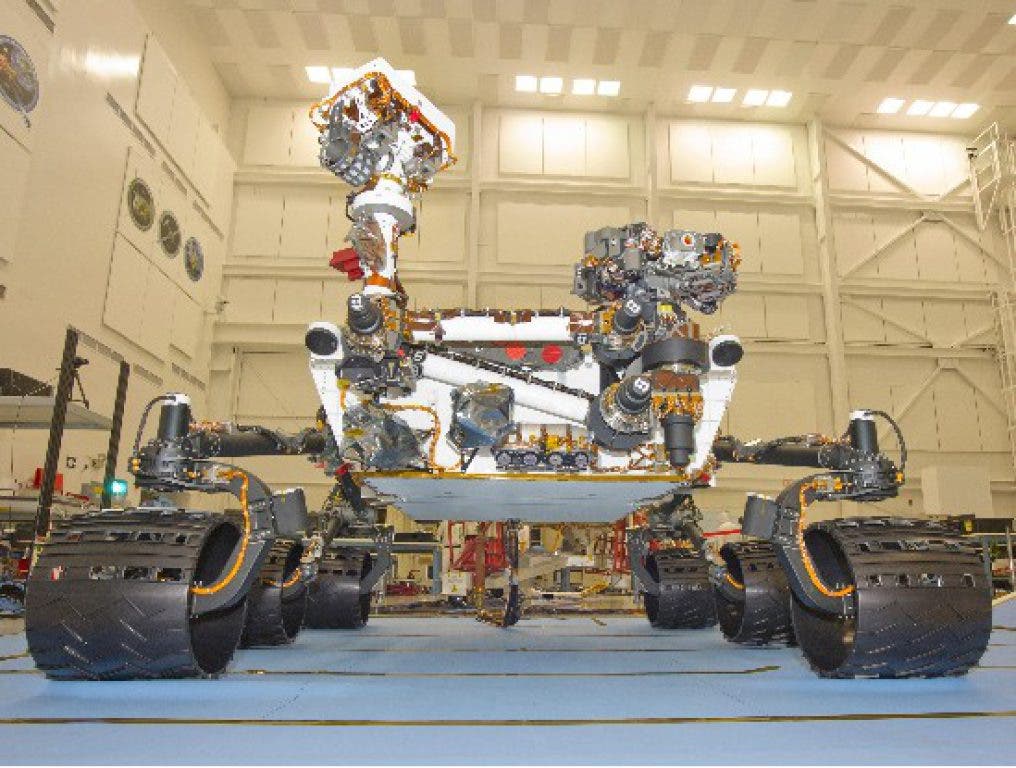


You wouldn't know it from the scant media attention it's received, but in less than three weeks, NASA will attempt to land our newest rover, the Mars Science Laboratory (a.k.a.: Curiosity) inside the red planet's Gale Crater.
The MSL's primary mission goals are to test for organic compounds, measure for dangerous levels of radiation and confirm whether this site is suitable for a space base envisioned for the 2030s.
Roughly as big as a Mini Cooper, Curiosity weighs almost a ton and is powered by a plutonium reactor the size of a microwave oven. It has several mast-mounted cameras with different objectives and a powerful laser that will vaporize rock. NASA researchers will analyze the laser-generated sparks with spectrometers that can tell precisely what compounds the rock contains - at least in the Gale Crater neighborhood. It will take scientists years to dissect the data while they debate whether the results hint that life now exists or had at some time in Martian history.
Curiosity's kit is stuffed with drills, scoops, microscopes and mini-laboratories. Spain has contributed a weather station to send continuous climate reports throughout a complete cycle of seasons. Russian researchers designed a hydrogen detector to assay for water ice or water that is bound in minerals just below the planet's surface. All this, plus communications, still photos and video, locomotion and basic maintenance functions running on a little more than 100 watts of power. There's plenty of torque - enough for the rover to climb 25-30 degree inclines and propel it about 100 meters a day. Curiosity's handlers at the Jet Propulsion Laboratories/Cal Tech will pick which routes she'll travel and determine when to stop at interesting spots along the way and start drilling or to "just keep truckin' on."
Identifying trace amounts of molecules without contaminating samples is tricky business under controlled laboratory conditions on Earth. The complications multiply with remote testing over 150 million miles away. Despite the fact that Curiosity was assembled in an antiseptic "clean room," it will drill samples of ITSELF to test for and "subtract" any organic stowaways that survived the 255-day journey. Designers have even taken into account that the primary drill bit could break or get stuck, so they've included spare parts and a mechanism that allows changing her bit twice during Curiosity's 2-year anticipated service life. Optimistically, the mission will continue for many more years than that. Experience with the Voyager I and II spacecraft leads NASA to expect that the MSL could continue functioning for decades.
Far larger and better equipped than previous rovers, Spirit & Opportunity (launched in 2003) and Sojourner (launched in 1996), this latest ATV will land with the help of an untried "sky crane." It's hard to imagine that this was the final landing design that the engineers chose; I'd like to know about the ones they rejected! The entry, approach and landing sequence includes braking S-turns, a parachute deployed at hypersonic speeds and a space platform that uses retrorockets to hang motionless in the thin Martian air with Curiosity dangling below on plastic lines. Keep in mind that it takes 14 minutes for signals to reach Earth from Mars and another 14 minutes to get a system control signal back to Mars. This spacecraft has to "know" how to fly itself and land its precious cargo with minimal human input. In the final sequence, the sky crane will lower 3 nylon cables to gently place Curiosity on the crater's surface, detach itself, fire its rockets one last time, and crash-land less than a mile away. An awful lot has to go right within a seven minute, hold-your-breath, final approach and landing. That's why I'll be watching it live. With any luck, color video cameras will capture Curiosity's descent and landing with the smoldering sky crane debris off in the distance. This is a bold roll of the dice, indeed!
If you can't stay up until the wee hours of the morning, you may want to add some extra time to the DVR for what could be an historic moment.
Percival Lowell
Read here about the explosive ballet that's been choreographed for Curiosity's final minutes before touchdown.
See it in pictures here and go here for other links to NASA's Mars Science Laboratory Mission info.