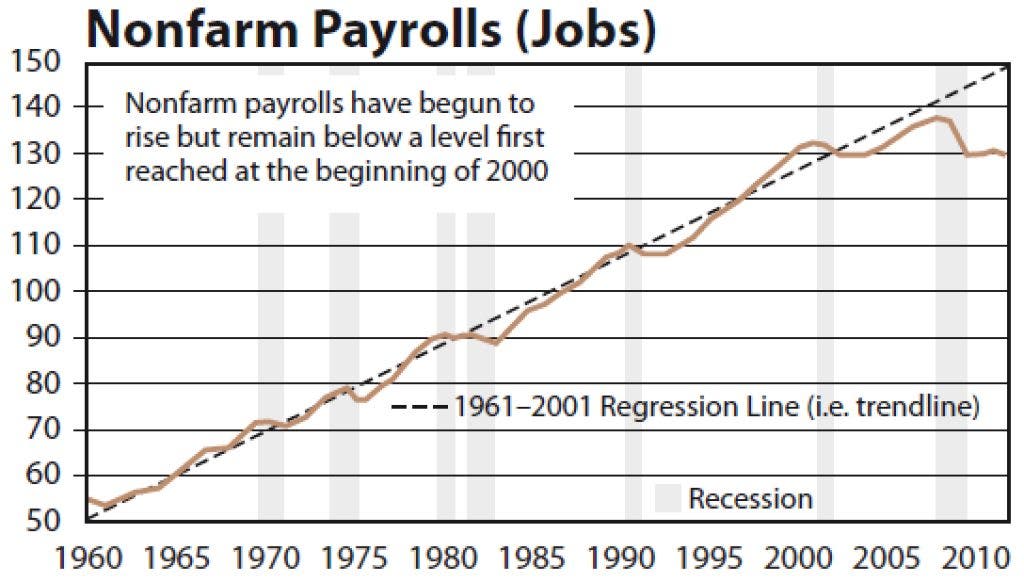

As you can see from the attached chart, the jobs recovery (or non-recovery) is lackluster, which is putting it mildly.
Why aren't businesses hiring and what does it take to fix this? There really aren't any simple answers (economics is rarely simple) and to understand the problem, you have to look beyond the political rhetoric and media soundbites.
The economic recovery is dependent on a jobs recovery, and job creation is sluggish for the following reasons (not an all inclusive list):
Find out what's happening in Long Valleyfor free with the latest updates from Patch.
- The high cost of hiring.
- A high degree of business uncertainty.
- Big government is a drag on the economy.
- The credit bubble never deflated.
If government leaders want to help the economy recover, they need to address these issues. In fact, all of these hindrances were caused by bad government policy.
Find out what's happening in Long Valleyfor free with the latest updates from Patch.
The cost of hiring:
The cost of hiring is going up precipitously. A case in point is Bogen Communications Inc. in Ramsey, N.J. It's President, Michael Fleicher, explains:
Meet Sally (details changed to preserve privacy). Sally is a terrific employee, and she happens to be the median person in terms of base pay among the 83 people at my little company in New Jersey, where we provide audio systems for use in educational, commercial and industrial settings.
When you add it all up, it costs $74,000 to put $44,000 in Sally's pocket and to give her $12,000 in benefits.
Because my company has been conscripted by the government and forced to serve as a tax collector, we have lost control of a big chunk of our cost structure. Tax increases, whether cloaked as changes in unemployment or disability insurance, Medicare increases or in any other form can dramatically alter our financial situation. With government spending and deficits growing as fast as they have been, you know that more tax increases are coming—for my company, and even for Sally too.
Companies have also been pressed into serving as providers of health insurance. In a saner world, health insurance would be something that individuals buy for themselves and their families, just as they do with auto insurance. Now, adding to the insanity, there is ObamaCare.
Every year, we negotiate a renewal to our health coverage. This year, our provider demanded a 28% increase in premiums—for a lesser plan. This is in part a tax increase that the federal government has co-opted insurance providers to collect. We had never faced an increase anywhere near this large; in each of the last two years, the increase was under 10%.
To offset tax increases and steepening rises in health-insurance premiums, my company needs sustainably higher profits and sales—something unlikely in this "summer of recovery." We can't pass the additional costs onto our customers, because the market is too tight and we'd lose sales. Only governments can raise prices repeatedly and pretend there will be no consequences.
And even if the economic outlook were more encouraging, increasing revenues is always uncertain and expensive. As much as I might want to hire new salespeople, engineers and marketing staff in an effort to grow, I would be increasing my company's vulnerability to government decisions to raise taxes, to policies that make health insurance more expensive, and to the difficulties of this economic environment.
A life in business is filled with uncertainties, but I can be quite sure that every time I hire someone my obligations to the government go up. From where I sit, the government's message is unmistakable: Creating a new job carries a punishing price.
Indeed, governments impose a 33% surtax on Sally's job each year. That 28% increase from ObamaCare cost Mr. Fleicher's company 225K more, enough to hire three more people like Sally. Raising the cost of business is never a good thing, especially during a very serious economic downturn.
Business uncertainty:
In addition to the certainty that government will increase employee costs for businesses (thus making employees more of a liability and less of an asset) businesses also have a high degree of uncertainty caused by government policy.
Stephen Wynn - Founder, Chairman, and Chief Executive Officer of Wynn Resorts - sums it up rather bluntly in a recent earnings call. From the call transcript:
I believe in Las Vegas, I think its best days are ahead of it, but I'm afraid to do anything in the current political environment in the United States. You watch television and see what's going on on this this debt ceiling issue. And what I consider to be a total lack of leadership from the President, and nothing will get fixed until the President himself steps up and wrangles both parties in Congress. But everybody is so political, so focused on holding their job for the next year, that the discussion in Washington is nauseating.
And I'm saying it bluntly that this administration is the greatest wet blanket to business and progress and job creation in my lifetime. And I can prove it and I could spend the next three hours giving you examples of all of us in this marketplace that are frightened to death about all the new regulations, our health care costs escalate. Regulations coming from left and right. A President that seems, you know -- he keeps using that word redistribution.
Well, my customers and the companies that provide the vitality for the hospitality and restaurant industry, in the United States of America, they're frightened of this administration. And it makes you slow down and not invest your money. Everybody complains about how much money is on the sidelines in America. You bet. And until we change the tempo and the conversation from Washington, it's not going to change.
And those of us who have business opportunities and the capital to do it, are going to sit in fear of the President. And you know, a lot of people don't want to say that. They say oh, God, don't be attacking Obama. Well, this is Obama's deal. And it's Obama that's responsible for this fear in America.
The guy keeps making speeches about redistribution, and maybe he ought to do something to businesses that don't invest, they're holding too much money. You know, we haven't heard that kind of talk except from pure socialists.
Everybody is afraid of the government. And there's no need -- there's no need, you know, soft pedaling it. It's the truth. It is the truth. And that's true of Democratic businessmen, and Republican businessmen, and I am a Democratic businessman and I support Harry Reid, I support Democrats and Republicans, and I'm telling you that the business community in this country is frightened to death of the weird political philosophy of the President of the United States. And until he's gone, everybody is going to be sitting on their thumbs.
I can't recall ever hearing such a blistering assessment of a U.S. President, delivered in a corporate earning's call. If anyone should know about a comparison between capitalism and communism it is Steve Wynn: The biggest growth prospect for his company is located 12 time zones away in Macau, China. It's a sad commentary of how out of touch the elites in Washington have become.
Government drag on the economy:
We hear the mantra that government spending is what's sustaining the economy and keeping us from going into a recession. That's debatable. Governments consume wealth, rather than multiply it. "Stimulus" didn't work in the 30s, it didn't work in the 70s and it didn't work recently either. There's a reason why stimulus doesn't work, but it makes everyone "feel" better that the government is doing something (even if its hurting the economy and delaying the recovery). Very few of FDR's programs actually accomplished what they were intended to do, but everyone "felt" like FDR was compassionate because he did something. In reality, most of what FDR did made things worse, increased the misery and delayed the recovery.
There's a terrific 2008 article by Brian M. Riedl, at The Heritage Foundation, in which he cites the following studies about the ineffectiveness of government spending:
- A Journal of Macroeconomics study discovered that “a 1% increase in government size decreases the rate of economic growth by 0.143%.”
- Public Choice reported that “a one percent increase in government spending as a percent of GDP (from, say, 30 to 31%) would raise the unemployment rate by approximately 0.36 of one percent (from, say, 8 to 8.36 percent).”
- The Quarterly Journal of Economics reported that “the ratio of real government consumption expenditure to real GDP had a negative association with growth and investment,” and “growth is inversely related to the share of government consumption in GDP…”
The total cost of government (State and Federal) has increased by 18% since 2007 (which is 11% of GDP). By the above estimates, this created a 4% drag on employment and a 2.5% drag on GDP. How's that "stimulus" working out for you? It's Keynesian economics at its best.
The credit bubble:
Finally we come to the biggest drag on the economy, the huge debt that was not allowed to destroy itself. We never let the "creative destruction" of capitalism do its job.
Dan Gross explained in “Pop! Why Bubbles Are Great for the Economy”:
“The typical investing bubble leaves behind something of value. Whether it was thousands of miles of railroad tracks in the 19th century or thousands of miles of fiber-optic cables in the 1990s, usable infrastructure survives the bubble. Assets get scooped up out of bankruptcy for pennies on the dollar. Eventually, all of this over-investment in the bubble du jour becomes a productive part of the economy. All that cable laid by Global Crossing and Metromedia Fiber and other bankrupt firms? Today, it is the band-width infrastructure that supports Google Maps, Netflix streaming video and Twitter."
Ah yes, but how does this compare to what gets left behind in a credit bubble? No infrastructure, no innovations and no research breakthroughs; just crushing debt. What's the free market solution for that? Simple, the best way to get rid of the bad debt is for debtors to go bankrupt and creditors to take a haircut. This means foreclosures on homes, the closing of businesses and failed banks. There's really no better alternative. It's painful, but the bad debt does destroy itself so that the economy can regain momentum again.
Unfortunately, what we did was shift all that bad debt onto the sovereign instead (stimulus, bailouts, Freddy and Fannie, etc) so that the debt never destroyed itself. The only way to get rid of the debt now is for the sovereign to inflate the debt away through money printing (paying off the debt with newly created dollars). This causes inflation which in turn causes a huge wealth gap between the rich and the poor.
... and here we are.
References:
- No run-of-the-mill recession (The Washington Post)
- Why I'm Not Hiring (WSJ)
- Wynn Resorts' CEO - Q2 2011 Earnings Call Transcript (Seeking Alpha)
- Economic Data, Federal Reserve Bank of St. Louis (FRED)
- Why Bubbles Are Great For The Economy (Dan Gross)
- New Deal or Raw Deal (Burton W. Folsom Jr)
- Why Government Spending Does Not Stimulate Economic Growth (Heritage Foundation)